
The Best Supplement Stack Is Simpler Than You Think
You've got a corner of the counter colonised by supplement bottles, and you suspect half of them do nothing. Or maybe you haven't bought any yet, and the 20-item lists online just make you want to close the tab. Either way, you want the short answer for the best supplement stack: which few earn their place? Here it is.
The best supplement stack, in one line
For almost everyone, the best supplement stack is three things: creatine, omega-3, and vitamin D. Add one or two more only if they fit a specific goal, and skip the rest. That's the whole answer. The list is short because the evidence rewards a few well-chosen supplements, not a long shelf of them.
That short list isn't arbitrary. The most-studied supplements each do a different job well, which is why you carry a few that pull their weight instead of a 20-bottle cabinet. The trial evidence behind each pick is in the verdicts below.
It is also what people are asking for. One of the most-discussed posts in this corner of the internet wasn't someone adding supplements. It was someone who cut their stack from eight down to three.
Here is the whole stack at a glance, graded honestly:
| Supplement | Best for | Grade | Impact | Earns its place? |
|---|---|---|---|---|
| Creatine monohydrate | Strength and recovery (and memory in older adults) | A | Meaningful | Yes, for almost everyone |
| Omega-3 (EPA+DHA) | Exercise recovery and metabolic markers | A- | Meaningful | Yes, for almost everyone |
| Vitamin D3 | Correcting a shortfall (bone, immunity) | A- / B | Meaningful when you're low | Yes, test first |
| Protein powder | Muscle, only if you under-eat protein | B | Modest | Only if it fits your goal |
| Magnesium glycinate | Sleep and specific goals | B- | Modest | Only if it fits your goal |
| Multivitamin | – | – | False reassurance | Skip for most |
| NMN / NAD+ | – | – | No solid human evidence | Skip |
How to tell whether a supplement earns its place
A supplement earns a spot when it passes three quick tests. First, does it fill a gap your food and lifestyle leave open? Second, is the effect big enough to notice or measure, not just big enough to show up in a study? Third, bonus points if it does more than one job, so you can carry fewer bottles.
Run anything on your shelf through those three and most of it falls away fast. A greens powder fails the first test if you already eat vegetables. A test booster fails the second, because the effect on a healthy man is too small to feel. The point isn't to take the most supplements. It's to take the fewest that each pull their weight, so you stop paying for pill fatigue and start spending on what moves the needle.
The three that earn their place for almost everyone
Three supplements clear that bar for nearly every adult: creatine, omega-3, and vitamin D. Here is what each one does, and where the hype outruns the evidence.
Creatine: the one almost nobody should skip
Creatine is one of the most studied supplements in sport. People who take it while training get measurably stronger, and beginners gain even more than seasoned lifters.3 Pool the dose-response trials together and both lean body mass and total weight climb when creatine is paired with resistance training.6
It isn't just for young men at the gym, the audience the marketing pictures. A recent review of trials in postmenopausal women found gains in lean mass and leg-press strength when creatine was combined with training.5 We dig into that audience in our guide to creatine for women.
It also pulls double duty. The same molecule helps buffer energy in your brain. Pooled memory trials show a benefit that is clearest in older adults, and more modest in the young.4 That second job is a big part of why it earns its place: one cheap powder, two uses.
The kidney worry you may have heard is a misread. Creatine nudges a blood marker called creatinine upward, but that is an artifact of how creatine is processed, not a sign of damage. When researchers pooled the kidney studies, filtration rates stayed normal in healthy adults.7 It's a worry that keeps getting repeated in supplement threads, but the long-term safety record here is about as clean as it gets.
Set expectations on two fronts. For mood, the depression trials show a small effect that sits below what you'd notice, on very low-certainty evidence.8 For inflammation, the trials found no change in markers like CRP.9 Neither is a reason to take creatine.

Staring at a dozen bottles and not sure which earn their place? Tell Your Supp' Buddy what you take and the one goal you care about most. It runs each item against the evidence, flags the duds and the overlaps, and hands back a shorter list you can defend.
Omega-3: the recovery and metabolic pick
Omega-3 fish oil is the recovery workhorse. When researchers pooled 35 trials in more than 1,200 trained athletes, they compared creatine, protein, and omega-3 head to head. Omega-3 ranked first for exercise recovery.1 On its own, it also lowers post-exercise soreness and the muscle-damage markers that come with hard training.210
It also helps on the metabolic side. Combined with exercise, omega-3 nudged heart-health markers like blood fats and blood pressure in the right direction.11 Read the heart claims carefully, though. The evidence supports better risk markers, not a proven drop in heart attacks or strokes. So treat "omega-3 for your heart" as better numbers, not a guarantee.
Want to get specific about the two fatty acids in the bottle? Our EPA vs DHA breakdown covers which one matters for which goal. The main reason omega-3 earns a spot is simple: most people don't eat enough oily fish to close the gap on their own.
Vitamin D: only if you're short on it
Vitamin D behaves more like a hormone than a vitamin, running processes all over the body. One physician's review simply called it a "buy." The catch is that the payoff shows up mainly when you are correcting a shortfall. Surveys consistently find that a sizeable share of adults sit below the usual adequacy line for vitamin D. That's most common in people with darker skin, limited sun, or older age.
The clearest wins come from filling a gap. Combined with exercise, vitamin D and calcium improved bone density in postmenopausal women.14 And in young children, a recent Cochrane review (which pools the trials together) reported a slight drop in infection-related doctor visits, on low-certainty evidence.15
If your level is already adequate, the upside is small; vitamin D fills a gap, it doesn't add a bonus on top. And don't take it for your heart: when the cardiovascular trials were pooled, vitamin D didn't clearly cut heart events.16 So test first, then supplement to fill a gap rather than chase a benefit you may not have room for.
Getting these from food first
You can cover part of this stack from the plate, so here is how far food gets you before a supplement earns its place.
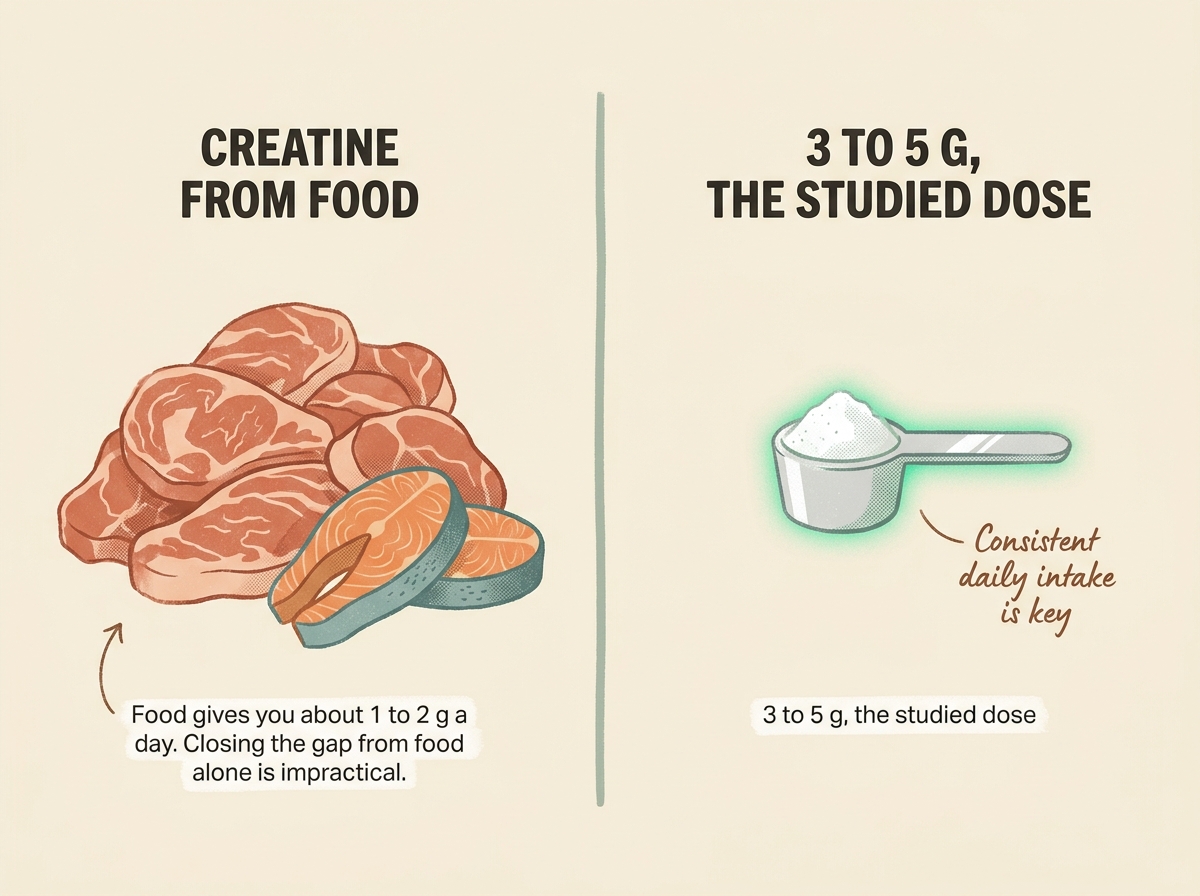
Creatine is the clearest case for a supplement. You get it from meat and fish, but only around 1 to 2 grams a day from a normal diet. Matching the studied dose from food alone would mean eating roughly a pound of beef plus a couple of salmon fillets every single day. A small scoop does the same job for pennies. Creatine is the rare supplement that isn't optional if you want the dose the trials used.
| Food | Serving | Creatine |
|---|---|---|
| Beef (raw) | 1 lb / 453 g | ~2 g |
| Salmon | 8 oz / 227 g | ~1 g |
| Tuna | 1 can, 5 oz / 140 g | ~0.8 g |
How much, how often: matching the studied 3-to-5-gram target from food would take about a pound of beef (453 g) plus two salmon fillets. Every day. Vegetarians and vegans get almost none from meat, so they tend to respond even more to a supplement. For everyone else, a scoop is simply the practical route.
The other three are easier to chase on a plate. Two to three servings of oily fish a week, like salmon, sardines, or mackerel, closes most of the omega-3 gap. If fish isn't a regular thing for you, a fish-oil or algae softgel fills it. Vitamin D barely exists in food, so most of your supply comes from sun on skin. A supplement makes sense when sun is limited, in winter or for indoor and darker-skinned people. Protein is the one to hit from food first. Most people can reach the daily target, 1.6 to 2.2 grams per kilogram if training hard, from normal meals.
This is also why some people who tighten up their diet find they can drop supplements they used to lean on. Whole food does a lot of the work, and the stack is for the gaps it leaves.
The pattern is the same across the board: food first, and a supplement to fill the gap food cannot close. The supplement tops up the plate. It doesn't replace it.
Creatine content figures are from the published literature; amounts are approximate per serving.
Know roughly what your diet covers but not what's left to fill? Run your routine past Your Supp' Buddy. Tell it how you eat and the one goal you're chasing. It maps the gaps to a short, three-to-five item stack that fits you, not a generic shopping list.
Add these only if they fit your goal
Two more can earn a spot, but only under specific conditions. Add protein if you're not hitting your daily target, and magnesium if sleep is the goal.
Those two are the general-purpose adds. Plenty of other supplements genuinely earn their place for a specific goal rather than as everyday foundation, once the evidence backs that particular job. If you're chasing something in particular, that's its own question with its own answer: we've gone through the trials on supplements for anxiety, an ashwagandha and L-theanine stack for stress, and L-theanine with caffeine for focus. The three above are the foundation; these are for when you have a clear target.
Protein powder is useful, with one honest caveat. When researchers pooled 75 protein trials, the performance wins almost all came from studies where the supplement group also ate more total calories.12 In other words, a lot of the "protein builds muscle" effect is closer to "eating enough builds muscle." Whey itself does switch on muscle-building after a workout, and 20 to 40 grams around training is the practical sweet spot.13 If you already hit your protein target from food, a tub of powder is mostly expensive convenience.
Magnesium can be worth a try for sleep, where the glycinate form has the best case. The effect is modest, and we walk through the form-by-form evidence in our guide to magnesium for sleep. As a daily-health add for everyone, though, it doesn't clear the bar the way the three do.
What to skip (and why the bottle won't tell you)
Two popular buys don't earn their place for the average person: the daily multivitamin and the NMN or NAD+ longevity pill. The label will never tell you to skip either one, because there is no money in subtraction. One physician's buy-try-skip review lands on the same split.
The multivitamin sells reassurance more than results. For someone eating a reasonably varied diet, it mostly tops up nutrients you weren't short on. Worse, it can lull you into thinking you've covered your bases while a true gap like low vitamin D goes unaddressed. If you have a specific deficiency, treat that one thing directly. A scattershot once-a-day rarely changes anything you would notice.
What people say online: longevity channels and influencers push NMN and NAD+ as the anti-aging breakthrough, the pill that finally slows the clock.
What the evidence says: the exciting results are mostly from mice. In humans there is no solid trial evidence that these pills slow aging or deliver what the marketing promises. The same physician review files them under "big skip."
BCAAs belong in the same drawer. The branched-chain amino acids in those tubs help build muscle. But you already get plenty from any protein-rich meal or a scoop of whey. Once your total protein is covered, a separate BCAA product adds cost, not muscle.12
How much, when, and do they interact?
Timing barely matters for this stack; consistency does. Take vitamin D and omega-3 with a meal that has some fat, take creatine whenever you'll remember it, and don't overthink the order.
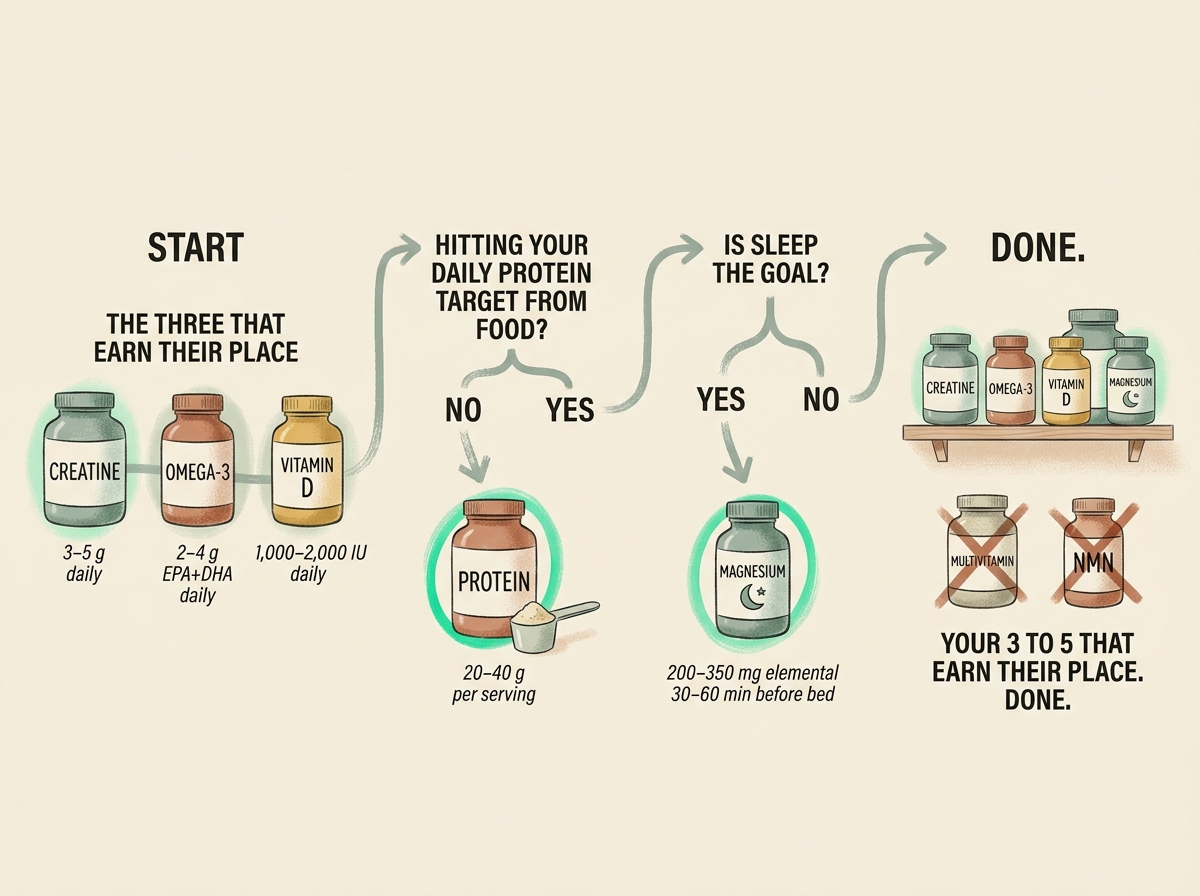
| Supplement | Form | Daily dose | Timing | Notes |
|---|---|---|---|---|
| Creatine monohydrate | Powder or capsule | 3–5 g | Any time; consistency beats timing | No loading phase needed; about four weeks to saturate; micronized is easier on the stomach |
| Omega-3 (EPA+DHA) | Fish oil or algae softgel | 2–4 g combined EPA+DHA | With a fat-containing meal | Give it six weeks or more for the recovery effect; algae form for vegans |
| Vitamin D3 | Softgel | 1,000–2,000 IU | With a fat-containing meal | Test your level first; the daily ceiling is 4,000 IU; pairing with K2 is optional |
| Whey or plant protein | Powder | 20–40 g per serving | Around training or any meal | Only if you are under 1.6 to 2.2 grams per kilogram a day from food; choose third-party tested |
| Magnesium glycinate | Capsule | 200–350 mg elemental | 30–60 min before bed | Glycinate is tolerated best; supplemental ceiling is 350 mg; space it from certain antibiotics |
The thing people ask most is whether these clash. For this short stack, mostly no. The one spacing rule involves magnesium. Keep it about two hours apart from certain antibiotics (the tetracycline family) and from bone drugs called bisphosphonates, since it can blunt their absorption. One old worry, that caffeine cancels out creatine, hasn't held up in more recent work. Still, it's reasonable to avoid taking both in the same pre-workout hit.
A few per-supplement safety notes round it out. If you have any degree of kidney disease, talk to your doctor before adding creatine. The safety data is reassuring for healthy adults, but your situation is different. If you're on a blood thinner, check with your prescriber before pushing omega-3 above four grams a day. High doses thin the blood a little more. With vitamin D, test before taking high doses and stay under the daily ceiling, because sustained very high intake can cause problems. With protein powder, pick a third-party tested brand, since some products carry heavy-metal contaminants. If you're pregnant, breastfeeding, or under 18, run any stack past a clinician first; the doses here are for general healthy adults.
The bottom line
Our read on the evidence: the best supplement stack is the short one you'll stick with, not the long one you'll abandon. Creatine, omega-3, and vitamin D are the foundation that earns its place for almost everyone. From there, the smart move is to add deliberately, the supplement that fits a goal you actually have, rather than on the feeling that more is automatically better. A bloated cabinet usually comes from adding by default; the evidence rewards adding on purpose, not adding nothing.
If you want a place to start this week: creatine every day, omega-3 with a meal, and vitamin D once you've checked you're low. Give it a couple of months, keep what's pulling weight, and let the bottles you can't justify quietly run out.
Common questions
What are the top three supplements to take?
For almost everyone, creatine, omega-3, and vitamin D. Creatine is the best-evidenced pick for strength, with a bonus for memory in older adults. Omega-3 is the recovery and metabolic-marker pick. Vitamin D matters most when you're correcting a shortfall, so test first.
Can I take 20 different supplements at once?
You can, but most of them won't do anything except cost money. The bigger risk is that a long stack hides the few that matter and drains the budget you could spend on them. Thin it to the three that earn their place, then add only what fits a specific goal.
What two supplements should not be taken together?
Within this short stack there's no hard clash. The main spacing rule is magnesium: keep it about two hours from tetracycline antibiotics and from bisphosphonate bone drugs, which it can stop you absorbing. Separately, if you take a blood thinner, talk to your prescriber before combining it with high-dose omega-3.
What's the best combination of supplements for overall health?
The same three carry general health: creatine, omega-3, and vitamin D. Add a protein powder only if you're not hitting your daily protein target from food. Skip the multivitamin and the NMN or NAD+ pills, which don't earn their place for the average person.