
Post-Workout Supplements: What Helps You Recover Faster
You just finished a workout. In front of you sits a row of tubs: fish oil, whey, creatine, BCAAs, glutamine, tart cherry. Maybe you take a few already, maybe you're just tired of guessing. The real question is simple. Which post-workout supplements help you recover, and which are you buying out of habit? For most people, the list is shorter than the shelf.
Post-workout supplements: three jobs, not one
Here is the short version. Of everything sold for after training, only two reliably move the needle on soreness and recovery: omega-3 and protein. The famous one, creatine, is built for strength, not soreness. And the best-supported recovery supplement is the one most people forget to buy: plain fish oil.
The reason your cart overflows is simple. "Post-workout" got sold as one thing. It's three different jobs. A different supplement wins each one.
Think of it as three lanes. Strength is the raw force you can put out. Muscle is the size you build over months. Recovery is how fast soreness fades and your muscles come back online.
Here is the freeing part. If you eat well and train a few times a week, you may not need anything. Soreness is normal, and it fades on its own. Supplements only shave the edges. They don't replace sleep, food, or rest days. Reach for them once the basics are handled, not before.
Three separate 2025 and 2026 reviews each crowned a different winner. Whey protein ranked first for building muscle.[5] Creatine ranked first for raw strength.[2] Omega-3 came out on top for soreness and recovery.[21] Three jobs, three different supplements.
This article is about the recovery job. That means feeling less wrecked and getting your strength back faster between sessions. If you're chasing size and strength instead, that's a different stack. We break it down in building muscle and training performance. The recovery shortlist is shorter than the shelf suggests.
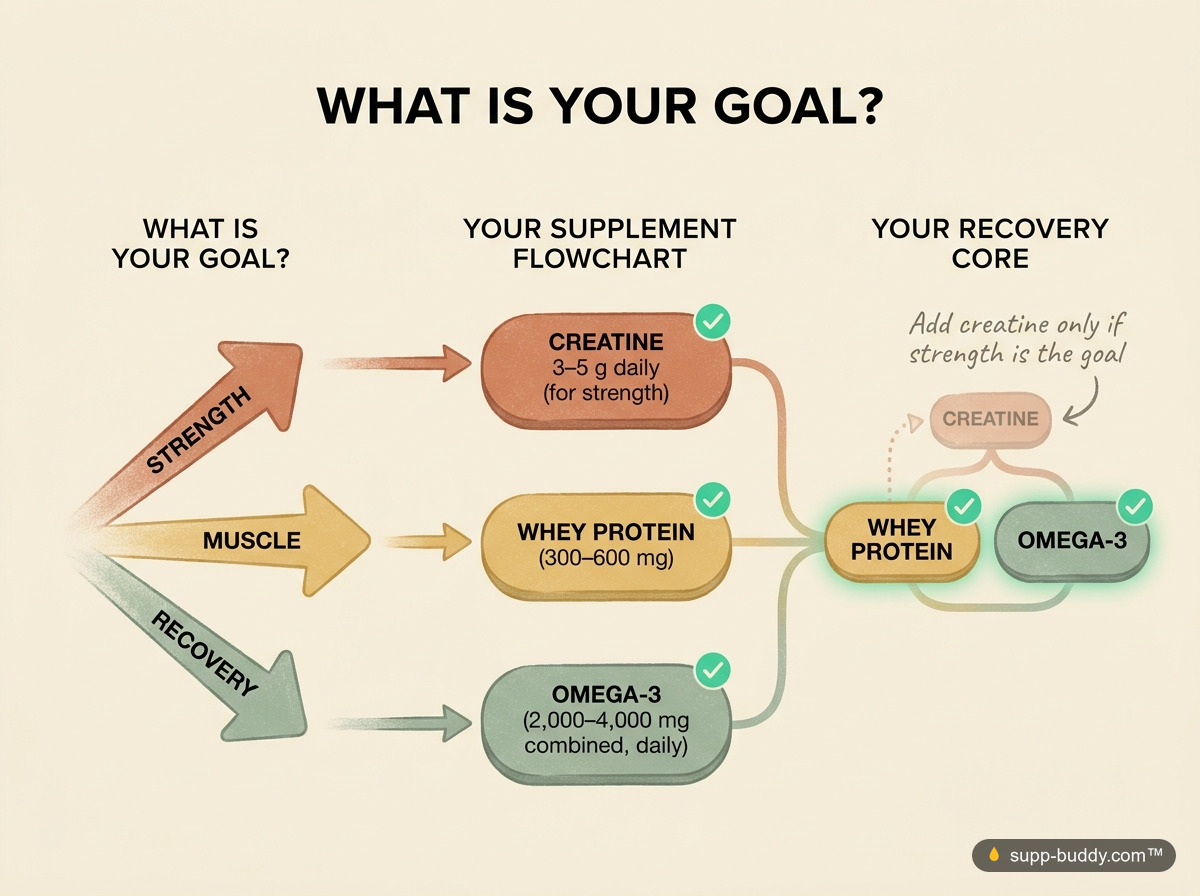

Not sure which of your tubs pull their weight? Tell Your Supp' Buddy what is in your post-workout lineup and what you train for. It flags which ones overlap and which you can drop.
Omega-3: the recovery supplement almost nobody talks about
Omega-3 is the surprise of this list. It rarely comes up in post-workout threads. Yet it has the cleanest recovery evidence of anything on the shelf.
A 2026 review pooled 43 studies on fish oil and recovery.[21] It found a clear drop in delayed-onset muscle soreness, or DOMS. That's the ache that peaks a day or two after a hard session. The same review found lower creatine kinase too. Creatine kinase, or CK, is a blood marker that climbs when muscle gets damaged. Strength and range of motion also came back faster.[21]
An independent review reached the same call. It named omega-3 among the best-supported recovery supplements.[14]
How does it work? The EPA and DHA in fish oil settle into your muscle cell walls. There they calm the inflammation that follows hard training. Less inflammation means less of the swelling and soreness that drag out recovery. It's a slow shift, not a switch you flip overnight.
So who benefits most? Anyone who trains hard and rarely eats fish. If your sessions leave you sore for days, omega-3 is the first thing to try. If you already eat salmon twice a week, you may be covered. Either way, give a fish oil four to six weeks before you judge it.
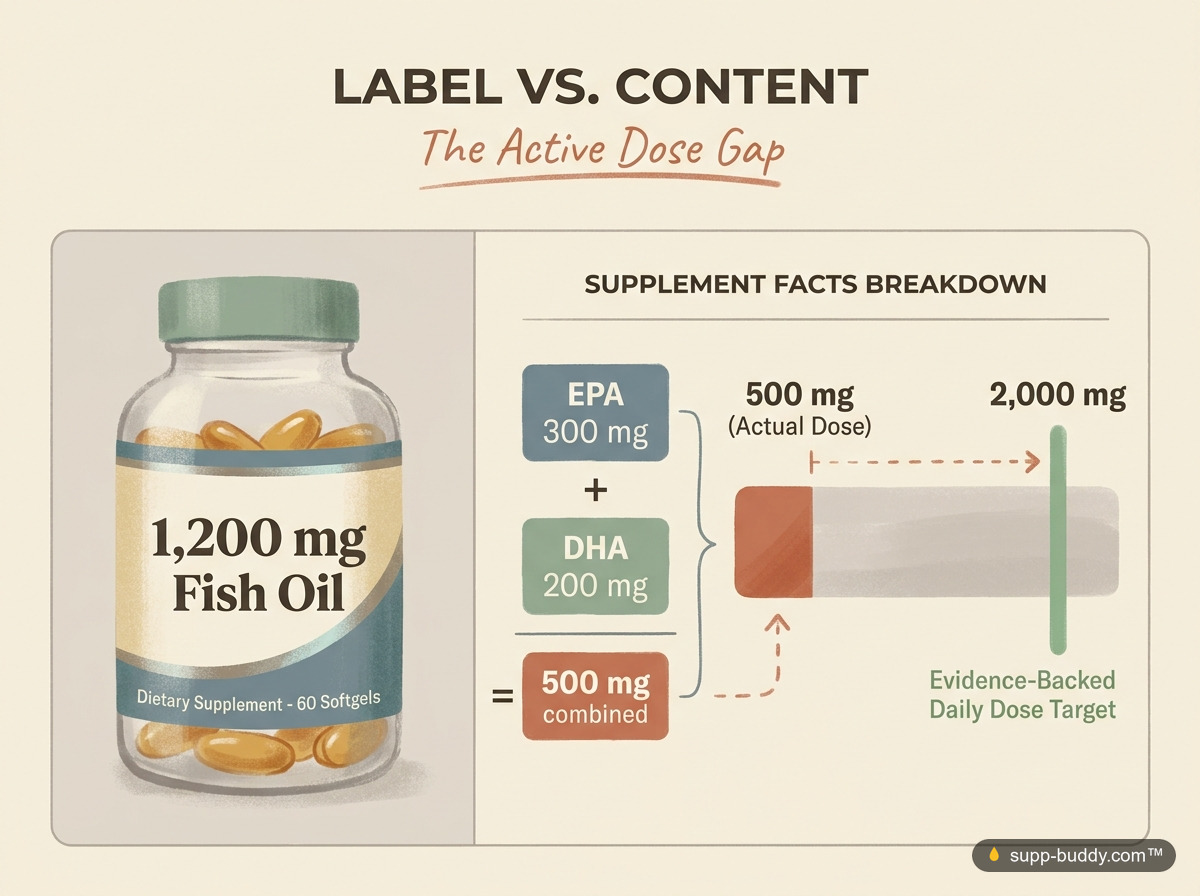
There is a catch, and it's on the label. The two omega-3 fats that do the work are EPA and DHA. A 1,200 mg capsule often holds just 300 mg of EPA and 200 mg of DHA. That's 500 mg of the part that matters. The studies that worked used about 2,000 mg of combined EPA and DHA a day. So one softgel rarely gets you there.
Read the back of the label, not the front. Add the EPA and DHA numbers together. Aim for around 2,000 mg a day, which is two or three softgels on most bottles. To pick between the two fats for your goal, see our EPA vs DHA breakdown.
One more buying tip: the form matters. Look for fish oil in the triglyceride form, the shape closest to how the fat sits in whole fish. Your body takes it up better than the cheaper ethyl-ester version. If you skip fish, algae oil gives you EPA and DHA directly.
Not sure your fish oil even hits the dose the studies used? Scan the bottle with Your Supp' Buddy. It reads the EPA and DHA off the label and checks them against the evidence-backed range. You learn whether you have a recovery dose or a rounding error.
Whey protein: recovery starts with repair
Whey is the one supplement here you probably already own, and it earns its spot. Recovery is not only about less soreness. It's about giving your muscles the raw material to rebuild. That material is protein.
Your muscles repair by rebuilding protein. A 2025 review of 21 trials found whey plus training sped that rebuild up, well beyond training alone.[4] A separate review of 150 trials found milk proteins like whey added a small but steady amount of lean mass.[6]
When researchers compared protein types, whey paired with resistance training came out on top for muscle. The result carried high confidence.[5]
You don't need whey specifically. Any quality protein does the job. Whey is just fast, cheap, and easy to drink. What matters far more than the brand is the daily total. Aim for 1.6 to 2.2 grams of protein per kilogram of body weight, spread across the day.[8] The post-workout shake is a small piece of that total, not the whole job.
One honest caveat. A 2026 review found that some of the muscle benefit shows up only when the supplement also bumps your daily calories.[7] Part of what people credit to the powder is just eating enough. Two forms sit on the shelf: concentrate is cheaper, while isolate is filtered further and easier on a lactose-sensitive stomach.
Chasing fat loss instead of size? Protein still earns its keep. It keeps you full and helps protect muscle while you eat at a deficit. For the muscle-building side of whey, and how it stacks with creatine, see the muscle-gain guide.
The ones with a mixed story: creatine and tart cherry
These two get grouped together because their recovery story has the same shape. Each is solid in one narrow way and oversold in another.
Creatine: strong for strength, mixed for soreness
Creatine is the most studied supplement in the gym. It works, just not mainly for recovery. The strength evidence is excellent.[2] The recovery evidence is thinner and mixed.
One 2025 trial found a week of creatine loading lowered how sore people felt.[1] But the same trial found no gain in the objective markers. Those are the strength and power tests run over the next three days. A separate review of 13 trials found no soreness benefit at all.[3]
So the picture is muddy. Maybe a little less perceived soreness, but no faster return to full function. Take creatine for getting stronger, not for bouncing back faster. The full strength case lives in the muscle-gain guide. If you're a woman, the creatine story for women is stronger than the gym-bro framing suggests.
Tart cherry: helps the comeback, not the ache
Tart cherry is the surprise of the group. A 2026 review of 19 trials found it helped muscles regain strength faster after hard sessions.[12] The benefit grew over the two or three days afterward.
But the same review found no drop in the soreness people felt. It also found no change in two markers of muscle damage and inflammation.[12] An earlier review did find it lowered one inflammation marker.[13] The active compounds are anthocyanins, the dark pigments that give the cherries their color.
So tart cherry helps your muscles perform sooner, even if you still feel beat up. It's useful loaded before a competition or a big event. It's less useful as an everyday tub.
The ones you can skip: BCAAs and glutamine
Not every tub earns its place. These two are the most common money-wasters for people who already eat enough protein.
BCAAs: redundant if you eat enough protein
BCAAs, or branched-chain amino acids, are three of the building blocks already in any protein. They're the classic case of paying for something you already get.
A 2021 review of 9 trials found they trimmed creatine kinase in the first day or two.[9] A 2024 review of 18 trials backed that up.[10] But the soreness effect was small and short-lived. A 2025 review in wrestlers called the recovery results inconsistent.[11]
Here is the catch. If you already eat enough protein, you get all the BCAAs you need. A scoop of whey delivers more leucine, the main muscle-building amino acid, than a BCAA serving does. Save your money, unless you train fasted and want a few grams mid-session.
Glutamine: save it for the clinic, not the gym
Glutamine is the weakest recovery case here for healthy lifters. A small 2021 trial in basketball players saw lower muscle-damage markers.[18] A trial in older women found a strength benefit, but that's a different group.[19]
For a healthy person who trains and eats normal protein, glutamine offers little for recovery. Your body makes plenty on its own, and your diet covers the rest. It earns its place after surgery or serious illness. That's the clinic, not the gym.
The honest pattern across these two is the same. Both got popular before the evidence caught up. Both add a little in a lab and almost nothing once your protein is sorted. If a tub promises faster recovery but your diet is already solid, the money is better spent on more fish or better sleep.
The 30-minute anabolic window is a myth
You have probably felt the panic. The workout is done, the clock is ticking, and you have 30 minutes to slam a shake or waste the session. Let it go. That window is mostly a myth.
The claim: You have a 30-minute "anabolic window" after training to get protein in, or you lose the gains.
What the evidence says: A 2017 study compared protein taken right before training versus right after. The muscle gains came out the same either way.[8] What drives results is your total protein for the day, not the timing of one shake. The window is more like several hours.
This is the permission slip a lot of lifters need. You don't need a shaker in your gym bag like a fire extinguisher. Eat a normal protein meal within a few hours of training. You have covered the timing question. Your muscles work on a timescale of days, not minutes.
Getting recovery nutrients from food first
Before you buy anything, look at your plate. For recovery, food does most of the heavy lifting. The supplement only fills the gap food can't close.
For omega-3, fatty fish is the gold standard. A single serving of salmon can deliver most of a day's recovery dose on its own.
| Food | Serving | EPA + DHA |
|---|---|---|
| Wild salmon (cooked) | 3 oz / 85 g | ~2.2 g |
| Mackerel | 3 oz / 85 g | ~2.0 g |
| Herring | 3 oz / 85 g | ~1.8 g |
| Sardines (canned) | 3 oz / 85 g | ~1.4 g |
| Rainbow trout | 3 oz / 85 g | ~1.0 g |
How much, how often: two or three servings of oily fish a week gets most people into the recovery range, with no capsule needed. If you don't eat fish, that's the clear reason to supplement. A 2,000 mg fish oil, or an algae oil, covers the gap. Plant sources like flax and chia give a different omega-3 called ALA, which converts poorly, so they don't count here.
For protein, food does the heavy lifting too. A 70 kg lifter aiming for 1.6 to 2.2 g per kg needs roughly 110 to 150 g a day. A 6 oz / 170 g tub of Greek yogurt gives 17 to 20 g. A 3.5 oz / 100 g chicken breast gives about 31 g. Two eggs add 12 g. Stack a few of those and a shake becomes optional.
One habit helps recovery more than any single food: spread protein across the day. Three or four meals with 25 to 40 g each beats one big hit at dinner. Your muscles rebuild around the clock, so a steady supply works better than a single dump.
Creatine is the odd one out for food. It lives in red meat and fish. But you would need close to a pound (450 g) a day to match a 3 to 5 gram dose. Vegetarians start lower and tend to respond most to the powder. Tart cherry is the other exception, since the concentrate is the practical year-round form. As for BCAAs and glutamine, you already get both, for free, in any protein-rich meal.
The pattern holds across the list. Food covers most of what your muscles need to repair. The supplement fills the gap food can't close that day. It doesn't replace the plate. Runners stacking recovery around a race can go deeper in our runner recovery protocol.
Nutrient data from USDA FoodData Central.
Doses and safety worth keeping on hand
Here is the recovery shortlist in one place, with doses you can photograph and take to the store.
| Supplement | Recovery dose | When | Notes |
|---|---|---|---|
| Omega-3 (EPA+DHA) | 2,000 to 4,000 mg combined, daily | With any meal | Slow build over weeks; ask a doctor above 3,000 mg if on blood thinners |
| Whey / any protein | 20 to 40 g per serving | Any time; daily total matters most | Lactose-sensitive: use isolate |
| Tart cherry | Concentrate around hard events | A few days before and after | High in natural sugar |
| Creatine | 3 to 5 g daily (for strength) | Any time | Safe; not mainly a recovery tool |
| BCAAs | Skip if protein is adequate | Only if training fasted | Redundant with enough protein |
| Glutamine | Skip for gym recovery | Not for gym use | Clinical use only |
A few things to watch, by situation:
- If you take creatine and caffeine, space them a few hours apart. Caffeine can blunt some of creatine's effect when taken together.
- If you have a kidney condition, talk to your doctor before starting creatine. It nudges up a blood marker called creatinine, which can look like a kidney flag on a lab test without harming healthy kidneys.
- If you're on blood thinners, omega-3 above 3 g a day can add to their effect, so check with your prescriber before going high-dose.
- If glutamine upsets your stomach, that's the dose talking. Very high amounts cause stomach trouble. The 5 to 10 g range sits fine for most people.[20]
- If you're lactose intolerant, a whey isolate has far less lactose than a concentrate and usually goes down clean.
- If you're pregnant or breastfeeding, the safety data on most of these at supplement doses is thin. The cautious move is to get what you can from food and clear any supplement with your doctor first.
One last habit worth keeping. Buy from brands that run third-party testing, shown as an NSF or Informed Sport seal. Supplements are loosely regulated, so that seal checks that what is on the label is in the tub. It matters most for anything you take daily, like fish oil and protein. Women sometimes ask whether any of this changes for them. Mostly it does not, but the details have their own read in post-workout supplements for women.
The bottom line
Our read on the evidence: the recovery aisle is mostly two supplements wearing six costumes. Omega-3 and whey do the work. Fish oil cools the inflammation that makes you sore. Whey hands your muscles the bricks to rebuild. Everything else is a strength tool wearing a recovery label, a situational pick, or a redundant buy if you eat enough protein.
If you want to test it, the protocol is boring on purpose. Hit 1.6 to 2.2 g of protein per kg daily. Add 2,000 mg of combined EPA and DHA with a meal. Give it a few weeks of training before you judge. Recovery doesn't announce itself. You just notice, one day, that the stairs after leg day stopped hurting.
Frequently asked questions
What is the best post-workout supplement for muscle recovery?
For recovery, the strongest 2026 evidence points to omega-3 fish oil. A review pooling 43 studies found it cut soreness, lowered muscle-damage markers, and sped the return of strength.[21] Whey protein is the close partner, because it supplies the raw material your muscles rebuild with.[4] For most people, that pairing covers the job.
Do I need protein within 30 minutes of working out?
No. The 30-minute "anabolic window" is mostly a myth. A 2017 study found the same muscle gains whether protein came right before or right after training.[8] Your total protein for the day matters far more than the timing of any single shake.
Are BCAAs worth taking after a workout?
For most people, no. BCAAs trim muscle-damage markers a little in the first day or two, but the soreness benefit's small.[9] If you already eat enough protein, a scoop of whey gives you more of the key amino acid than a BCAA serving does. They only make sense if you train fasted.
What should you avoid after a workout?
Avoid two things: panicking about the 30-minute window, and spending on supplements that duplicate your diet. If your protein is solid, BCAAs and glutamine add little for recovery.[11] The bigger risk is under-dosing what works. A fish oil that hides only 500 mg of active omega-3 behind a "1,200 mg" front label is the classic trap.