
Supplements for Anxiety: What the Evidence Shows (and the Risks Nobody Mentions)
You've done the reading. You've seen ashwagandha recommended in every thread. You've bought the magnesium. Maybe you've heard saffron is "basically a natural antidepressant."
But here's what none of those recommendations told you. One of those supplements has documented safety issues that rarely get mentioned. Another one works by the same mechanism as your SSRI. And the one the internet swears by for anxiety? Its best evidence is for sleep, not anxiety.
Five supplements have clinical evidence for anxiety and stress. This article covers all five, grades the evidence honestly, and names the risks that popular content skips.
What the internet says vs. what the evidence says
In supplement communities, magnesium is the go-to recommendation for anxiety. People describe feeling calmer, sleeping deeper, having less muscle tension. That tracks with the research, but there's a catch. The anxiety benefit most likely comes through better sleep, not a direct calming effect.6 If your sleep is fine, magnesium probably won't move the needle.
L-theanine gets called "the one that takes the edge off" for presentations and social situations. That's mostly right. Where it falls short is treating diagnosed anxiety disorders. A network analysis of medicinal herbs for anxiety found L-theanine didn't reach statistical significance for clinical anxiety.1
Ashwagandha is more polarising. Most people who try it report stress reduction. A smaller group reports the opposite: anxiety getting worse, liver enzymes going up, hormonal changes. Both sides are supported by the evidence, and the hormonal effects are addressed in the risks section below.
Community claim: "Ashwagandha is completely safe. It's just a root."
What the evidence says: Case reports of liver injury from ashwagandha exist in the medical literature, including prolonged cholestasis requiring hospitalisation.9 A large safety trial of 1,002 adults showed normal liver function at standard doses of branded extract over 8 weeks.10 The risk appears low with regulated products at standard doses, but it isn't zero.

Seen five different recommendations and don't know where to start? Tell Your Supp' Buddy what you're managing and what you already take. It'll rank these supplements for your situation and flag anything that creates an interaction.
Five supplements, five verdicts
Ashwagandha for anxiety: the strongest evidence, the most caveats
Multiple systematic reviews show ashwagandha reduces anxiety scores in adults with stress.81 One review of five trials found a meaningful drop in standardised anxiety scores after 8 weeks.8 Some studies measured stress hormones directly and found they dropped too, adding an objective layer most supplements lack.12
Dr. Christy Risinger, a physician who reviewed the ashwagandha trial literature, put it this way:
"Overall I was surprised to see that ashwagandha performed pretty well in reducing anxiety and stress... some studies even used objective measures of stress like serum cortisol in the blood and were able to show that serum cortisol levels even reduced when using ashwagandha."
— Dr. Christy Risinger, MD
The direction is clear. But results vary widely across trials, and many were small or industry-funded. The grade for stress: B+. For mood: B. Honest, not glowing. Reassess at 30 days: if nothing has shifted by then, the dose or extract may not be right for you.
Magnesium glycinate and the sleep-anxiety loop
Your brain uses magnesium for hundreds of processes, including the ones that regulate your stress response. Studies estimate that nearly half of adults in the US fall short of the recommended daily magnesium intake (NIH Office of Dietary Supplements), making deficiency-driven effects plausible. When you're low, your stress system overreacts.
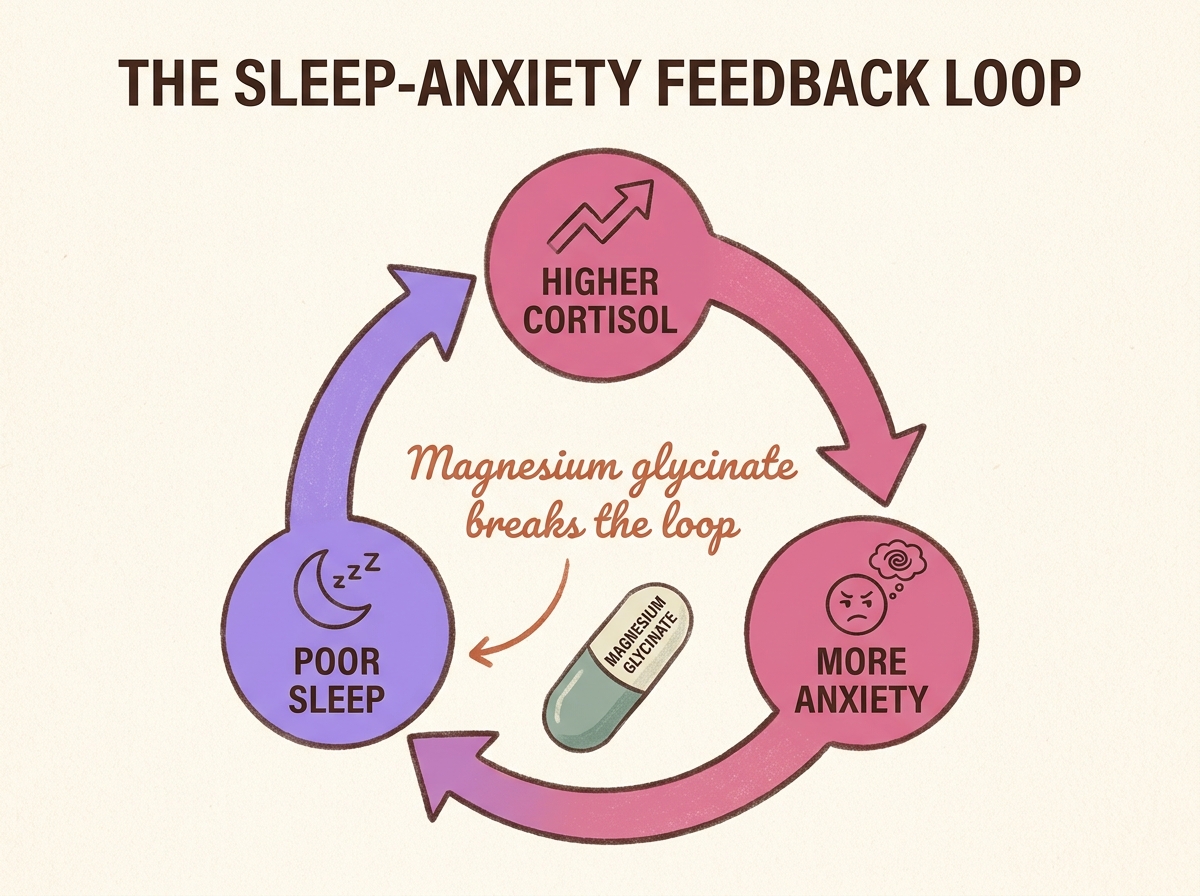
But here's the honest framing: direct trials on magnesium and anxiety show mixed results.6 The strongest path from magnesium to less anxiety runs through sleep. Poor sleep raises stress hormones. That feeds anxiety. Worse anxiety wrecks sleep. Magnesium glycinate can interrupt that loop by improving sleep quality. If your sleep is part of the picture, we cover the full protocol in our magnesium sleep guide.
Grade for anxiety: B-. If your anxiety is tied to poor sleep, this is a reasonable starting point. If your sleep is fine, the direct effect is modest.
L-theanine for anxiety: for the edge, not the disorder
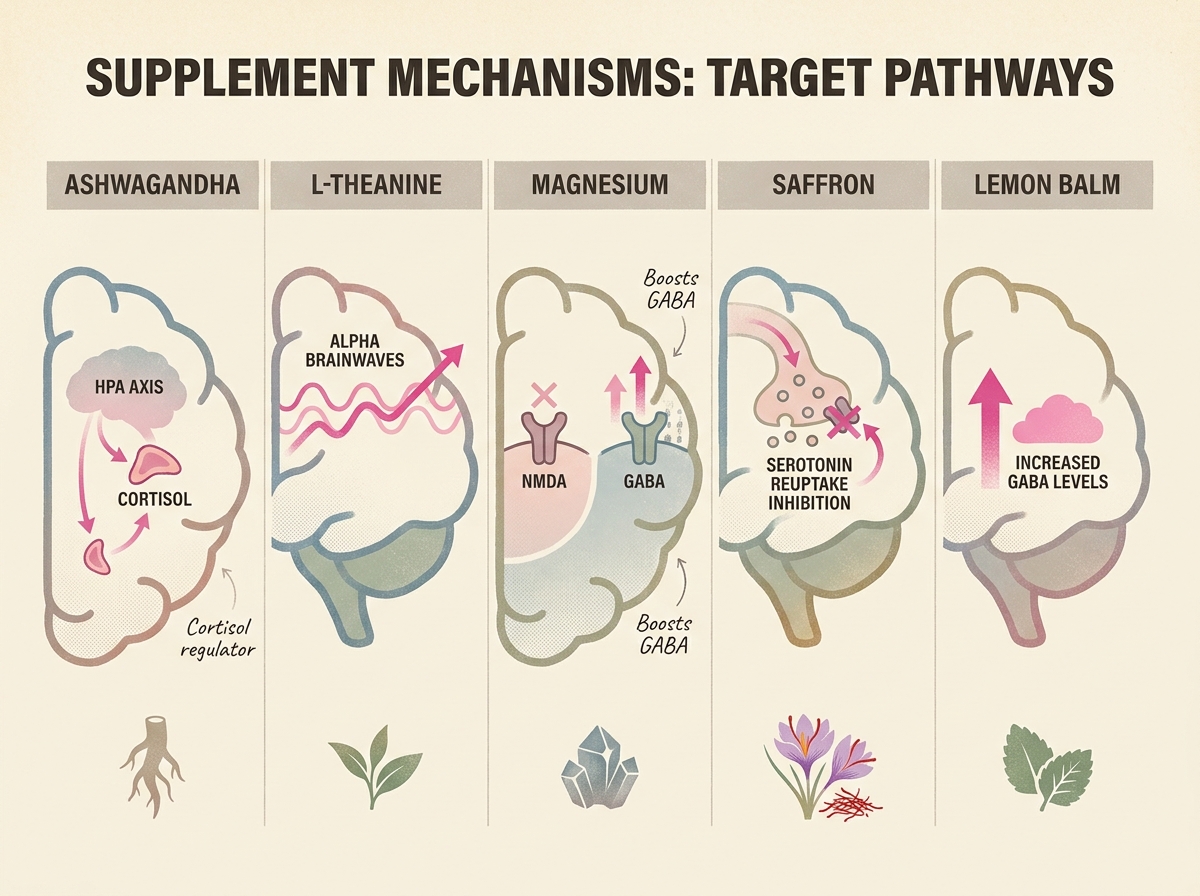
L-theanine is the amino acid behind green tea's calming effect. It increases alpha brainwave activity, the pattern your brain shows during relaxed focus. Calm without drowsy.
Two systematic reviews found it reduces stress reactivity at 200 to 400 mg per day.45 It works within 30 to 60 minutes.5 That makes it useful for specific moments: a presentation, a flight, a difficult conversation. But a network meta-analysis found it didn't beat placebo on clinical anxiety scales.1
Grade for stress: B-. L-theanine is good at calming you down in the moment. It's not a treatment for clinical anxiety.
Saffron: the surprising SSRI comparison
This is the finding most people don't expect. When researchers compared saffron directly to SSRIs in head-to-head trials, it performed roughly the same for depression symptoms. Statistically fewer side effects too.2 A broader network analysis that pools data across many treatments went further. It ranked saffron monotherapy as more effective than standard antidepressants for depressive disorders.3
That's for depression. For anxiety as a standalone target, the evidence is thinner. A network meta-analysis found saffron's anxiety reduction didn't reach statistical significance.1 And a recent trial of 51 people with subclinical symptoms found no significant effect on its primary anxiety-fatigue composite.11
Grade for depression: B. Grade for anxiety: C. Preliminary signal, not a recommendation on its own.
Lemon balm: the largest effect from the smallest evidence
Lemon balm produced the most striking single finding in this article: a large effect size in its meta-analysis of anxiety trials.7 It works by increasing GABA levels in the brain, similar to how some anti-anxiety medications work (rosmarinic acid pharmacology).
The catch: that large effect comes from fewer than 500 people across all studies, mostly testing acute anxiety over days, not months. The wide confidence interval means the true effect could be anywhere from impressive to modest. Grade: B-. Worth trying for short-term situational use. Don't build a long-term protocol around it yet.
Reduces anxiety and stress scores in adults after 8 weeks
Reduces anxiety and stress scores in adults after 8 weeks
Grade: B+ (stress) / B (mood) | Moderate confidence
Ashwagandha: evidence across multiple reviews points the same direction. Stress hormone measurements add an objective layer most supplements lack.
Results vary widely across trials, and many were industry-funded or small. Drug interactions and safety concerns limit who should use it.
Benefits mood via sleep and deficiency correction; limited direct anxiety evidence
Benefits mood via sleep and deficiency correction; limited direct anxiety evidence
Magnesium glycinate: the anxiety benefit most likely works through the sleep-anxiety loop and correcting dietary shortfall.
No glycinate-specific anxiety trials exist. The safety profile is excellent, which makes it a low-risk starting point even with indirect evidence.
Reduces acute stress reactivity; not proven for clinical anxiety disorder
Reduces acute stress reactivity; not proven for clinical anxiety disorder
L-theanine: strong for in-the-moment stress. A network meta-analysis did not find it effective for clinical anxiety disorder.
Best evidence is in healthy adults under acute stress, not in patients with diagnosed GAD. Fast-acting and safe, but limited in scope.
Matches SSRIs for depression in head-to-head trials; weaker for anxiety as primary outcome
Matches SSRIs for depression in head-to-head trials; weaker for anxiety as primary outcome
Grade: B (depression) / C (anxiety) | Moderate confidence for depression
Saffron: the SSRI comparison is the most striking finding for any supplement in this article. Fewer side effects in head-to-head trials.
Anxiety as a standalone outcome is weaker. The serotonin mechanism that explains its efficacy also creates drug interaction risk with prescription antidepressants.
Not sure which of these five matches your situation? Tell Your Supp' Buddy what you're managing: stress, mood, sleep, or all three. It'll rank these supplements by your goals and flag anything to check with your doctor first.
The risks most articles skip
Two of these five supplements carry interaction risks that almost never appear in the articles recommending them.
Ashwagandha and your liver
Case reports describe ashwagandha-associated hepatic damage, including one case of prolonged cholestasis that required hospitalisation.9 FDA adverse event reports include hospitalisations from ashwagandha use, with the volume of reports growing (FDA CAERS adverse event database).
Context matters. The large safety trial (1,002 adults, 8 weeks, 600 mg per day of branded extract) showed normal liver function throughout.10 The cases cluster around unregulated products at higher doses. Use a branded extract (KSM-66 or Sensoril), stick to 300 to 600 mg per day, and mention it to your doctor.
Ashwagandha and your prescriptions
Ashwagandha can affect how your body processes certain medications (in vitro pharmacokinetic data). It may speed up clearance of some statins, some benzodiazepines, and some immunosuppressants. It may also raise levels of bupropion (Wellbutrin). If you're on any prescription, check with your pharmacist before adding ashwagandha.
Saffron and serotonin
Saffron's active compounds block serotonin reuptake (in vitro pharmacology). That's the same mechanism as SSRIs. Adding saffron on top of an SSRI stacks two serotonin-raising mechanisms at once. That carries a theoretical risk of serotonin syndrome: agitation, rapid heart rate, high temperature. No documented cases from saffron specifically, but the pharmacology is clear. If you're on an SSRI, SNRI, MAOI, or triptan, do not add saffron without talking to your prescriber.
Who should skip what
- Pregnant: skip ashwagandha (possible uterine stimulation at higher doses)
- Thyroid conditions: use caution with ashwagandha (may raise T3/T4) and lemon balm (may affect thyroid function)
- Hormone-sensitive conditions: ashwagandha may raise testosterone and affect estradiol — check with your doctor if you have PCOS, endometriosis, or hormone-receptor-positive conditions
- Kidney disease: talk to your doctor before magnesium above the 350 mg supplement upper limit
- On benzodiazepines: ashwagandha and lemon balm can both add sedation. Not dangerous at normal doses, but worth knowing
Dosage, form, and timing
The form matters as much as the dose. A generic ashwagandha powder from an unregulated seller is not the same product as a branded KSM-66 extract. Here's what the studies used:
| Supplement | Form | Dose | Timing | Duration | Grade |
|---|---|---|---|---|---|
| Ashwagandha | KSM-66 or Sensoril extract | 300–600 mg/day | With meals, morning + evening | 8–12 weeks (reassess at 30 days) | B+ (stress) |
| L-Theanine | Pure L-theanine | 200–400 mg/day | As needed (30–60 min onset) | 4–8 weeks | B- |
| Magnesium Glycinate | Chelated glycinate | 200–400 mg elemental Mg/day | Evening preferred | 4–8 weeks | B- |
| Saffron | Standardised extract (≥3.5% safranal) | 28–100 mg/day | With food | 6–12 weeks | B (mood), C (anxiety) |
| Lemon Balm | Melissa officinalis extract | 300–900 mg/day | Twice daily or as needed | 2–4 weeks | B- |
The best supplement for anxiety: where to start
Here's how all five score across the eight Supp'Buddy pillars:
Stress and mood dominate, which makes sense for this group of supplements. Sleep sits meaningfully higher than focus, recovery, or energy — that's the anxiety-sleep loop showing up in the data. These supplements target a narrow band, and that's fine.
If everyday stress is the main issue and sleep is part of the picture, magnesium glycinate is the lowest-risk starting point. Add L-theanine if you need something for specific high-stress moments. Ashwagandha is the strongest option for chronic stress, but only if you're not on medications it interacts with and you're using a branded extract.
The bottom line
Every popular article about anxiety supplements ends with the same five recommendations and the same vague "talk to your doctor." None of them mention that ashwagandha interacts with common prescriptions. None flag that saffron raises serotonin the same way your SSRI does. That's not caution. It's a gap that leaves people combining things they shouldn't.
The supplements in this article work. Some of them work well. But "generally safe" and "safe for you, right now, with your prescriptions" are different claims. The second one is the only one that matters.