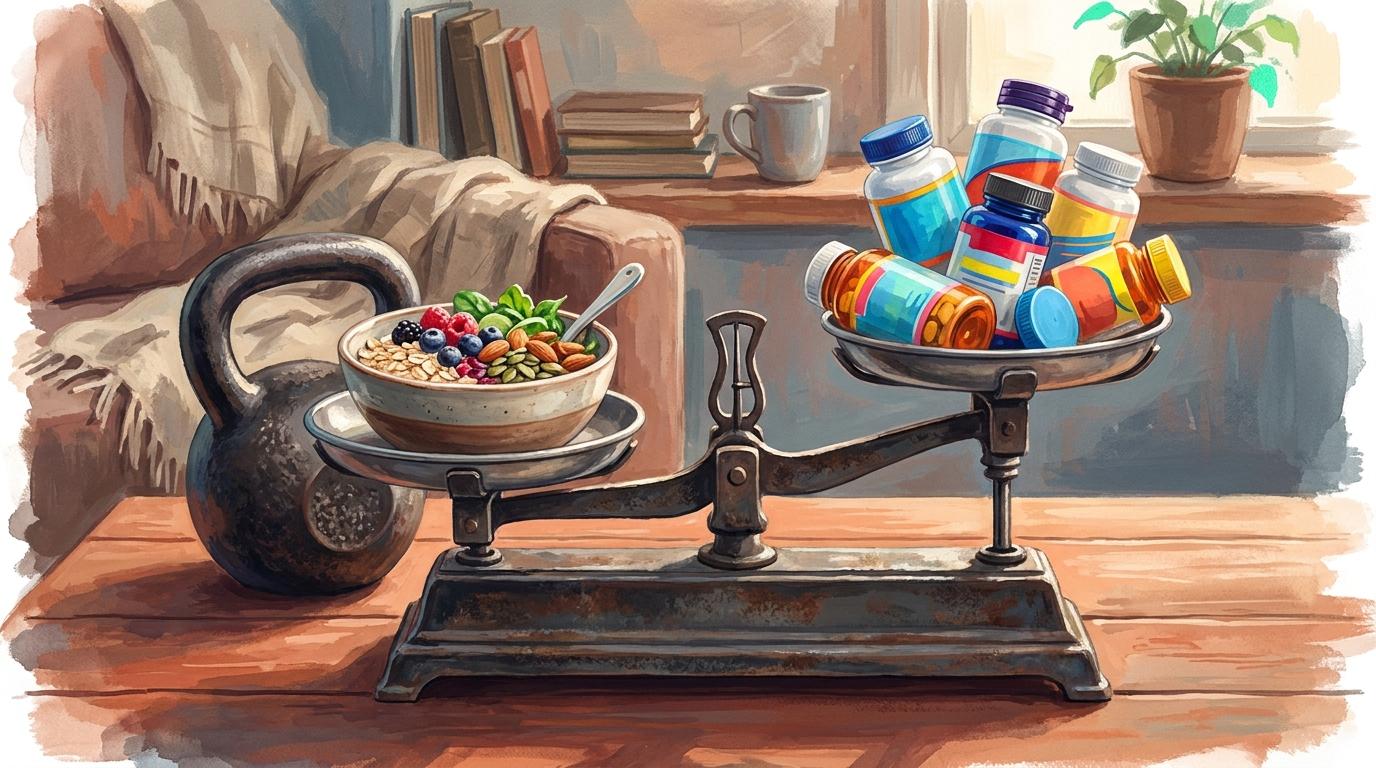
Do Post-Workout Supplements Help Women Lose Weight?
You're eyeing the fat-burner aisle, wondering if any of these post-workout supplements help women lose weight.
Here's the honest answer: not one of them burns fat on its own. The products sold as fat burners do worse in studies than plain diet and exercise.8 Two things, creatine and protein, can help, but only if you're lifting, and neither burns fat for you. You were right to be skeptical.
Where the "fat burner" promise comes from
The fat-burner pitch survives on one true fact stretched past its limits: stimulants can nudge how many calories you burn at rest, a little. These products are sold as thermogenics, meaning they claim to raise the calories your body burns just sitting still. The kernel is plausible. The promise on the label is not.
These products can lift your metabolism a touch. Even then, the metabolic-rate increases from thermogenic supplements are small and may not produce meaningful calorie deficits without changes to diet or exercise. A handful of extra calories burned over a day disappears into normal variation. It does not melt fat.
Women learned to distrust this aisle for good reason. The FDA once flagged a popular fat burner, OxyELITE Pro, for containing hidden, illegal drugs. And weight-loss supplement ads have a habit of stealing other people's before-and-after photos to sell pills those people never took. So the skepticism you walked in with is earned. The marketing has spent years teaching it to you.
What the research says about fat burners, CLA, L-carnitine, and green tea
In controlled studies, the four most-marketed fat-loss supplements run from "worse than doing nothing extra" to "too small to notice."
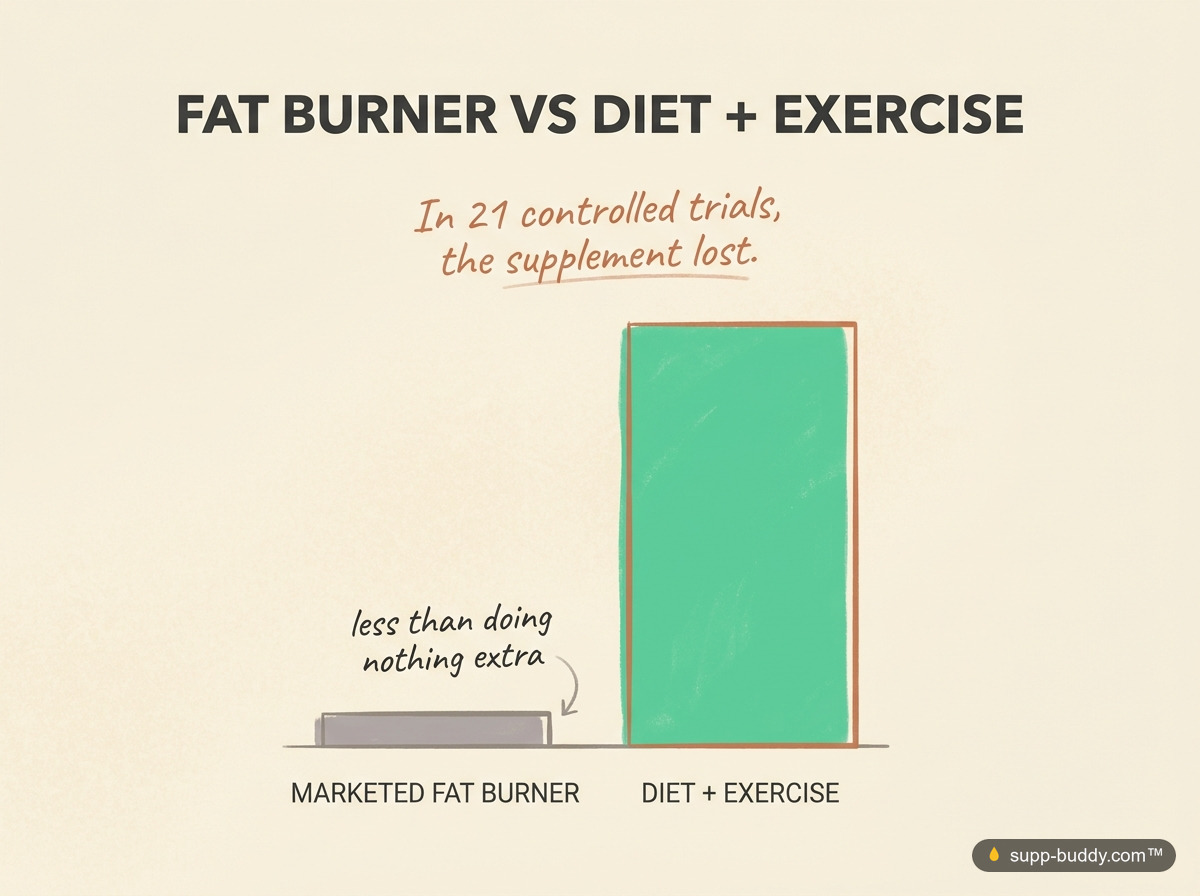
The clearest test pooled 21 trials of fat burners and thermogenics and lined them up against diet and exercise alone.8 The supplements lost. Across every outcome, the benefit was too small to count on. The people using free diet and exercise did better than the people paying for pills. That is the headline of this whole article in one sentence: the thing you can buy underperforms the thing that's free.
The other three contenders fare no better when you read the better-run studies. Here's where each one lands.
| Supplement | The claim | What controlled trials show | Verdict |
|---|---|---|---|
| Thermogenic fat burners | Burns fat, boosts metabolism | Less effective than diet and exercise alone; no benefit you can rely on 8 | Skip. Worse than free. |
| CLA | Reduces body fat | The best-quality studies show no change in fat mass or body-fat percentage 916 | Skip. Not worth it. |
| L-carnitine | Fat burner | Tiny effect on body weight; body-fat percentage doesn't budge 10 | Skip. Too small to feel. |
| Green tea extract | Burns fat | No meaningful weight loss in well-run trials 11 | Skip. No effect. |
CLA is the one that should be open and shut. Seventy trials and thousands of participants have looked at it, and when researchers filtered down to the best-run studies, the change in body fat vanished.9 The main thing that survives is loose stools and constipation for some users,16 not a slimmer waist.
L-carnitine moves body weight by about 1.2 kilos at most,10 and the body-fat number, the one you care about, doesn't move at all.
Green tea extract shows no weight loss you'd notice once the trials are done well.11 Add up the cost per day across a year and you've paid a steady fee for nothing.
Post-workout supplements for female weight loss: the two that help (with one catch)
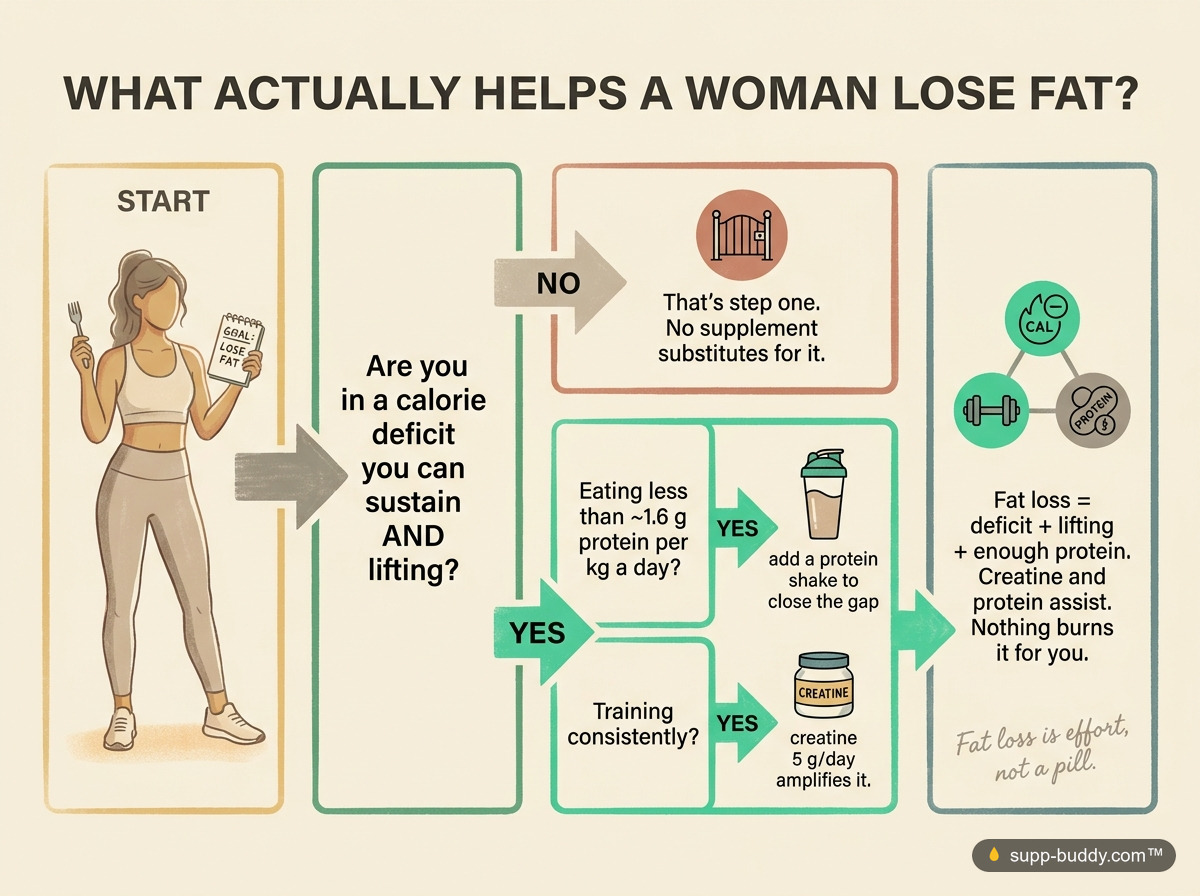
Two supplements move body composition, how much of you is fat versus muscle, for women: creatine and protein. Both work by making your training count, not by burning fat. Neither does anything without the resistance work behind it. When researchers pooled the studies of women, the supplements didn't add muscle on top of training. The training did that. But the exercise itself reliably helped.7 That's the catch, and it's the whole game.
Creatine: body recomposition, not a fat burner
Creatine is a compound your muscles use for short, hard bursts of effort, like a heavy lift or a sprint. Top it up with 5 grams a day and you can push a little harder in each session. Over weeks, harder training builds and holds more muscle, and that shifts the fat-to-muscle balance. The fat loss is a downstream effect of better training. It is not the creatine reaching into your fat stores.
A kinesiologist (a movement and exercise specialist) who coaches women, Michelle Roots, puts it plainly. Creatine helps fat loss, yes, but only if you're strength training and pushing to build muscle. The studies in active women are still thin. A review of them found mixed results, mostly because the trials didn't track differences between women across the month.2 Strength and power gains are there too, though they can run smaller in women than in men.6
Here's what that looks like in the research. In women who lift, creatine lowered fat mass over about 10 weeks, with strength and power rising at the same time.1 The effect is modest, and it rides entirely on the training underneath it.
Community claim: "Creatine makes women puffy and bloated with water weight."
What the evidence says: It runs the other way. In one study, creatine lowered post-exercise swelling in women while having no effect in men.3 That study is small, so treat it as a strong lead, not a closed case. Either way, it points the opposite direction from the bloating myth.
So if water-weight worry is what's kept you off creatine, the evidence we have points the other way. For the full guide to dosing and timing, see our deep dive on creatine for active women.
Protein: satiety and lean mass, not fat oxidation
Protein is the closest thing to a weight-loss supplement on this list, and it's a food, not a fat burner. Eating more of it leads to a little more weight lost, in the range of about 1.6 kilos across the studies.12 The reason is simple: protein keeps you full and protects muscle while you're eating less. Lean mass there just means the muscle you'd rather not lose on a diet.
The catch is the same as creatine's. In women studied across reproductive stages, protein only paid off for muscle when it was paired with lifting. Without the training, the extra protein did nothing.57 Studies of active women put the daily target at roughly 1.3 to 1.5 grams of protein per kilo of bodyweight.4 Once you're already hitting that target, extra protein adds cost, not results.
One thing you can stop worrying about: timing. The "anabolic window" that says you must drink a shake within minutes of training doesn't hold up. Whether women took protein before or after a workout, the gains came out the same in study after study.131415 Hit your total for the day and the clock doesn't matter.

Not sure whether creatine or protein earns a place in your routine? Tell Your Supp' Buddy what you already take and what you're working toward. It'll flag any interactions and sort out the timing. Then it gives you an honest read on whether either is worth adding, or whether you can skip the shelf.
Why fat loss works differently for women
Cut food too hard and a woman's body can dig in, which is why "just eat less" advice often stalls instead of working. Exercise physiologists who study female athletes call this the piece sex-blind supplement advice keeps missing. They argue it matters more than any product on the shelf.
Dr. Stacy Sims, an exercise physiologist, frames it around energy availability, the fuel your body has left after exercise. When a woman cuts food too far, a control center in the brain called the hypothalamus reads it as a shortage. It starts conserving energy instead of letting go of fat.
"Women have a higher percent body fat and it comes down to food intake in the hypothalamus. If we start taking out food and not replacing those calories with something else, then we end up in a lower energy state."
Dr. Stacy Sims, exercise physiologist
This is why so many women feel stuck despite eating less and less. The harder you cut, the more your body digs in, holding onto fat and dropping your energy, mood, and training quality. The fix runs against the marketing. Often it means eating a bit more, not less, so you have the fuel to train hard enough to reshape your body. A thermogenic pushes you the wrong way, nudging you to eat even less while promising the fat will fall off anyway.
Your cycle adds another layer the men's playbook ignores, shifting hunger and water weight week to week. Put it together and the formula that fits a woman's body isn't a thermogenic. It's enough food to train on, the resistance work that reshapes you, and enough protein to hold your muscle. The monthly cycle is one hormonal shift; the bigger one is the move into perimenopause, where these levers change again. Our guide to supplements for perimenopause picks up there.
Getting your protein from food first
You can hit the protein target that matters from food. Most women are only about 40 grams short of it a day, which is roughly one extra chicken breast or a single shake.
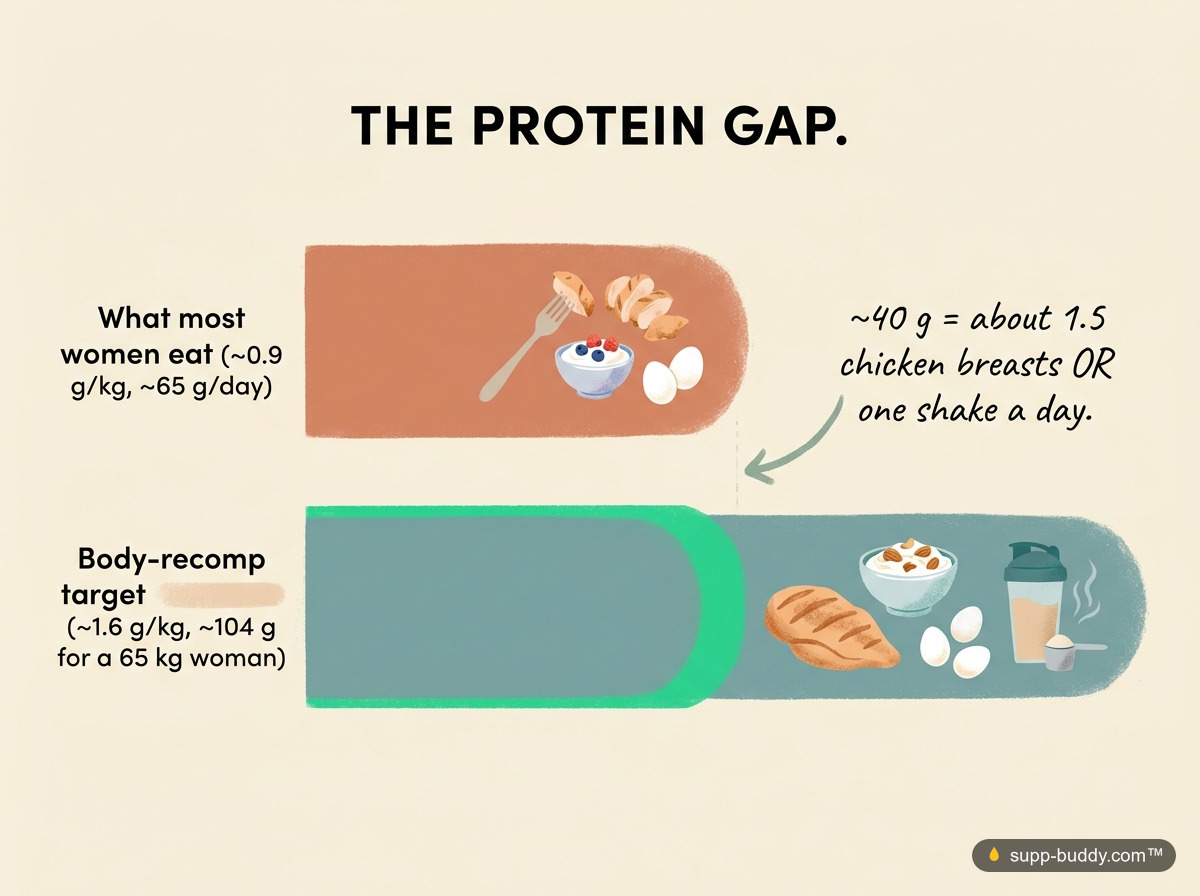
Most women eat around 0.9 grams of protein per kilo of bodyweight a day. The target for holding muscle while you lose fat sits closer to 1.6 grams per kilo. For a 65 kg woman, that's about 104 grams a day. That gap is food you can see on a plate, and it's smaller than it sounds. Here's where the highest-quality protein comes from.
| Food | Serving | Protein |
|---|---|---|
| Chicken breast (cooked) | 3.5 oz / 100 g | 31 g |
| Tuna, canned in water | 3.5 oz / 100 g | 26 g |
| Lean ground beef (95%, cooked) | 3.5 oz / 100 g | 26 g |
| Greek yogurt, plain non-fat | 3/4 cup / 170 g | 17 g |
| Cottage cheese, low-fat | 1/2 cup / 113 g | 14 g |
| Edamame, shelled | 1 cup / 155 g | 17 g |
| Eggs | 1 large / 50 g | 6 g |
How much, how often: a 65 kg woman aiming for about 104 grams can get there over a normal day. Think a chicken breast at lunch (5 oz / 140 g) for about 43 grams of protein. Add a cup of Greek yogurt (1 cup / 225 g) for roughly 23, and three eggs (3 large / 150 g) for another 18. Round it out with a palm of lean beef or a cup of lentils (1 cup / 200 g) at dinner. That's eating, not a meal plan. Plant-based eaters can lean on edamame and lentils, pairing them with grains so the amino acids round out.
A whey shake isn't magic, and it isn't food. A 25 to 30 gram scoop is a convenience tool for the days you fall short, closing that 40 gram gap without a fifth meal. Use it to fill the gap food leaves, not to replace the food.
Protein is easy to get from the kitchen. Creatine is the exception, because food can't sensibly get you there. Red meat carries only about 0.7 grams of creatine per 100 grams raw. Matching the studied dose would mean eating close to 700 grams of red meat every day. Here the supplement is the realistic intake route, and women who eat little or no meat start with lower stores and may notice it more.
The bottom line
Our read on the evidence: the fat-burner aisle is the one shelf to walk past. The thing that moves fat for a woman isn't sold in a tub. It's a calorie deficit you can live with, the resistance training that protects your muscle, and enough protein to back it up. Creatine and protein can ride along and make that training count, but nothing on the shelf does the work for you. The freeing part: the levers that matter were never the ones with the best packaging. They were never the ones charging you the most, either.