
GlyNAC Benefits: Who the Evidence Does and Doesn't Back
You've probably seen the headline that GlyNAC turns 80-year-olds into 20-year-olds. Or maybe you're hearing the name for the first time. GlyNAC's benefits are well-documented and unusually wide-ranging, but they show up almost entirely in adults over 60 and people managing a chronic condition. The one dose with real evidence behind it is large, about 15 grams a day. So the useful question isn't whether GlyNAC works, it's whether it works for someone like you.
GlyNAC and aging: who the trials were run on
Two camps shout past each other online, and both are half right. One side points to a trial where older adults got stronger, walked faster, and saw their blood markers improve. The other side, led by the YouTube channel Physionic, calls GlyNAC "a waste of money for a lot of people." That breakdown alone has over 122,000 views. They're describing the same evidence from opposite ends.
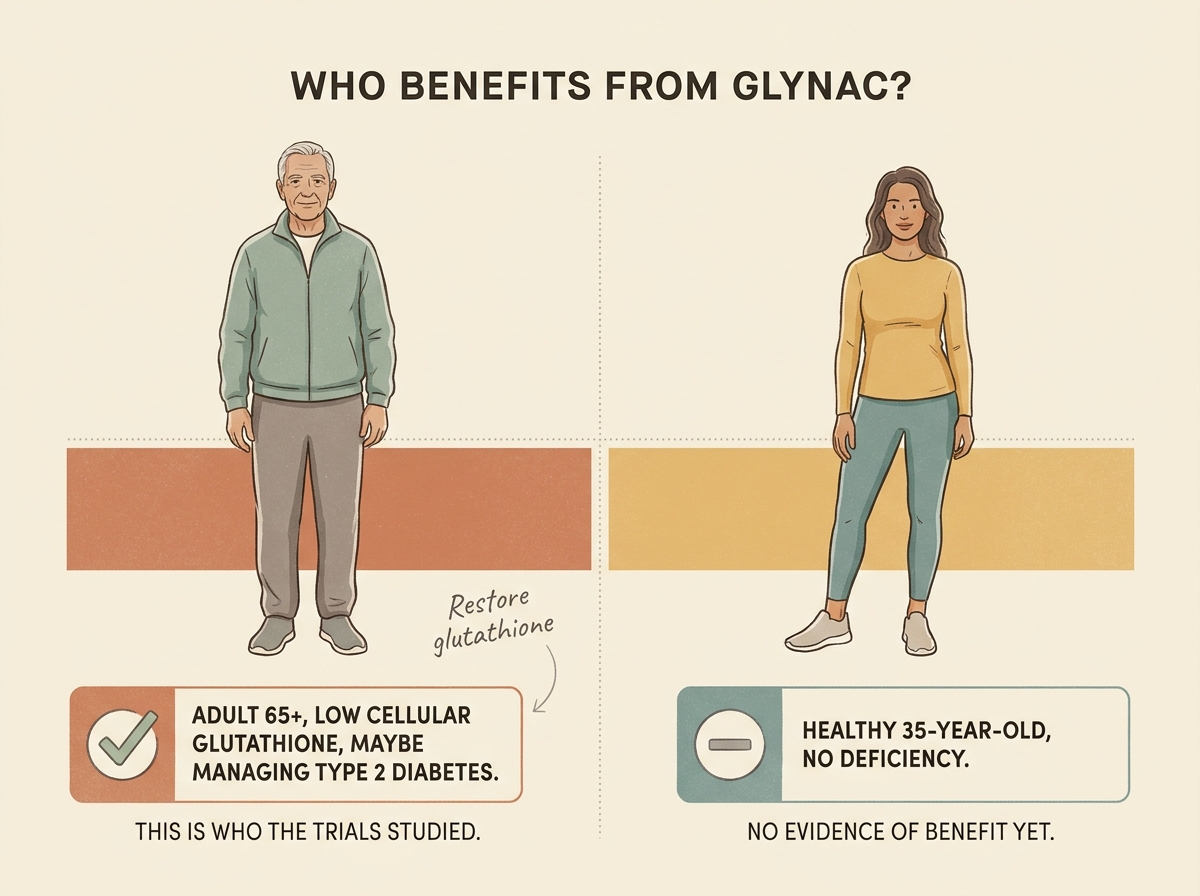
Here's what reconciles them. GlyNAC's strongest results come from a tightly controlled trial in adults around 70 years old.1 The benefits were broad and measurable. But "broad and measurable in 70-year-olds" is not the same as "useful for a healthy 35-year-old," and no study has shown the second thing. When an independent team (Nestlé-funded) tested GlyNAC in 114 healthy older adults for two weeks, the main glutathione measure didn't beat placebo.3
So the gate is simple. If you're over 60, or you're managing something like type 2 diabetes, the evidence is talking about you. If you're younger and healthy, it isn't, at least not yet. That's the same honest test we'd put to any longevity supplement, the way we weighed which omega-3 matters in EPA versus DHA. A "no, not for you" is a useful answer too. It saves you a daily powder and a chunk of money.
What GlyNAC does inside your cells
GlyNAC is two ingredients with one job: refilling the raw materials your body uses to make glutathione. Glutathione is your cells' master antioxidant, the molecule that mops up day-to-day damage. Those two raw materials are glycine and cysteine. The "NAC" part is N-acetylcysteine, a supplement form of cysteine that your body absorbs well.
This answers the question a lot of people ask: why add glycine if you already eat plenty of it? Those two raw materials are also called precursors (the building blocks your body converts into glutathione). As we age, both run short inside cells at once, and glutathione production drops with them. The clearest proof that refilling them works comes from older adults who had run short on both. Topping up the two precursors restored their glutathione by about 95% in two weeks.5 Supplying only one leaves the other as the bottleneck. You need both to refill the tank.
Here's why that matters for the rest of you. Glutathione protects your mitochondria (the tiny power plants inside every cell) from oxidative stress. That's the slow, rust-like damage that builds up over years. When glutathione is low, mitochondria run poorly and that damage climbs. Restore it, and the research shows those measures move back in the right direction.6 That single mechanism is why one supplement keeps showing up across so many different outcomes. Glycine also has a story of its own beyond the GlyNAC combo, which we unpack in our guide to glycine's benefits.
What the research shows, and who it was tested on
The strongest evidence is a single randomized trial in older adults. Everything else is smaller, shorter, or in mice. That one line is the whole evidence picture. Keep it in mind as the benefits stack up. The size of a claim and the size of its study don't always match.
Aging and physical function: the anchor
The central trial put 24 older adults on either GlyNAC or a dummy capsule.1 Neither the patients nor the researchers knew who got which, a double-blind design and the most trustworthy kind. After 16 weeks, the GlyNAC group improved grip strength, walking speed, and six-minute walk distance. They also lost fat, gained lean mass, and lowered oxidative-stress and inflammation markers. Several measures moved toward the range of much younger adults. An independent review of mitochondria-targeting nutrition lists GlyNAC among the few agents that improve physical function in older people.11 This is the part of GlyNAC's story that earns its grade.
Metabolic health: a big effect, a tiny study
Insulin resistance is when your cells stop responding well to insulin, the hormone that manages blood sugar. In ten people with type 2 diabetes, two weeks of GlyNAC cut it by roughly 22%.4 The same study found their cells burned fat for fuel about 30% better. Those are large numbers, but they come from one study with no placebo group and only ten patients. Here's why the biology still makes it worth watching. When glutathione runs low, the cell's power plants get worse at burning fat, and blood sugar control slips with it. Restore glutathione and both should recover. So treat this as a promising lead with a real mechanism behind it, not a settled result.
Cognition: encouraging in mice, thin in people
Thinking and memory improved in the main older-adult trial, but only as a secondary measure the study wasn't built to test.1 The detailed brain evidence, meanwhile, is in old mice, where GlyNAC reversed age-related cognitive decline.9 Animal results are encouraging. Human cognition data is still thin, so this is a "maybe," not a reason to buy. And that thinness has a single cause, one that shapes how much of GlyNAC's evidence you can lean on.
Put the outcomes side by side and the pattern is clear: strong where it's been studied properly, thin or absent everywhere else.
| Outcome | Grade | Who it was tested on | Honest read |
|---|---|---|---|
| Aging hallmarks + physical function | B | Adults 60+ | Central trial; large multi-system effects, small sample, one lab |
| Metabolic / insulin resistance | C | Type 2 diabetes patients | One uncontrolled 14-day pilot; big effect, early-stage |
| Recovery / muscle strength | B | Adults 60+ | Same trial population; independent-review corroboration |
| Cognition | C | Older adults (side measure) + mice | Human data thin; the detailed evidence is mouse-only |
| Healthy young adults | — | — | No evidence of benefit |
The replication question: why the grade stops at promising
Here's the part that keeps GlyNAC honest. Nearly every positive human trial comes from one research group, the Baylor lab run by Rajagopal Sekhar.14 The one human trial from an independent team came up null on its main endpoint.3 The outside corroboration is mostly other scientists reviewing that same Baylor data.10 The one independent result is separate: glycine on its own extends lifespan in mice across three labs.7 That's why the honest read is "promising and unusually multi-system," not "proven." One lab, however good, is not the same as the field agreeing.
What people say online: GlyNAC "rejuvenates 80-year-olds to levels resembling 20-year-olds."
What the evidence shows: The central trial measured improved blood markers and physical-function scores in older adults.1 That's improvement across many systems at once, which is rare and worth respecting. It is not a clock turned back to a 20-year-old's body.
Is GlyNAC better than just taking NAC?
The mechanism says there's a reason to add glycine. The human evidence says nobody has tested it head-to-head. That gap is the honest answer to the GlyNAC vs NAC question, and it's worth sitting with before you pay extra for the combo.
The case for glycine is that it's a second bottleneck in glutathione production, not a bystander. The strongest data point comes from aged mice: NAC plus glycine improved heart function and the mitochondrial machinery behind it, while NAC alone did not.8 That study is from the Sekhar lab again, in a different organ and question, so it isn't independent confirmation. Still, it's a clean signal that glycine pulls its weight. But it's a mouse heart study, and no human trial has ever compared GlyNAC against plain NAC for the outcomes you'd take it for.
The short version: if you already take NAC, the glycine add-on is cheap and biologically sound. Whether you'll notice a difference is untested in people.
So this is a "does it earn its place?" call worth making deliberately rather than by default. It's the same lens we apply to building a simpler stack.

Already taking NAC and wondering if the glycine upgrade is worth it? Tell Your Supp' Buddy your age, your goal, and what's already in your routine. It'll flag whether GlyNAC earns a place for you and where it lands on your longevity pillar. It also catches interactions with the rest of what you take.
Can you get glycine and NAC from food?
You can't reach the studied GlyNAC dose from food. This is a supplement-only protocol by design, and it's worth understanding why before you try to eat your way there.
Glycine does have a food path. It's concentrated in collagen-rich foods, and your body makes a few grams a day on its own. So for baseline glycine, food and your own biology cover most people.
| Food | Serving | Glycine (approx) |
|---|---|---|
| Gelatin / collagen powder | 1 tbsp / 10 g | ~2 g |
| Pork skin (crackling) | 1 oz / 28 g | ~3 g |
| Bone broth | 1 cup / 240 ml | ~1 g |
| Chicken thigh, skin-on | 1 thigh / ~100 g | ~1.5 g |
| NAC (N-acetylcysteine): no dietary source — it can't be eaten, only supplemented. Covered in the text below. |
How much, how often: the studied protocol uses roughly 9 grams of glycine a day. To get that from food alone you'd be eating something like four to five tablespoons of gelatin every day, on top of normal meals, indefinitely. Doable in theory, miserable in practice.
NAC is the harder half. There's no food source of NAC at all. Cysteine, the amino acid it's built from, shows up in eggs, chicken, and oats. But the protocol's roughly 6 grams a day of NAC isn't something protein foods deliver. And here's the key point: the shortfall GlyNAC corrects isn't a diet problem. It's an age-related drop in your cells' own ability to make these precursors, which no amount of bone broth fixes. Food first where food works. Here, at the studied dose, it can't reach, and that's the honest case for the supplement.
Glycine figures are approximate, from standard food-composition data.
How much GlyNAC to take, and for how long
The only dose with trial evidence behind it is large, and the convenient doses people take haven't been properly tested. That's the uncomfortable truth at the center of every GlyNAC dosage thread.
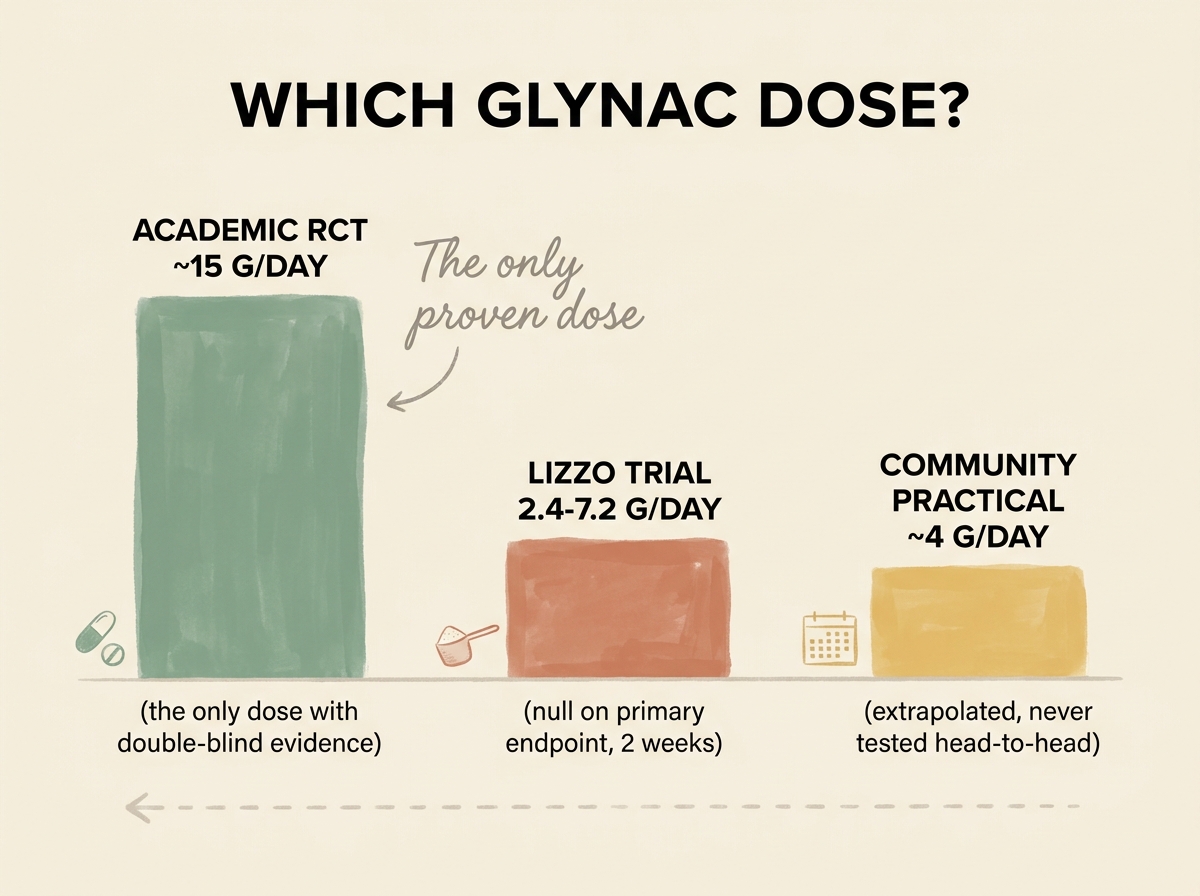
The academic protocol works out to about 15 grams a day for a 70 kg adult.1 You split it morning and evening, and run it for 16 weeks. That's a meaningful scoop of powder twice daily, which is exactly why people look for something smaller. The popular community estimate is around 4 grams a day. It's reasoned from the mechanism, but it has never been tested head-to-head against the full protocol, so nobody can promise it does the same thing.
What we do know cuts against going too low. When the independent team tested doses up to about 7 grams a day for two weeks, the main marker didn't beat placebo.3 That trial was shorter and lower than the academic one, so it doesn't rule small doses out, but it doesn't reassure you either.
| Protocol | Daily total (70 kg adult) | Timing | Duration | Evidence |
|---|---|---|---|---|
| Academic trial | ~15 g (≈9 g glycine + ≈6 g NAC) | Split AM/PM | 16 weeks | The only rigorously tested dose |
| Independent trial | up to ~7 g | Split AM/PM | 2 weeks | Null on its main marker |
| Community estimate | ~4 g | Split AM/PM | Ongoing | Reasoned, never tested head-to-head |
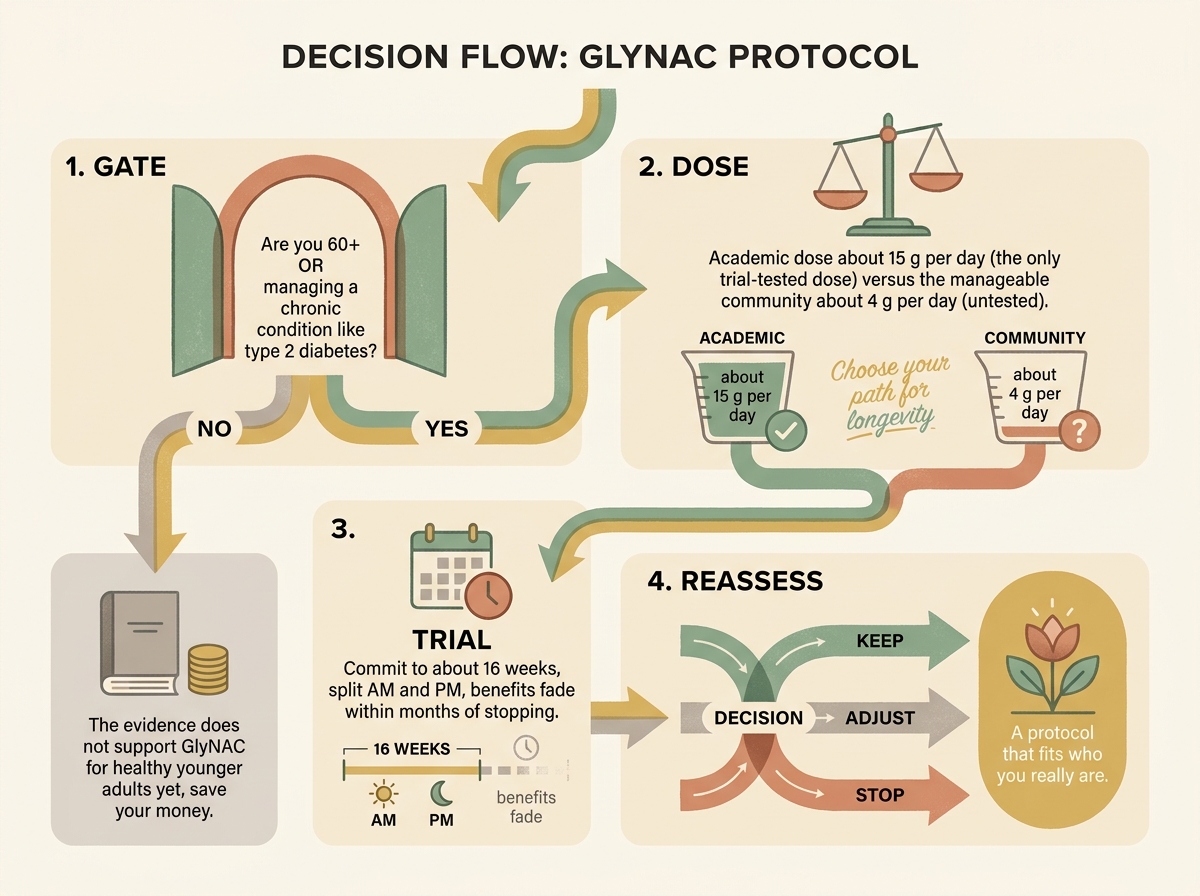
One more thing the dose decision depends on: GlyNAC behaves like an ongoing habit, not a one-time fix. In the human pilot, the gains faded within about 12 weeks of stopping.2 So if you start, plan for a proper run. Give it the full course before you judge it. The benefits stay only as long as you do.
Who should be careful: cancer, sex differences, and drug interactions
GlyNAC looked well-tolerated in the trials, with mild stomach upset (nausea, loose stools) as the most common side effect, mostly at higher doses.3 But three groups have reasons to pause before starting:
- People with active or suspected lung cancer, plus current or former heavy smokers. This is the one caution that needs a real explanation, not a footnote.
- Women. The strongest mechanism data is male-only, so we can't promise the same benefit.
- Anyone on warfarin or nitroglycerin, or with reduced kidney function. Clear it with whoever manages your prescriptions first.
The cancer question, with its actual scope
This is the concern that fills community threads, and it's worth treating honestly. Some mice were bred with specific cancer-driving gene mutations, called B-RAF and K-RAS. In them, antioxidants including NAC sped up existing lung tumors and shortened survival.13 The logic is that by quieting the damage signals tumors normally trip, antioxidants can let an existing cancer grow unchecked.
Now the scope. That was a mouse model with pre-existing, engineered tumors tied to heavy smoking, not a study of healthy people taking a supplement. There's no human evidence that NAC at normal doses causes cancer in healthy adults. The sensible line: if you have active or suspected lung cancer, skip high-dose NAC until your oncologist clears it. The same goes for current or former heavy smokers. For everyone else, this is a disclosure to know about, not a blanket red light.
A straight answer for women
The honest position: the strongest mechanism data is male-specific, and we can't yet promise women the same benefit. In a study of aged mice, GlyNAC improved heart function in males but not females, and the female mice performed worse on exercise.12 The human trials weren't built to detect a difference between men and women, so whether this carries over to people is unknown. We'd rather tell you that plainly than let a woman assume the headline results apply to her without question. If you're a woman considering GlyNAC, factor this uncertainty in, and weigh it with a clinician.
Drug interactions and other cautions
A few practical flags. High-dose NAC may add to the blood-thinning effect of warfarin, and it can interact with nitroglycerin, so anyone on those should check first. If your kidneys aren't working well, both ingredients clear through them, so dose with medical guidance. There's no safety data in pregnancy, breastfeeding, or children, so the sensible default there is to avoid GlyNAC entirely. When in doubt, bring the exact protocol to whoever manages your prescriptions.
The bottom line
Our read on the evidence: GlyNAC is one of the few longevity supplements with broad, multi-system human trial data behind it. That's exactly why the answer is so personal. The trials that make it impressive also draw a hard line around who they studied. That's older adults and people with chronic conditions, from one lab. For that reader, GlyNAC is a considered yes with a commitment attached. If you're in the group it was tested on, the move is the studied dose for the full course the trial ran. Then take an honest look at whether anything changed. For a healthy younger adult, the most useful thing the science says is "not yet." There's no shame in pocketing the money until the evidence catches up.