
Ashwagandha and L-Theanine Together: The Stress Stack That Works
You've been told to try ashwagandha. And L-theanine. Maybe you bought both and now you're not sure whether to take them together, separately, or whether you wasted money on a duplicate.
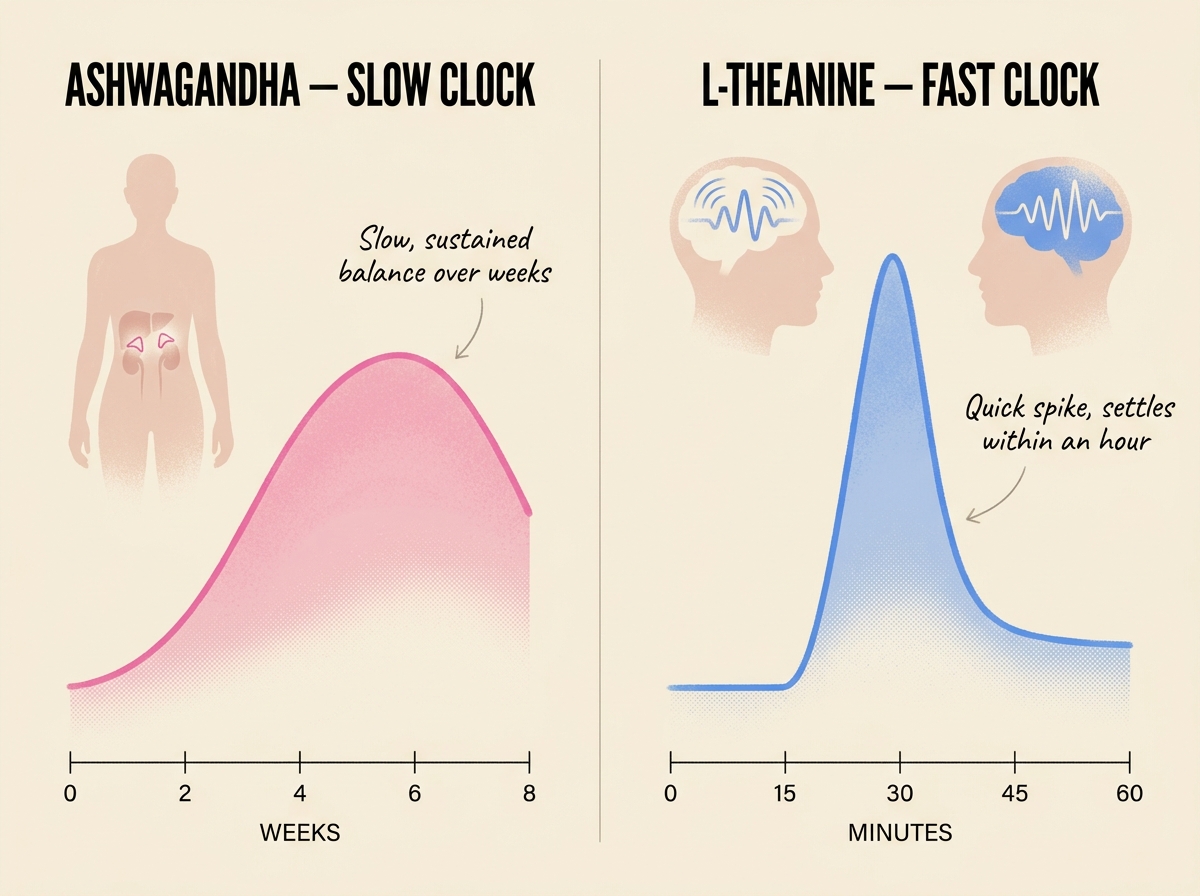
Short version: they don't do the same job. Ashwagandha works on the stress system in your body, over weeks. L-theanine works on the mental hum in your head, in about half an hour. Stacking them covers two shifts.
Why this combination, specifically?
The supplement aisle has 30 things labelled "stress relief" that mostly repeat. Ashwagandha and L-theanine target two non-overlapping pieces of the same problem.
Stress has two shapes. The background hum: shoulders up, jaw clenched, alarm system simmering all day. And the spike: the 4 pm meeting that makes your heart race, or the email that lands wrong. The moment the day flips from manageable to overwhelming.
Ashwagandha addresses the hum, L-theanine the spike. The community shorthand for this is anxiety in your head versus anxiety in your body, and the longest-running explainer in this space puts it cleanly:
"If your anxiety is in your head, use L-theanine for instant calm focus. If your anxiety is in your body, use ashwagandha to fix your underlying stress."
BioLogic, supplement-science explainer channel (YouTube, 2026)
That maps onto how the two molecules behave. Ashwagandha works on the system that controls your cortisol output. After 4 to 8 weeks of daily use, your stress response settles back toward normal.18 L-theanine crosses the blood-brain barrier in about 30 minutes and ramps up alpha brain waves. The clinical effect is taking the edge off without sedating you.56 When the dose wears off, the effect's gone.
One slow worker for the underlying problem, one fast worker for moments that flare up. (For burnout-leaning stress, rhodiola sometimes joins later.) Caveat up front: no randomized trial has yet tested the ashwagandha + L-theanine combination directly; the rationale for stacking rests on their complementary, non-overlapping mechanisms rather than combination-specific trial data. The community figured out the deliberate stack before research caught up.
How the two stress clocks work
Ashwagandha: the slow clock
Withanolides are the active compounds. They tune the HPA axis, which decides when your body releases cortisol, how much, and for how long. Chronic stress pushes it out of normal range, the biological source of "exhausted but can't unwind at night."
Ashwagandha doesn't sedate. It tunes the HPA axis back toward normal,12 with cortisol reductions showing up across reviews.18 The cortisol number can drop before you feel different. The biomarker and the feeling don't always move together.
A widely-shared community 2-month before/after blood panel shows cortisol and TSH shifting by week 8. That lines up with the trial expectation rather than confirming it. Plan for that timeline before you decide whether it's working.
L-theanine: the fast clock
L-theanine is an amino acid from green tea. It crosses into your brain, ramps up alpha brain waves (the relaxed-but-awake state), and modulates GABA and glutamate. Those are the brain's "calm down" and "fire up" signals. Net effect: your nervous system stops gunning the engine at every minor input. Onset is 30 to 45 minutes from 200 mg, half-life roughly an hour. A tool for moments, not a steady-state intervention.
The community calls it "the take-the-edge-off pill." A widely-shared thread describes it as "reducing arousal without sedating," which is exactly the pharmacology. The biggest L-theanine review pulled 11 trials and confirmed anxiety reduction, including in clinical populations.5 Pair it with caffeine at the 1:2 ratio (100 mg caffeine + 200 mg theanine) for more focus, fewer jitters than caffeine alone.69

Wondering which clock your stress is running on (the hum, the spike, or both) before you commit to one? Walk it through with Your Supp' Buddy. Tell it what your stress feels like and what's already on your shelf, and it'll talk through where to start.
What the evidence shows
Each supplement has an RCT track record. The combination doesn't.
Ashwagandha for stress and mood
Ashwagandha has the strongest evidence in the stack by a wide margin (see the card below for the headline numbers). Two independent 2024 reviews reached the same conclusion.78 A 2026 RCT in athletes during pre-season training showed reduced cortisol and stabilised sympathetic activity (the fight-or-flight side of your nervous system).2
The slow/fast split applies to sleep too. Ashwagandha shifts baseline sleep quality over weeks via the same HPA-axis work that quiets daytime stress. L-theanine handles the bedtime version of racing thoughts in the moment. The same ashwagandha reviews report sleep-quality and onset improvements, likely strongest when insomnia is stress-driven rather than circadian or apnoea-related.71
L-theanine for stress and mood
L-theanine has solid B+ evidence. Not as deep as ashwagandha's, but reproduced across reviews. Ghaffari 2024 (11 trials) found benefit on anxiety and other mental health outcomes.5 Wang 2025, meta-analysing tea-derived compounds, showed mood and cognition improvements, strongest paired with caffeine.69
What it doesn't show: a strong solo effect on baseline stress that builds over weeks. L-theanine works dose-by-dose. Stop, and the effect stops. Take it as needed, not daily.
The combination itself
Honest part: no head-to-head RCT has tested ashwagandha and L-theanine together against either alone or against placebo. That trial hasn't been done.
What we have: each compound's solo evidence (strong for ashwagandha, solid for L-theanine) plus the mechanistic logic that they target different timescales. The community has been stacking them for years.
The protocol
What to buy, what dose, when, and how long to give it before you judge:
| Supplement | Form | Dose | When | Trial period |
|---|---|---|---|---|
| Ashwagandha | KSM-66 (most studied) | 300-600 mg/day | Morning OR evening, with food, daily | 4-12 weeks |
| Ashwagandha | Shoden (high-potency) | 120-240 mg/day | Once daily with food | 8-12 weeks |
| Ashwagandha | Sensoril (root + leaf) | 125-250 mg/day | Split AM/PM | 8 weeks |
| Ashwagandha | AshwaSR (sustained release) | 150-300 mg/day | Once daily | 60 days |
| L-Theanine | Suntheanine or generic | 200 mg per dose, max 400 mg/day | 30-45 min before stressor | Acute / as needed |
| L-Theanine + caffeine | Standard pairing | 100 mg caffeine + 200 mg theanine | With morning coffee or pre-work | Acute |
| Rhodiola (optional) | SHR-5 (3% rosavins / 1% salidroside) | 200-600 mg/day | Morning only (stimulating) | 4-8 weeks |
Which form of ashwagandha to buy
Standing in front of a wall of ashwagandha bottles? Short version:
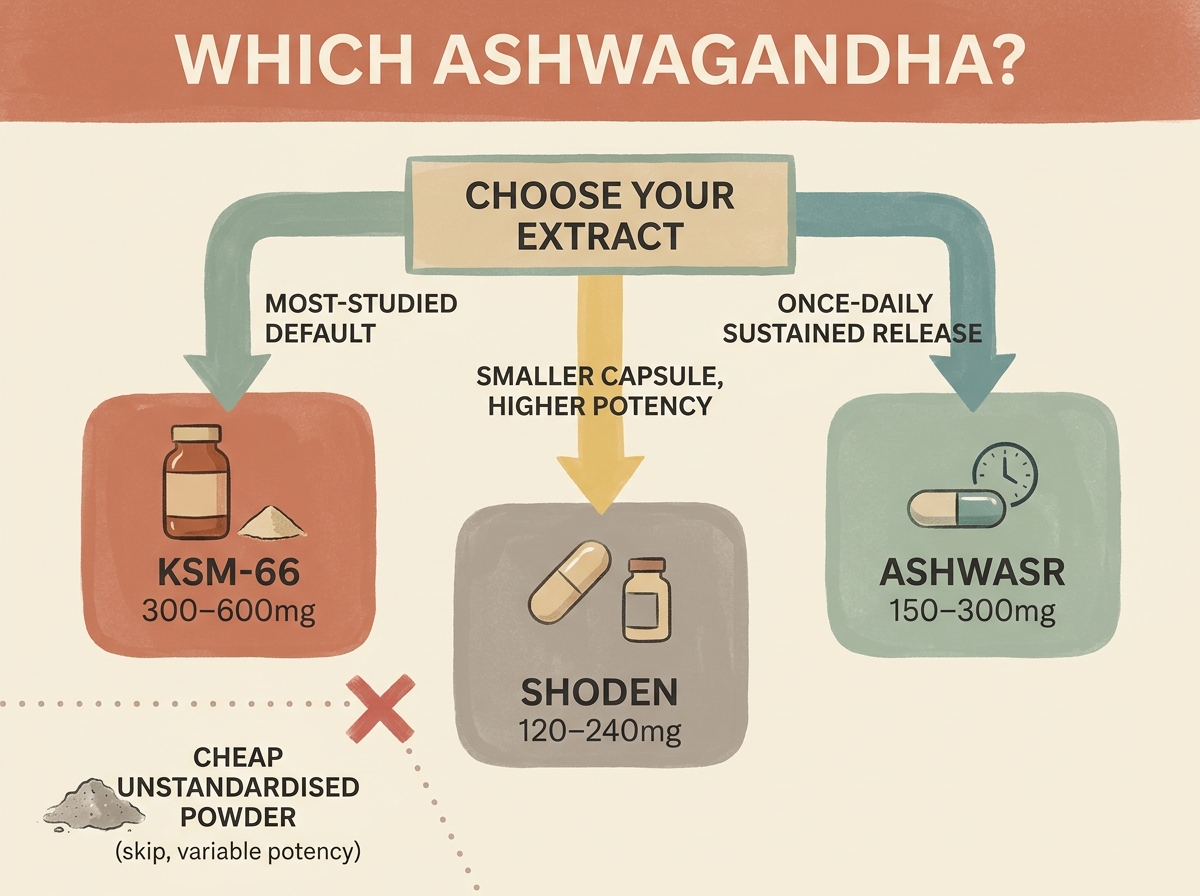
KSM-66 is the workhorse. Most-studied extract, used in trials at 300 to 600 mg per day. The trial-grade default.17
Shoden is the high-potency option, standardised to 35% withanolide glycosides. 120 to 240 mg matches KSM-66 at 300 to 600 mg. Smaller capsule.
Sensoril uses root plus leaf for higher withanolide concentration. 125 to 250 mg per day, often split AM and PM.
AshwaSR is sustained-release. Less long-term data than KSM-66, but the 2026 trial signal at 150 to 300 mg over 60 days is strong.3
Skip unstandardised root powder. Withanolide content varies up to 10x between batches.
Worried that a medication or condition you have lands you in one of the safety flags below? Tell Your Supp' Buddy what's on your shelf and what you take. It'll talk you through whether this stack is one to start, modify, or skip.
When to take what, and how to start
If money is tight or you only want one, start with L-theanine. Cheap, fast, and you'll know within a week. Take 200 mg, 30 to 45 minutes before whatever's stressing you. Coffee drinkers: try the 1:2 combo (100 mg caffeine + 200 mg theanine) in the morning.
Then add ashwagandha. 300 mg KSM-66 with breakfast or dinner, daily. Effects emerge somewhere in the 2-to-8-week window, with most trials measuring at 8 weeks.1 If you feel nothing by week 4, hold to 8 weeks before drawing a conclusion. The HPA axis takes that long to recalibrate.
After 8 to 12 weeks, you may want more cortisol-side support, or your stress may shift toward burnout (mental fatigue, brain fog rather than anxiety). Rhodiola is sometimes added as a third here. The mechanism review pairs rhodiola with ashwagandha as adaptogens with overlapping but non-identical targets.10 Rhodiola has a separate fatigue signal of its own.11 The "rhodiola for burnout" framing is mechanism-based, not RCT-tested. Morning only (it's stimulating). Note: theoretical additive effect on cortisol suppression when adding rhodiola has not been tested in combination RCTs. Start at 200 mg when stacking and stay in the 200-400 mg morning range. The dosage table's wider 200-600 mg figure is for solo rhodiola.
Last thing on what to buy. Pre-made combo capsules ("ashwagandha + L-theanine" all-in-ones) look efficient but usually use unstandardised ashwagandha and underdose the L-theanine below the 200 mg the trials test. Buy them separately for similar money and keep control of dose, timing, and form.
Cycling: is it necessary?
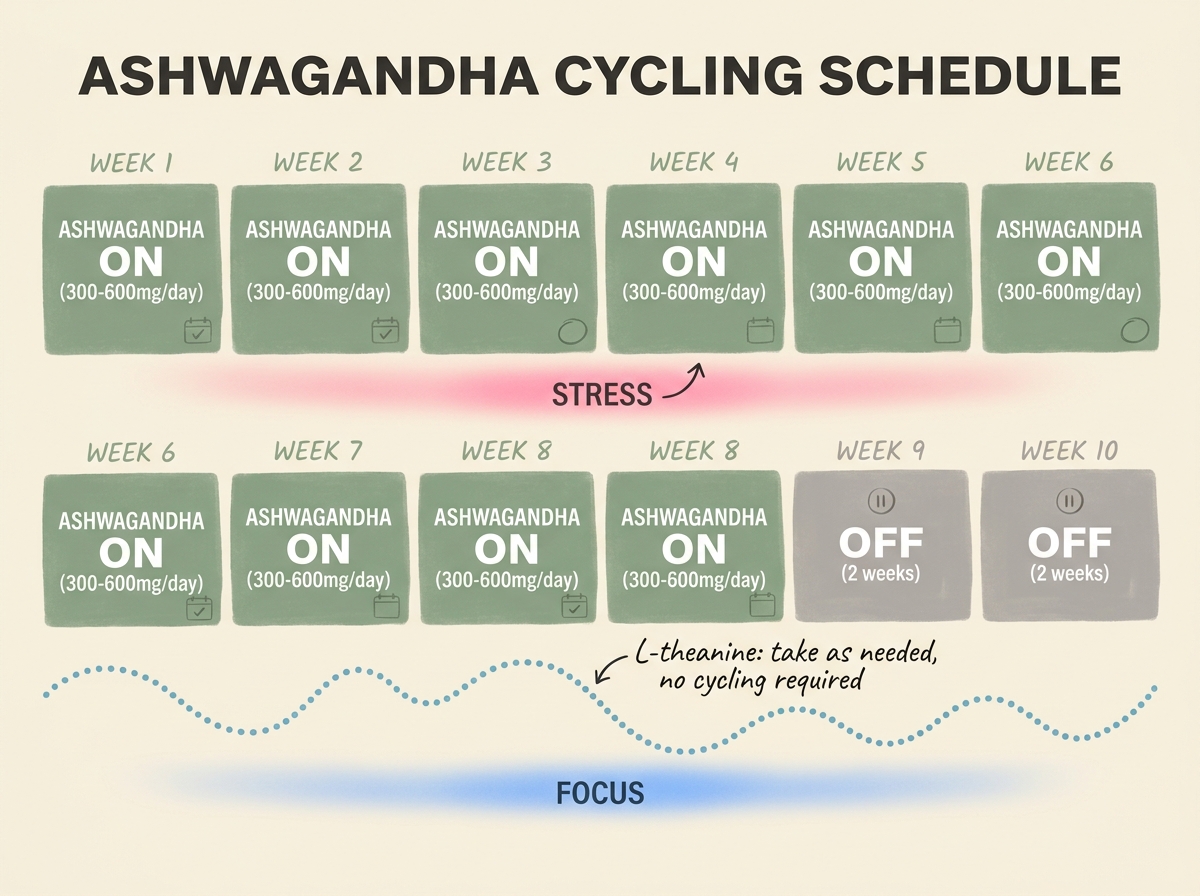
Cycling means 6 to 8 weeks on, 2 weeks off, then resuming. The community's near-universal default is to cycle. A widely-shared r/Supplements thread frames continuous use as "the worst" on receptor-desensitisation theory.
Honest version: many practitioners recommend cycling based on mechanism-of-action concerns about receptor desensitisation, though this has not been directly compared to continuous use in a head-to-head trial. The 2026 8-week safety trial showed no tolerability problems at standard doses,4 and several RCTs have run 12+ weeks without issue.17
Cycling is still a sensible habit even without a controlled comparison. It lets you feel your baseline without the supplement and cuts total exposure, which matters more for ashwagandha than L-theanine.
The community talks about what happens when you stop more than the cycling rationale itself. A widely shared thread describes a stop window: baseline anxiety returns, mood drops, and a few weeks of feeling "off" pass before the body resettles. No published trial of ashwagandha discontinuation syndrome exists, so this stays in observation territory. Practical move: taper over 1 to 2 weeks rather than cliff-edging.
L-theanine doesn't need cycling. It clears in hours. No buildup, no tolerance issue. Take it when you need it, every day or never.
Who shouldn't take this stack
Ashwagandha is often pitched as "natural, so safe for everyone." It isn't. The 2026 8-week safety trial showed it's well-tolerated in healthy adults.4 Several populations have documented reasons to skip it or talk to a clinician first.
Community claim: "Ashwagandha is natural, so it's safe for anyone to try."
What the evidence says: Not for everyone. Thyroid conditions, pregnancy, and active liver concerns are documented reasons to skip it; SSRIs and SNRIs are reasons to check with a prescriber first. The detail on each is below.
The specifics:
Thyroid conditions. If you have Hashimoto's, hyperthyroidism, Graves', or take levothyroxine, ashwagandha can shift your TSH and T4. Community 2-month bloodwork posts routinely show TSH movement. Without thyroid issues, this is a feature. With them, a problem. Get labs and talk to your prescriber, or skip it.
Pregnancy and breastfeeding. Skip ashwagandha (traditional emmenagogue use, no pregnancy safety data). L-theanine is also under-studied; skip both.
SSRIs and SNRIs. Ashwagandha has theoretical serotonergic additive potential and RCTs exclude these populations. Talk to your prescriber before stacking. Rhodiola is the riskier of the three for SSRI users; definitely clinician-check before adding it.
Perimenopause and menopause. Women in this window are over-represented in the "needle-mover" supplement threads on r/Supplements, and ashwagandha is one of the most-cited picks. Two practical notes. Thyroid effects matter more here because perimenopausal TSH already shifts on its own. Retest at 8 weeks is worth doing. Community reports often reach for rhodiola as a third-add when energy and mental fatigue dominate. No perimenopause-specific trial has tested rhodiola, so treat it as a community pattern, not a clinical recommendation.
Liver concerns. A small number of community case reports describe cholestatic liver injury after starting ashwagandha. One detailed thread describes bilirubin reaching roughly 50x the normal range with weeks of jaundice. Rare overall. If you have liver history or take other hepatotoxicity-flagged supplements, run bloodwork before and 2 months after starting.
Mood blunting. A subset of users report ashwagandha makes them feel emotionally flat: anxiety down, motivation and joy also dulled. Drop the dose or stop if you notice this in the first month.
L-theanine has a much cleaner profile. No documented significant drug interactions. Safe at 100 to 400 mg per day. The one caution: it can add to benzodiazepines' sedating effect, so start at 100 mg if you take any sedating medication. Between the two stack supplements themselves, no interaction is documented.
Where this stack lands across the 8 pillars
Tracking your overall health portfolio? Here's how this stack scores across the eight Supp' Buddy pillars before the verdict.
Stress dominates at 88: it's what the stack is built to do. Mood (72) tracks closely because ashwagandha hits anxiety and depression in the meta-analyses. Sleep (68) gets a secondary lift through HPA-axis work plus L-theanine on bedtime racing thoughts. Focus (60) is the L-theanine + caffeine pairing. Everything else sits low. This isn't a longevity or immunity stack. It's a stress stack that does one thing well.
The bottom line
This combination feels obvious in hindsight for the same reason most people get it wrong on the first try: stress isn't one problem. It's two. The chronic system in the background, and the acute moments that crack the day open. One supplement can't cover both because the timescales are different.
Ashwagandha tunes the slow clock over weeks. L-theanine handles moments in minutes. Same split applies at bedtime if sleep is part of what you're solving. Take both because they solve different problems, not because more is more. If the only thing you remember is which one to start with: L-theanine, this week, 200 mg before whatever's coming on Tuesday afternoon.