
The Runner Recovery Protocol: Joints, Inflammation, Sleep
You've probably bought the collagen powder and the fish oil capsules. Maybe some magnesium too. The uncomfortable part: there's a good chance at least one of those bottles isn't doing what you think.
Most runner recovery advice comes in listicle format. Twenty-seven supplements, ranked by someone who may or may not have read the studies. This is different. It's a four-supplement protocol with exact doses, specific forms, and a daily timing plan. Collagen peptides, omega-3, vitamin C, and magnesium glycinate. One system you can start tonight.
What runners are already doing (and the one thing most get wrong)
If you follow running communities or sports nutrition podcasts, you've seen some version of this stack before. Collagen, fish oil, magnesium, vitamin C. Andy Galpin, a professor of exercise science who consults with professional athletes, recommends a recovery stack that includes all four. The instinct is correct.
The community also figured out the collagen + vitamin C trick on its own. Runners routinely recommend taking collagen with vitamin C before exercise. That advice checks out. A study showed that vitamin C-enriched gelatin taken before activity doubled a key marker of collagen production.7
Runners also talk about magnesium for cramps, especially during hot-weather training. The cramp angle is common, but the form selection is all over the place. Most runners don't distinguish between magnesium oxide (cheap, poorly absorbed, likely to upset your stomach) and magnesium glycinate (better absorbed, gentler, with a sleep-specific benefit).
But here's the thing most runners miss: the omega-3 dose.
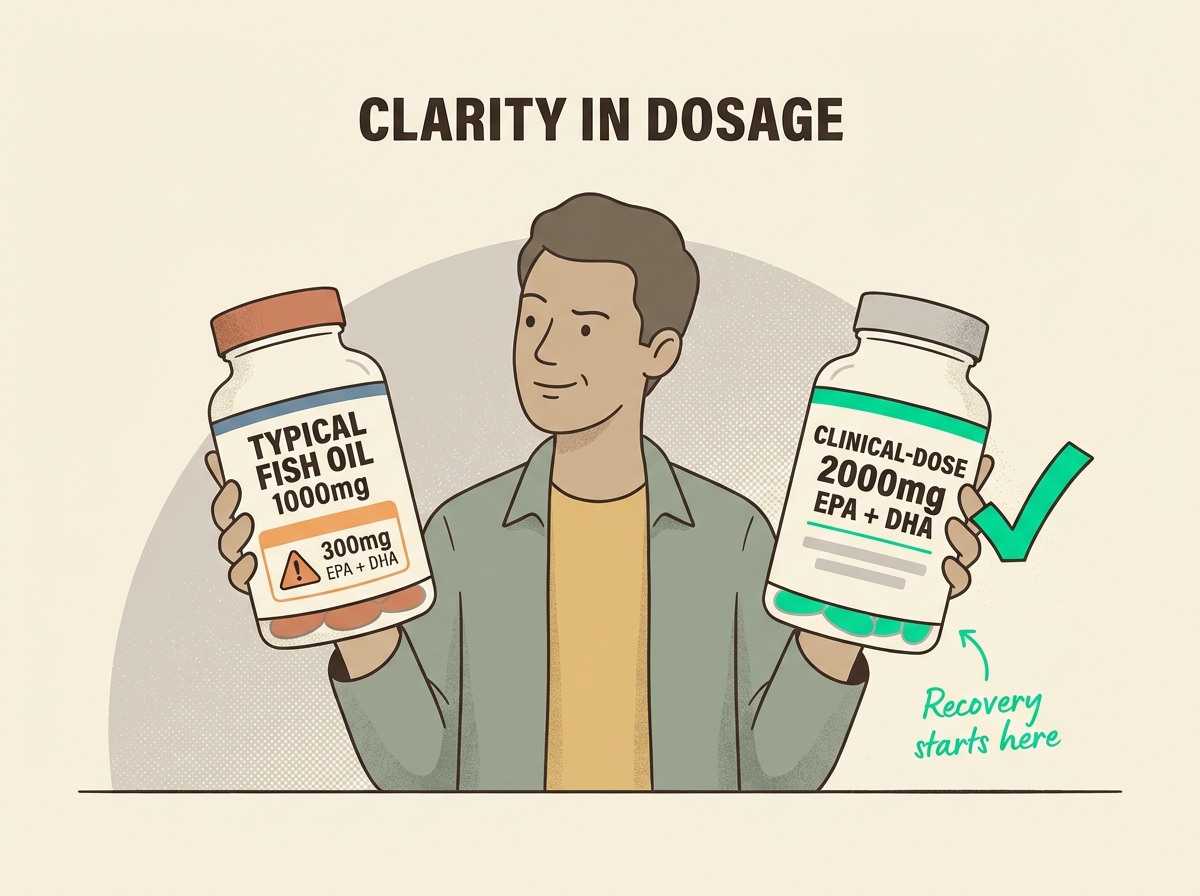
A typical fish oil capsule says "1,000 mg" on the front. Flip it over. Check the back label. You'll usually see around 300 mg of EPA + DHA combined. Those are the two omega-3s that do the work. The largest meta-analysis on omega-3 and exercise recovery, pooling 41 trials, found that doses at or above 2g of EPA + DHA per day produced a meaningful anti-inflammatory effect.1 That's roughly six or seven standard capsules. Most runners take one or two.
Community claim: "Eating collagen sends it straight to your injured knee or tendon."
What the evidence says: Your body breaks collagen into amino acids and small peptides. It can't route them to a specific joint. The benefit comes from flooding your system with glycine and proline, the building blocks connective tissue needs, not from targeted delivery.2

Not sure your fish oil dose matches the evidence? Show Your Supp' Buddy your supplement label. It'll check the EPA and DHA numbers and tell you where you stand.
Why these four (and how they work together)
This protocol targets three recovery problems runners face: joint wear from repetitive impact, low-grade inflammation from cumulative mileage, and poor sleep after evening sessions. Each supplement handles a different piece.
Collagen peptides: restocking the raw materials
Your tendons, ligaments, and cartilage are mostly collagen. Running puts heavy, repeated load on all of them. Hydrolyzed collagen peptides supply the specific amino acids your connective tissue burns through on every run: glycine (about a third of collagen by weight) and proline. Think of it as restocking raw materials, not sending a repair crew to one specific joint.
Hydrolyzed collagen peptides dissolve easily in liquid, which makes them the most practical form for daily use. Bone broth contains collagen too, but the amounts vary so widely you can't rely on it as a standardised dose.
One more thing: collagen is not a replacement for regular protein. It's a poor source of essential amino acids for muscle building. Its value is specific to connective tissue. People who supplement collagen for joints also commonly report improvements in skin, hair, and nails.
Omega-3: the inflammation brake
Running generates inflammation. In small doses, that's how you adapt. In large, sustained doses from high-mileage training blocks, it becomes the stiffness and soreness that won't clear between sessions. EPA and DHA, the active omega-3s in fish oil, produce compounds called resolvins that help resolve inflammation rather than just suppress it.
Beyond soreness, omega-3 also has moderate evidence for joint discomfort. A meta-analysis of over 2,000 patients with osteoarthritis found improvements in pain and function.12 The population in that review had established joint disease, so the transfer to healthy runners isn't one-to-one. But the anti-inflammatory mechanism is the same, and runners are loading their joints hard enough to make the comparison reasonable.
Vitamin C: the collagen multiplier
Vitamin C is the cofactor for the enzymes that stabilise collagen's triple-helix structure. Without it, collagen synthesis stalls. The research is specific: vitamin C taken WITH collagen before exercise is what makes collagen supplementation work for connective tissue. Taking them separately doesn't produce the same effect. The key study used about 50mg of vitamin C (equivalent to a small glass of orange juice), which sets the floor for this protocol.7
Magnesium glycinate: the sleep and recovery mineral
Endurance athletes deplete magnesium during exercise. A study of well-trained endurance athletes found both ionised and total plasma magnesium dropped after 90 minutes of cycling at moderate intensity.14 Whether that depletion directly worsens sleep in athletes hasn't been tested yet. But we do know from separate trials that magnesium supplementation shortened the time to fall asleep in people who were already sleeping poorly.6
If sleep is the goal, go with glycinate. It causes fewer GI side effects than oxide or citrate, which matters when training is already stressing your gut. For more depth, see the full three-supplement sleep stack.

What the evidence shows
Four supplements, four different levels of proof. Here's where each one stands.
The protocol: doses, forms, and timing
Four supplements, three timing windows. No conflicts between them.
Runner Recovery Stack
| Supplement | Form | Dose | When | Duration | Evidence | Safety |
|---|---|---|---|---|---|---|
| Collagen peptides | Hydrolysed powder (type I/III) | 10-20g | 60 min before exercise, with vitamin C | 3-9 months | B+ | Check source if shellfish allergy |
| Vitamin C | Ascorbic acid | 50-500mg | Mixed into collagen, before exercise | Ongoing | B- | Low end if haemochromatosis |
| Omega-3 (EPA+DHA) | Fish oil, TG form | 2-6g combined EPA+DHA | With meals (split AM/PM) | 6+ weeks | A | Doctor clearance above 3g if cardiac history |
| Magnesium glycinate | Chelated capsule or powder | 200-400mg elemental | 30-60 min before bed | 4-8 weeks | B- | Check with doctor if kidney disease |
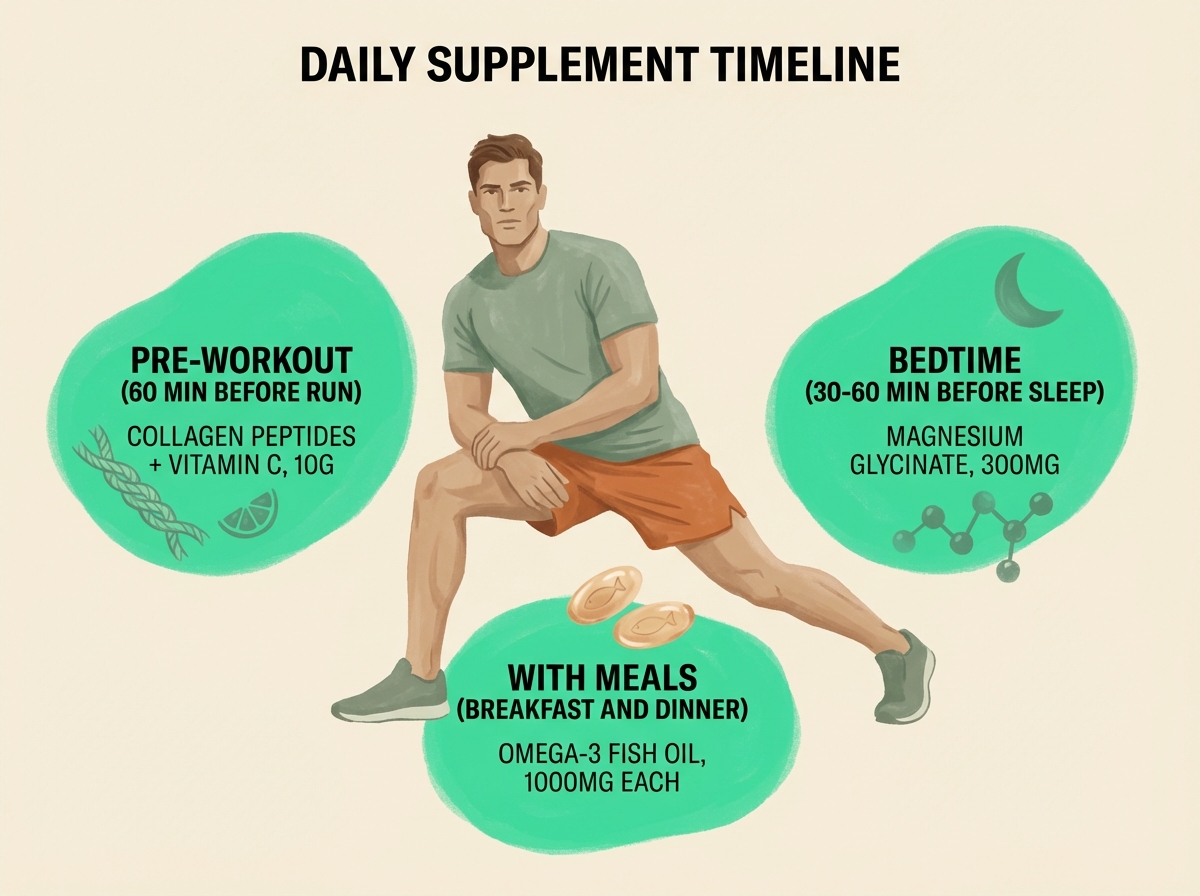
Pre-workout (60 minutes before)
Mix your collagen powder with water or juice and add your vitamin C. The Shaw study used about 50mg, so even a small dose works. Drink it about an hour before your run. This timing matters: the study that showed doubled collagen synthesis used exactly this protocol.7 On rest days, take it in the morning anyway. Daily consistency matters more than perfect timing when you're not training.
With meals
Split your omega-3 across breakfast and dinner. Taking it with food that contains some fat improves absorption. If you're aiming for 2g of EPA+DHA per day, that's roughly 3-4 concentrated fish oil capsules. Not the single capsule most runners take.
Look for fish oil labeled "triglyceride form" or "TG" rather than "ethyl ester" or "EE." The back of the bottle usually lists which you're getting.
A dose-response trial found that higher doses (up to 6g per day) were the most effective for recovery from intense exercise.10 During heavy training blocks, you can go higher, but read the safety note below about doses above 3g before you do.
Before bed
Take magnesium glycinate 30-60 minutes before you want to sleep. Start at 200mg elemental magnesium. If you don't notice a difference in sleep onset after two weeks, try 400mg. Don't go above 400mg from supplements without talking to your doctor.
Space magnesium at least two hours from calcium-heavy meals or supplements. They compete for absorption through the same intestinal pathways.
How long before you notice anything?
Omega-3 needs at least 6 weeks to build up in your cell membranes and start reducing inflammation.1 Don't judge it at week 2.
Collagen showed benefits in studies lasting 3 to 9 months.2 This is a slow build. If you're expecting relief by next Tuesday, adjust your expectations.
Magnesium is the fastest. If you're depleted from training, you may notice better sleep onset within 1-2 weeks. Give it 4-8 weeks for a fair test.6
Vitamin C doesn't need a loading period. It starts supporting collagen synthesis from day one. The limiting factor is the collagen and the training stimulus, not the vitamin C.
Now that you've seen the protocol, want it mapped to your schedule? Walk Your Supp' Buddy through what you take and what you're training for. It'll sort the timing and flag anything that clashes.
Safety and interactions
These four supplements have no harmful interactions with each other. You can take them all on the same day without conflicts.
- Omega-3 and blood thinners: If you're on warfarin or another anticoagulant, talk to your doctor before taking more than 2g per day of EPA+DHA. Higher doses can affect clotting time.
- Omega-3 above 3g per day: If you have any heart rhythm conditions or cardiac history, get your doctor's clearance before going above 3g per day. This is especially important if you're aiming for the 6g dose during heavy training blocks.
- Magnesium and kidneys: Healthy kidneys handle extra magnesium without trouble. If you have kidney disease, check with your doctor before supplementing.
- Magnesium and antibiotics: Space fluoroquinolone or tetracycline antibiotics at least two hours from magnesium. Magnesium reduces their absorption.
- Vitamin C and iron: Vitamin C boosts iron absorption, which is usually good news for runners since iron deficiency is common. If you have haemochromatosis, keep vitamin C at the lower end of the dose range.
Collagen has no known contraindications at standard doses. It's derived from animal sources (typically bovine or marine), so it isn't suitable for strict vegans. If you have a fish or shellfish allergy, check the source before starting.
Where this protocol lands across the 8 pillars
Recovery leads at 85. That's the point of this protocol. Sleep comes in at 55, strong enough to matter for post-run wind-down but not a sleep-first stack. Longevity sits at 45, mostly from omega-3's long-term cardiovascular and joint protection.
The remaining pillars land below 35. This protocol wasn't designed for those, and it doesn't pretend to be.
The bottom line
Running supplements don't fail runners. Runners fail running supplements. Most stacks get quit in the first six weeks, which is roughly the minimum time omega-3 needs to build up in cell membranes and start doing anything measurable. Most fish oil bottles get swapped for the next shiny thing before the old one ever got a chance to work.
That's not a supplement problem. That's a patience problem. And there's no capsule on any shelf that fixes patience.