Rhodiola Rosea Benefits, Dosage, and What's Oversold
Whether you've already tried rhodiola rosea or you're just eyeing the bottle, the same problem trips people up. It's sold for energy, focus, mood, stress, even sleep. But the evidence only piles up in one place. A Reddit thread or a Huberman clip can make it sound like it fixes everything. It doesn't. Our take: rhodiola does one thing well and gets oversold for the rest. Here's the honest version of what works.
What rhodiola rosea is good for (the honest version)
Short answer first. Rhodiola has steady evidence for one job: fighting fatigue and helping you hold up under hard effort, both in the gym and at your desk.1 For stress and focus it's a reasonable maybe. For depression it does not beat a dummy pill.11 One top community thread called it life-changing for brain fog and fatigue, with hundreds of upvotes. That part lines up with the studies. The rest of the hype mostly doesn't.
| What people use it for | Evidence grade | What it means for you |
|---|---|---|
| Energy & anti-fatigue | A- | The standout. Reliably cuts fatigue and lifts endurance. |
| Exercise & recovery | B+ | Strong, current support. Less muscle damage; holds performance under sustained effort. |
| Stress & burnout | B- | Promising, but the trials are small. A reasonable maybe, not a sure thing. |
| Focus & cognition | B- | Helps when you're already run-down. Nothing at baseline, and no ADHD trials. |
| Mood & depression | C | The myth. No better than a dummy pill for depression. |
So if you came for the energy story, you came to the right plant. If you came hoping for a mood lift you can point to, this is where we save you the money.
Why rhodiola gets sold for everything
Rhodiola rosea is a flowering plant, also called golden root or arctic root, that grows in cold, high mountains across Europe and Asia. It's an adaptogen, a plant said to help your body cope with stress. That label is part of the problem. "Helps with stress" is vague enough to get stretched to cover energy, mood, sleep, focus, and burnout all at once.
Search engines don't help. Google's own AI summary for rhodiola lists alertness, memory, focus, mild stress, anxiety, and mild depression as if they're all settled. They are not. When one supplement gets pitched for eight different things, the honest move is to ask which of those eight has the studies behind it. For rhodiola, the answer is narrow and clear.
How rhodiola works, and why it's a morning supplement
The active ingredients are two compounds in the root: rosavins and salidroside.2 They seem to work on three fronts. First, they calm the body's main stress-response loop, the one that runs from your brain to your adrenal glands. That keeps cortisol, your main stress hormone, from spiking as hard. Second, they nudge the same brain-messenger systems that mood and energy drugs act on. Third, they help your cells handle the wear of hard exercise, which shows up as lower markers of muscle stress.1
The anti-fatigue effect seems to work on two levels: how tired you feel, and the physical stress your body is under. How much each side matters isn't fully pinned down in people. The split between "tricks your brain into feeling less tired" and "lowers the actual fatigue chemicals" is still being worked out. Dr. Eric Berg, a chiropractor with a large following, put the first half plainly. Rhodiola can lower how hard a workout feels by quieting the body's stress signals.
Here's the part that matters for your day. Rhodiola is stimulating. That's why it works for energy, and it's also why timing is not optional. Take it in the morning, and it lifts you. Take it at lunch or later, and for a lot of people it backfires into a wired evening and a bad night. We'll come back to that in the dosing section.

Not sure rhodiola fits what you're chasing? Tell Your Supp' Buddy your top goal, whether that's steadier energy, gym recovery, or calmer stress. It'll map the evidence to that goal and give you an honest read on whether this one belongs in your routine.
The evidence, outcome by outcome
Energy and fatigue are where rhodiola earns its reputation. The biggest review we have pooled 26 trials and more than 600 people.1 Across them, rhodiola lifted endurance and cut the markers of fatigue your body produces under load. An older review reached the same direction, if less cleanly, across fatigue studies.5 A separate review of the trials agreed rhodiola helps both physical and mental performance.6 One of the foundational trials followed physicians working night shifts and found their fatigue scores dropped on rhodiola.7 Another tracked students through exam season and saw the same.8
Exercise and recovery sit just behind, and the support here is current. Recent trials in football, soccer, and basketball players had them take rhodiola for about four weeks.1315 They held their sprint and endurance numbers better as fatigue set in, and made sharper decisions late in play. A trial using the isolated salidroside compound found stable mood during exhaustive exercise, with a muscle-damage marker that stayed flat versus placebo.18 A broader review of rhodiola in sport reached the same read: the endurance signal is its most consistent.21 Another trial found strength held up better even under mental fatigue.19 The through-line: rhodiola's most consistent edge is helping you sustain performance as fatigue sets in.
Stress and burnout are where the story gets softer. Some early trials did find lower stress and anxiety scores.109 But one skipped a dummy-pill group, and another wasn't a proper head-to-head, so the results are easy to oversell. Early evidence suggests rhodiola may take the edge off everyday stress, but the trials are small and a bit shaky. Treat it as a maybe worth trying, not a sure thing. And watch out for the "stress relief" claims that ride on multi-herb blends. One stress study that gets quoted a lot mixed rhodiola with holy basil and schisandra, so there's no way to credit rhodiola alone.17
Focus is a similar shape, with one honest twist. In trained athletes tested around hard exercise, rhodiola sharpened focus and reaction time.16 But a trial in rested, healthy adults using a rhodiola-containing gum found no clear cognitive lift.4 So the focus signal is strongest in active, exertion contexts; the everyday "sharper at my desk" benefit is much thinner. That's also the most honest answer to the ADHD question, which comes up a lot in the community. There are no trials testing rhodiola for ADHD. The fatigue-and-focus finding may explain why some people with attention struggles feel it helps. But feeling sharper when you're tired is not the same as treating ADHD. If brain fog and focus are your main issue, our guide to supplements for brain fog and focus covers what the evidence supports.
Then there's mood, which is where most of the myth lives.
Community claim: "Rhodiola is as good as antidepressants."
What the evidence says: One trial put rhodiola up against both sertraline and a dummy pill for major depression. Rhodiola came out no better than the dummy pill.11 It did cause fewer side effects than the drug, about 30 percent of people versus 63 percent. But fewer side effects from something that didn't beat a sugar pill is not an antidepressant. A wider review of milder-depression treatments did rate rhodiola as a possible option for mild low mood, with a positive signal versus placebo.12 That's a much softer bar than major depression, where the one head-to-head trial found nothing. For low mood tied to being burned out and exhausted, the energy benefit might help indirectly. As a replacement for an antidepressant in clinical depression, the case isn't there.
On an antidepressant, a beta blocker, or anything daily, and wondering if rhodiola is safe to add? Walk Your Supp' Buddy through your meds and supplements once. It flags the interactions that matter, sorts the timing, and tells you whether this is one to skip.
Getting rhodiola from food
This one's quick. Rhodiola rosea is a mountain root, not a food. It isn't in any everyday meal, and you can't eat your way to a dose. Even in the cold regions where it grows, people brewed the prepared root, they didn't get it from their diet. So unlike most things we write about, there's no "eat more of X instead" option here. The supplement is the only practical way to take it, which makes buying the right one matter even more.
How much rhodiola to take, and when
For everyday energy and stress, most trials used 200 to 600 mg a day of a standardized extract.78 That means an extract measured to contain a set amount of the active compounds. Start at 200 mg and give it a few weeks. If you're a trained athlete chasing performance, the sport trials went higher, into the 600 to 2,400 mg range.13 That higher dose is usually taken pre-workout. The bigger endurance gains showed up above 600 mg a day.1 Most people don't need that much.
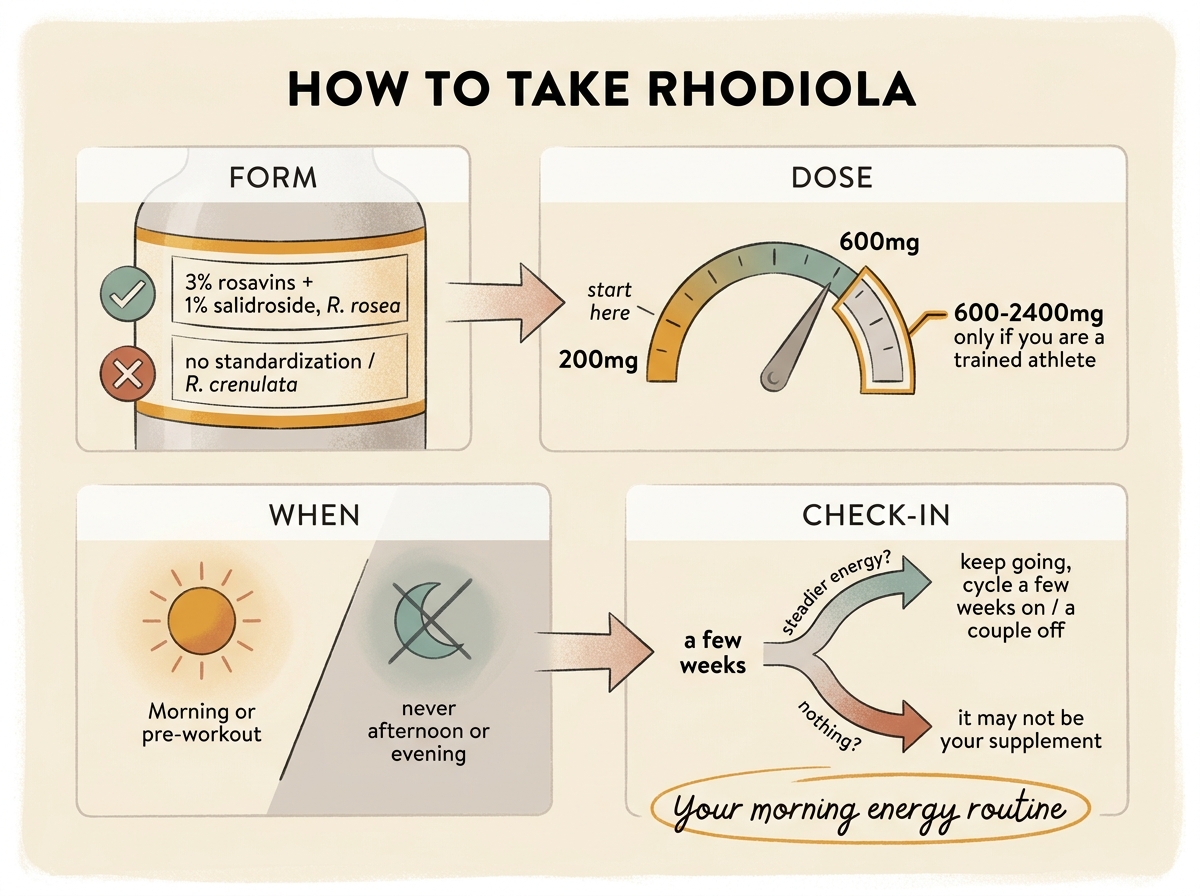
Now the timing rule, because it's the single most common way people get rhodiola wrong. Take it in the morning, or before a workout. Never in the afternoon or evening. Rhodiola is stimulating, and afternoon doses are the leading cause of the "it kept me awake" complaints. No trial has pitted morning against evening dosing head to head. But the supplement's stimulating action and the steady stream of insomnia reports point one clear direction: take it early. One community write-up describes a lunchtime dose: drowsy at first, then wired all evening, then unable to sleep. The fix was simple: move it to the morning.
A note on the "take it at night to lower your cortisol" advice floating around. It gets the mechanism backward. Rhodiola is an upper, not a downer, and taking an upper before bed is how you end up staring at the ceiling. Many people also cycle it, roughly a few weeks on and a couple weeks off. No trials have tested taking it nonstop for the long haul. The cycle-it habit comes from old Scandinavian and Soviet use, not from a study.
One pairing the evidence does support: rhodiola plus caffeine. Trials combining the two in athletes found they stack well, in both soccer and volleyball players.1420 The community line that rhodiola "smooths out" caffeine's jitters has backing too. Dr. Layne Norton, a nutrition scientist, described the same on the Huberman Lab podcast. If caffeine is already your morning move, our breakdown of the caffeine and L-theanine focus stack is worth a look. It walks through how to build a calm-energy morning.
How to buy authentic rhodiola
This is the part almost no one explains, and it's where most of the everyday confusion lives. Rhodiola is a known target for fakery, and a bottle that says "rhodiola" tells you almost nothing. Twelve separate community threads boiled down to one worried question: how do I know I'm getting the right thing? Here's the answer.
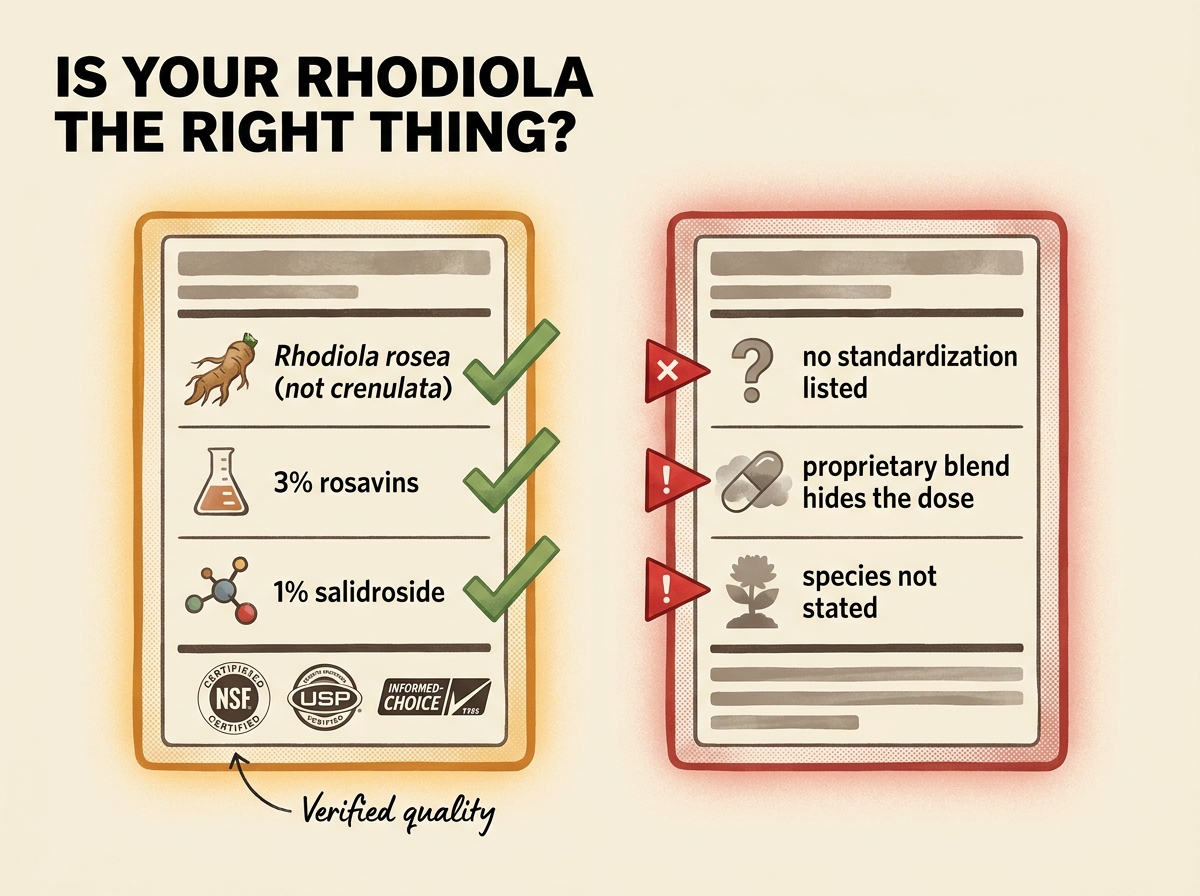
Look for three things on the label. First, the species: it should say Rhodiola rosea. A cheaper look-alike, Rhodiola crenulata, gets substituted and has a different mix of active compounds. Second, the standardization. Every clinical trial used an extract measured to 3 percent rosavins and 1 percent salidroside. If the bottle doesn't list those numbers, you don't know what you're getting. Third, third-party testing, like an NSF, USP, or Informed-Choice seal, which means an outside lab checked the contents.
Worth knowing: even Google's AI summary gets this backward, listing the ratio as 3 percent salidroside and 1 percent rosavins. It's the other way around. When the reference surfaces themselves are confused, it's no wonder shoppers are. A "proprietary blend" that hides the dose, or a label that won't name the species, is your signal to put the bottle down. Brand-name searches like SALVORA and floraviva come up a lot for this reason: people are hunting for one they can trust. The seal and the standardization numbers matter more than the brand on the front.
Side effects, safety, and what it interacts with
For most healthy adults, rhodiola is well tolerated for up to about 12 weeks, which is as long as the studies run. The most common complaints are mild: dizziness, headache, dry mouth, and, when the timing is off, trouble sleeping. There's a paradox worth naming, too. Because rhodiola is stimulating, a subset of people get more anxious or restless on it, especially at higher doses or late in the day. If that's you, a smaller morning dose, or skipping it, is the answer.
One more concern shows up in the community that's worth a calm word. Some people describe feeling like they "can't stop" taking it, hooked on the daily energy it gives them. There's no evidence rhodiola is physically addictive the way caffeine or nicotine can be. What's likely going on is simpler: you notice the lift, you miss it on the days you skip, and that feels like dependence. The fix is the same cycling habit from the dosing section. Take a planned break every few weeks and see how you feel without it. If your baseline is fine, that's your answer. If the fog rolls back in, you've learned it was doing something.
The interactions are where you should slow down. If you take an antidepressant, this matters. Rhodiola acts on some of the same brain-messenger systems as antidepressants like SSRIs, SNRIs, and the older MAOIs. Combining them can stack effects in ways nobody can predict. Don't pair them without your prescriber's sign-off. If managing anxiety alongside medication is your situation, our honest look at supplements for anxiety walks through the safety side in more depth. A blood-pressure interaction with losartan has also been reported, and because rhodiola may thin the blood slightly, stop it about two weeks before any surgery.
If you're pregnant or breastfeeding, the safest call is to skip rhodiola. There simply isn't enough safety data to say it's fine, and that gap is reason enough to wait. People with bipolar disorder should also be cautious, since a stimulating supplement can tip the wrong way. As for stacking, rhodiola and caffeine go together well in the morning. Rhodiola and ashwagandha are more of a day-and-night pairing. Ashwagandha is calming and better suited to the evening, and our ashwagandha stress-stack guide covers that side.
The bottom line
Our read: rhodiola is one of the few supplements that does one thing well and gets sold for ten. The one thing, fighting fatigue and holding your performance under stress, is worth having. The other nine are mostly marketing, and the depression claim is flatly wrong. Most of the work isn't deciding whether rhodiola helps. It's buying a properly standardized root and remembering to take it before noon.
If you want to test it: 200 mg of a 3% rosavins extract, taken in the morning, for three to four weeks. Watch for steadier afternoon energy and fewer 3 p.m. crashes, not a dramatic lift. If nothing's changed by week four, it's probably not your supplement, and that's a useful answer too.
What's the best time of day to take rhodiola rosea?
Morning, or 30 to 60 minutes before exercise. Rhodiola is stimulating, so afternoon doses are the top cause of insomnia complaints. One rule: take it early.
How much rhodiola should I take?
For everyday energy and stress, 200 to 600 mg a day of an extract standardized to 3% rosavins and 1% salidroside. Start at 200 mg. Trained athletes chasing performance sometimes go higher, into the 600 to 2,400 mg range, but most people don't need that.
Does rhodiola rosea work for ADHD?
There are no ADHD trials. The focus benefit shows up around hard exercise, which is different from treating ADHD. Don't swap it for a prescribed treatment.
Can I take rhodiola with my antidepressant?
Not without checking with your doctor first. Rhodiola acts on some of the same brain-messenger systems as SSRIs, SNRIs, and MAOIs, so combining them can stack effects unpredictably. This is one to clear with whoever prescribes your medication before you start.
How do I know if I'm buying authentic rhodiola rosea?
Check three things. The species should read Rhodiola rosea, not the cheaper crenulata. The label should list 3% rosavins and 1% salidroside. And a third-party seal (NSF, USP, or Informed-Choice) means an outside lab verified the contents. No standardization listed is a red flag.
Does rhodiola help with depression?
Probably not as a primary treatment. The one trial that tested it for major depression found it no better than a dummy pill. It caused fewer side effects than the antidepressant it was compared to, but the mood benefit wasn't there. For low mood tied to exhaustion and stress, there may be an indirect lift through its anti-fatigue effect.
How long does rhodiola take to work?
Some people notice steadier energy within a week or two. Give it three to four weeks before deciding. If you feel nothing by then, the most likely answer is that it isn't your supplement, which saves you the cost of guessing further.