

Creatine for women: what it does for your brain, muscles, and hormones
Most of what you've heard about creatine was written for men in a gym. The doses on the label assume you weigh 90 kg. The protocols were designed for athletes chasing maximum muscle in minimum time.
None of that is your life. And the science that matters for you doesn't live in a weight room.
Until recently, almost none of the creatine research included women. That gap is closing fast. A 2025 review looked at creatine across women's entire biological life, from menstrual cycles through pregnancy to menopause.6
The picture is bigger than muscle. Creatine supports your brain, your bones, and possibly your mood. Early analyses suggest women may benefit at least as much as men for cognitive function, but that finding hasn't been replicated widely yet.
You don't need to be an athlete. You don't need a loading phase. And it won't make you bulky.
What people worry about (and why most of it is wrong)
"Will creatine make me bulky?" is the most common question women ask. Right behind it: "Will I get bloated?" Both fears trace back to bodybuilding culture. The evidence tells a different story.
Community claim: "Creatine will make me bulky"
What the evidence says: Creatine doesn't build muscle on its own. It helps your muscles work harder during training, which can support gradual muscle growth over months. In studies of women at standard doses, the gains were modest: lean mass, not bulk. No trial in women has produced a "bulky" outcome at these doses.456
Community claim: "Creatine causes bloating and water retention"
What the evidence says: Creatine does pull water into your muscle cells. That happens, and it shows on the scale (usually 0.3-0.7 kg in women). But this is water inside your muscle cells, not puffiness under your skin. A study of female dancers found total body water went up about half a kilogram at the recommended dose. That's intracellular hydration, not cosmetic bloating.56
Your scale may move up slightly in the first few weeks. That's the creatine doing what it's supposed to. If you're tracking progress, measure how your clothes fit instead of just weight.
Not sure creatine fits alongside everything else you're taking? Walk Your Supp' Buddy through your current supplements once. It'll flag any interactions and tell you whether creatine belongs in your routine or whether you can skip it.
How creatine works (the 30-second version)
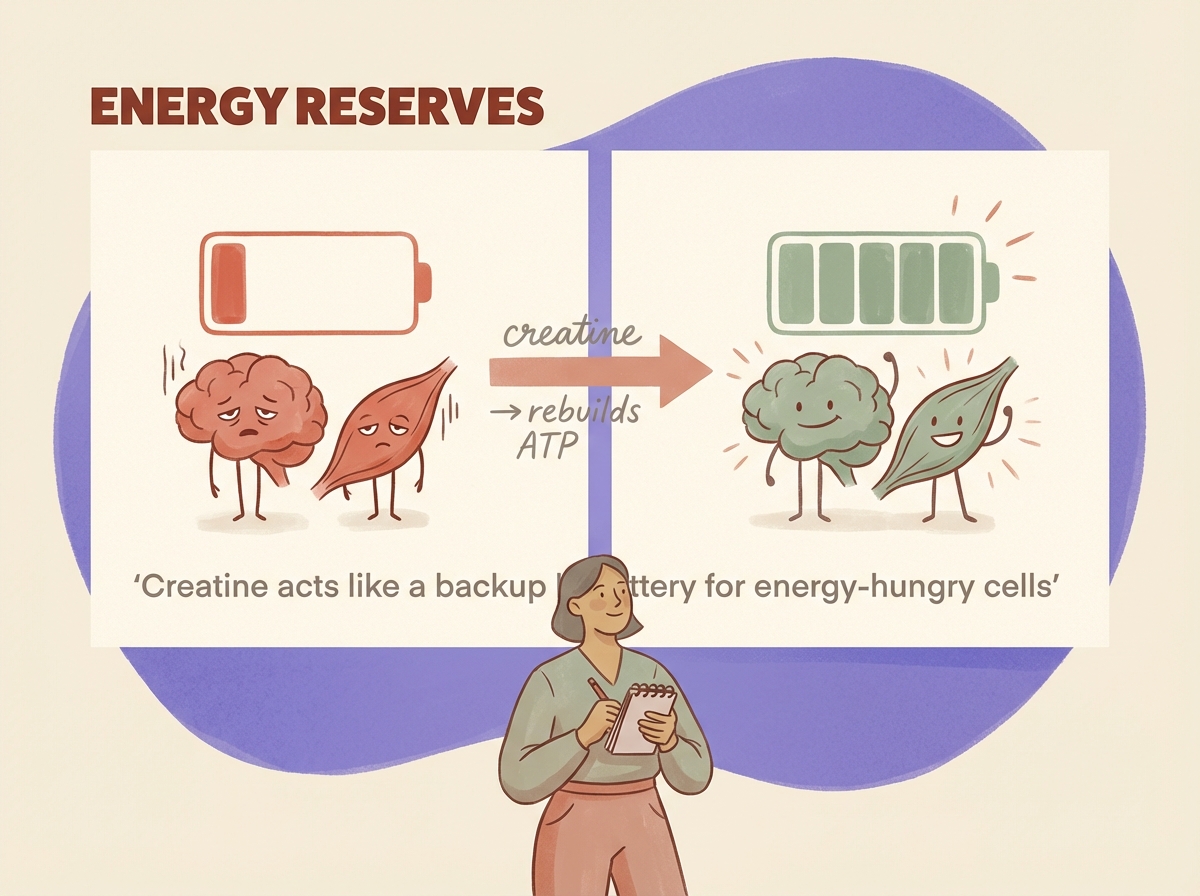
Your muscles and brain run on a molecule called ATP. When you push hard (sprinting, lifting, solving a tough problem at 3 pm) you burn through ATP fast. Creatine acts like a backup battery — it helps rebuild ATP almost instantly, so your cells can keep firing.
That's the entire mechanism behind every benefit you'll read about below. Muscles, brain, mood — all energy supply.
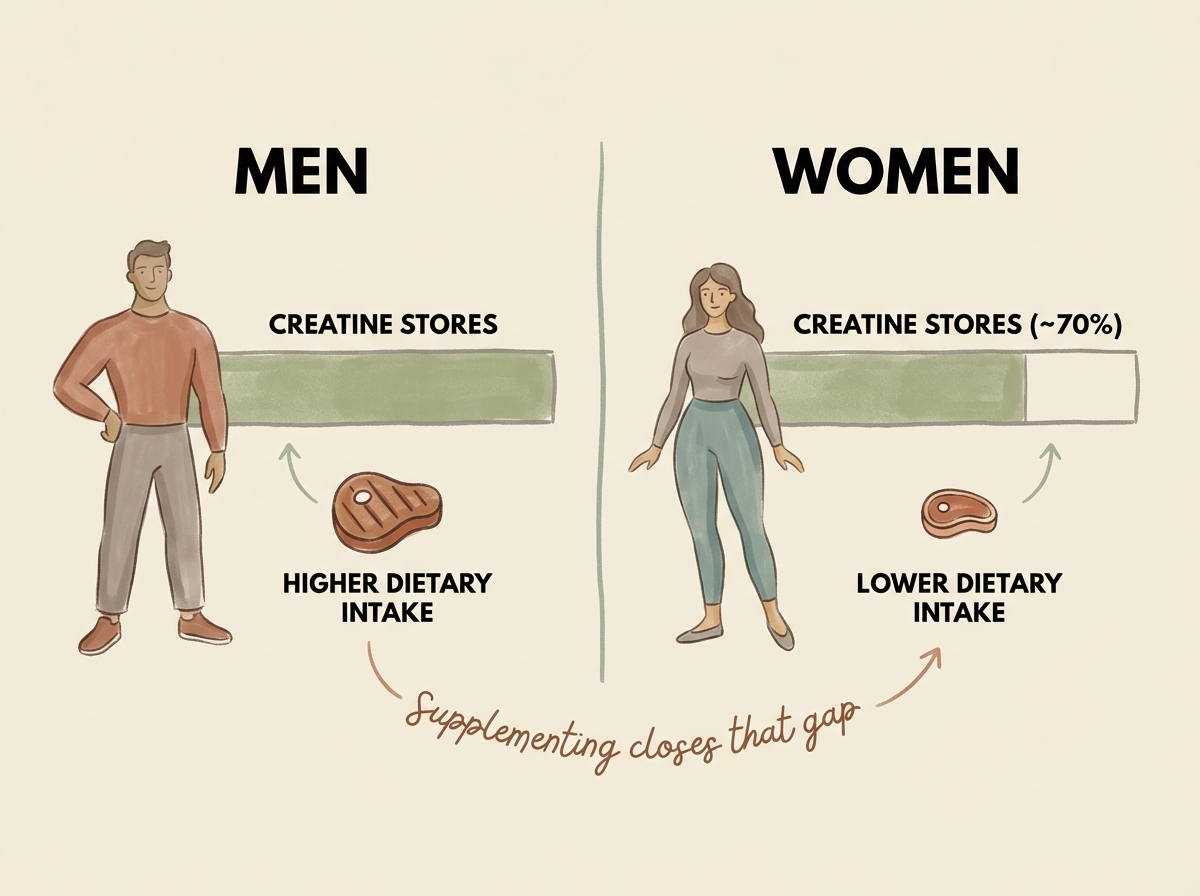
Here's the part that matters specifically for women: you start with less creatine than men do. About 70% of men's stores, according to a 2025 review.6 Part of that is diet: women tend to eat less red meat, the main dietary source. Part of it is hormonal. Either way, supplementing closes that gap in about three weeks.
Dr. Stacy Sims, a physiologist who specialises in female athlete nutrition, puts it plainly: "Women have around 70% of the stores that men have. At a single daily dose, it doesn't come with the side effects you'd get from bodybuilding-style loading protocols — five grams four times a day."
What the evidence shows: four outcomes, four honest grades
Creatine for women isn't one story. It's four. The evidence is strongest for muscle performance, the brain story is better than most people expect, bone health is moderate, and mood is early but promising. Here's what each looks like.
Muscles and recovery
Women gain meaningfully in squat and explosive power with creatine supplementation.410 The ISSN's position stand, the closest thing sports nutrition has to a consensus document, confirms creatine is effective and safe across populations.4 A short-term loading study in trained athletes found creatine enhanced strength and sped up recovery between sessions.10
Grade: A- | Strong confidence
Women who take creatine get measurably stronger, especially in squat and explosive movements. The pattern is consistent across studies.
Most early trials mixed men and women together instead of studying women separately. That gap is narrowing. Female-specific studies confirm the same direction, if slightly smaller in some measures.
Brain and cognition
Some early analyses suggest women may benefit at least as much as men from creatine for cognitive function, possibly more. Promising, but not yet replicated widely enough to call definitive. A large women-only cognitive trial is the missing piece.
What we do have: two systematic reviews found cognitive benefits — one in healthy adults2, one specifically in older adults.1 The largest single trial (123 people, crossover design) found a modest but repeatable benefit.3 A 2026 trial of 103 older adults (57 women) found creatine combined with resistance training improved neurocognitive biomarkers beyond exercise alone.14
Grade: B+ | Moderate confidence
Improvements in memory and attention show up reliably across multiple reviews. Benefits are clearest under cognitive stress: sleep deprivation, aging, heavy mental workload.
The studies are still small and a large women-only cognitive trial hasn't been done yet. But the direction holds across every review so far.
Trying to figure out which of creatine's benefits matters most for you? Tell Your Supp' Buddy your age and which pillars you care about (Recovery, Focus, Mood) and it'll map the evidence to your priorities. Free to start, sets up in a couple of minutes.
Perimenopause and bone health
If you're in your 40s or 50s and dealing with brain fog, the fatigue, and the nagging worry about bone density, this is the section that matters most.
As estrogen drops during perimenopause, your body handles creatine differently. The same intake that worked at 30 can feel less effective at 508. Dr. Sims calls creatine one of the few supplements that addresses multiple perimenopause concerns at once: "brain function, gut function, heart health, all of that requires creatine."
The bone health data needs honest framing. A two-year trial of 237 postmenopausal women found creatine plus resistance training did not increase bone mineral density.7 That sounds like bad news, but it's not the whole picture. The same study found creatine maintained bone geometry: the structural properties that predict whether a bone breaks under stress. Section modulus and buckling ratio held steady in the creatine group while declining in placebo. A separate meta-analysis confirmed creatine doesn't build denser bones.12 But the two-year trial showed it may help maintain their architecture.7
The lean mass improvements were clear. If you're postmenopausal and doing resistance training, creatine helps you build and keep muscle.7
Grade: B | Moderate confidence
Bone density doesn't change. But bone geometry (the structural properties that predict fracture risk) stays intact with creatine plus training. Lean mass increases too.
This is a maintenance story, not a reversal story. If you're expecting denser bones, creatine won't deliver that. If you're trying to hold the line on bone strength while building muscle, the evidence supports it.
Mood and depression
This one gets a big "promising but early" flag. A meta-analysis of 11 trials found a small effect on depression symptoms, but the certainty was very low and the true effect could be trivial.9 That's the honest read.
Where it gets more interesting: a pilot trial tested creatine as an add-on to cognitive behavioural therapy in 100 people (half women, average age 30). The creatine group scored meaningfully better on depression scales.8 That's one pilot study, not a consensus. But it's well-designed and worth following.
If you're managing depression, creatine is not a replacement for treatment. It may be a complement, and the early signal is worth watching. Talk to your prescriber before adding it.
Grade: B | Very low confidence
A meta-analysis found a small average effect on depression. One well-designed pilot study showed stronger results when creatine was added to therapy.
The evidence base is noisy and the overall certainty is low. This is a "watch this space" finding, not a recommendation. If you're on medication for mood, don't change anything without your doctor.
How to take it: the women's protocol
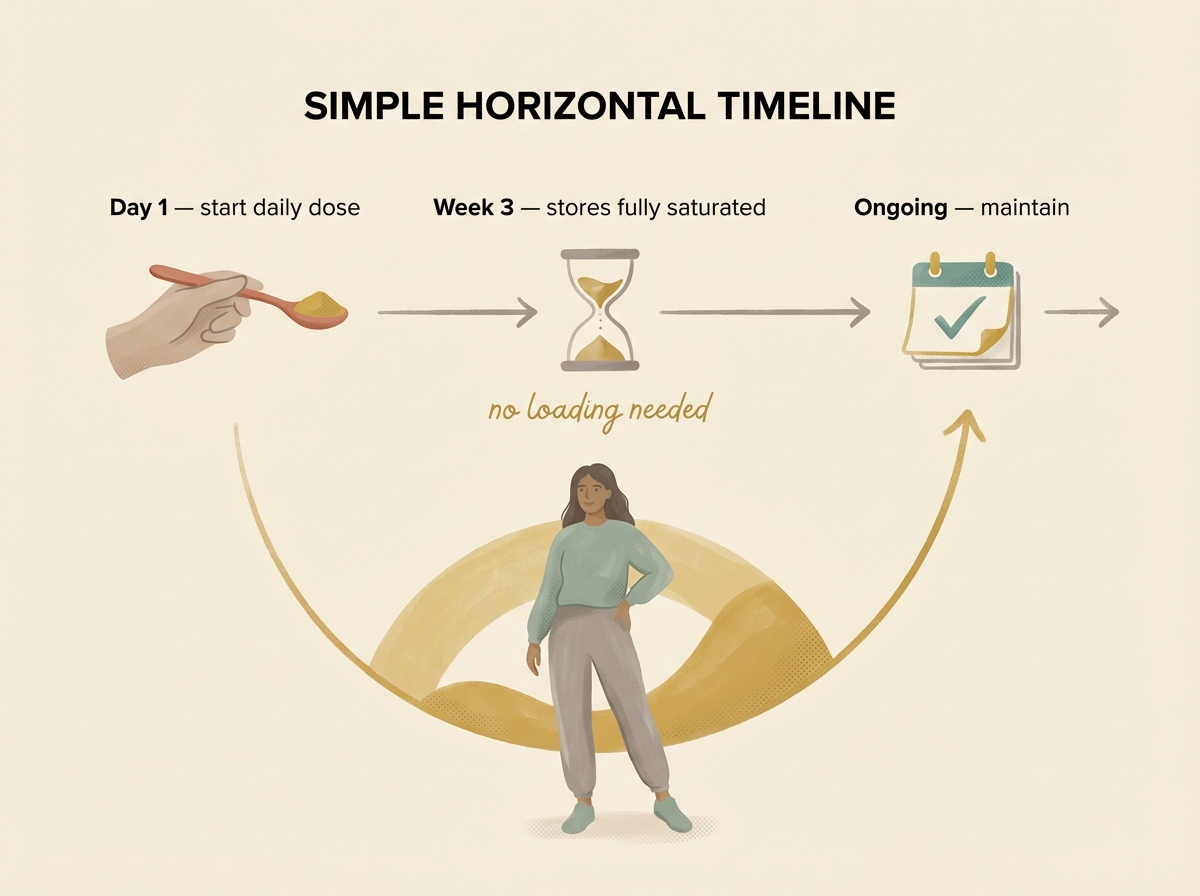
Forget the loading phase. Forget the four-times-a-day bodybuilding schedule. Here's what the research supports for women:
| Supplement | Form | Dose | Timing | Duration | Evidence | Notes |
|---|---|---|---|---|---|---|
| Creatine monohydrate | Powder or capsule | 3-5 g/day | Once daily, any time | Continuous; stores saturate in ~3 weeks | A-46 | Safe long-term; discuss with your doctor if you take statins |
| Creatine monohydrate (postmenopausal, bone focus) | Powder | ~0.1 g/kg/day (avg ~7g) | With resistance training sessions | 1-2 years | B711 | Well tolerated in trials; discuss with your physician |
The higher dose in the second row comes from the Chilibeck bone health trial. Most women will use the standard 3-5 g row.
Why no loading? Loading protocols (20g spread across four daily doses) were designed for male bodybuilders who wanted maximal stores by day five. A 2025 review by Smith-Ryan and colleagues notes those protocols may cause more GI discomfort in women, though this hasn't been formally studied.6 At a single daily dose, you reach the same level without the stomach upset. Same destination, smoother ride.
Monohydrate is the form used in every trial here. Creatine HCL is marketed as gentler, but no female trial has compared the two. Monohydrate is the evidence-backed option.4
Safety and interactions
The ISSN reviewed decades of data and concluded creatine is safe at up to 30 g/day for five years in healthy people.4 At women's typical doses, side effects were comparable to placebo. A few things to know:
- Kidney health: Creatine is fine for healthy kidneys. If you have kidney disease, don't take it. Creatine is metabolised to creatinine, and impaired kidneys can't clear it properly.4
- Statins: If you take a statin, mention creatine to your doctor before starting. Your doctor may already track CPK levels as part of routine statin monitoring, and creatine can affect those readings.
- Caffeine: High-dose caffeine may slightly blunt creatine's muscle benefit.13 At normal coffee intake, this likely doesn't matter.
- Pregnancy: Don't supplement during pregnancy without medical guidance. The data isn't strong enough yet.6
- Hair loss: The DHT-creatine connection comes from one rugby study that hasn't been replicated in women or in monohydrate studies at typical doses. Not a credible concern at the doses used in women's trials.
Where creatine lands across the 8 pillars
Here's how all of that evidence maps to Supp' Buddy's eight wellness pillars at once:
Recovery (80) and Focus (72) are creatine's strongest pillars, backed by the most consistent evidence. Mood and Energy sit in the middle: there's signal, but the studies are still small. If you're here for the brain and muscle benefits, the evidence is solid enough to act on today.
The bottom line
Creatine was the first sports supplement everyone "knew" was for men. That wasn't a scientific conclusion. It was a marketing decision made around a specific customer, the 1990s gym rat, and it stuck so well that women who take creatine today still feel like they're borrowing something.
They're not. The research on women has quietly caught up, and on memory and mood the case is arguably cleaner than the case for the powerlifters it was sold to. No loading week. No creatine-bloat apocalypse. Just three to five grams a day of the cheapest supplement in the store. The only thing women are behind on is permission.
[C4] Dr. Stacy Sims, Diary of a CEO — https://www.youtube.com/watch?v=ohO3d2viaXk
[C6] Dr. Stacy Sims, midlife hormones masterclass — https://www.youtube.com/watch?v=0odXU5bQojE