
Glycine for Sleep: Does the Cheap Amino Acid Work?
You may have seen glycine recommended as the sleep aid that costs about ten cents a night. Maybe a late-night thread talked you into trying it, and you still can't tell if it did anything. Either way, glycine for sleep keeps coming up. The pitch is easy to like. It's cheap. It's an amino acid, one of the building blocks your body uses to make protein. And people online treat it like a quiet little miracle.
The studied dose is small and specific: 3 g of plain glycine before bed. The honest verdict from the independent evidence is a modest edge on falling asleep for some people, not a knockout.
Here's the part those threads skip. Almost every human sleep study on glycine was paid for by the company that sells it. That doesn't make the findings wrong. It does mean we should read them with our eyes open. So that's what this guide does. Then it lands on whether glycine deserves a spot in your nightly routine.
Why glycine keeps coming up for sleep
Glycine has a few things going for it that make it spread fast online. The first is price. A tub of glycine powder works out to roughly ten cents per dose. Next to branded sleep blends, that feels almost free.
The second is taste. Glycine is mildly sweet, so it dissolves into a glass of water without the chalky aftertaste a lot of powders have. People describe it as drinking faintly sweet water before bed. That low friction matters. A supplement you don't mind taking is one you'll keep taking.
The third reason is a bit of a mix-up. Magnesium glycinate is one of the most recommended forms of magnesium for sleep. The word "glycinate" sends people looking up glycine on its own. The two are related, but they aren't the same thing, and that confusion is worth clearing up before we go further.
Community claim: "I felt magnesium glycinate working for my sleep, so plain glycine must be a great sleep tool too."
What the evidence says: Magnesium glycinate is dosed and studied for its magnesium. The glycine is mostly a carrier, and it was never tested on its own as a sleep dose in that form. The glycine sleep studies used plain glycine as its own bedtime dose.2 So if magnesium glycinate helps you, give the magnesium its due. Plain glycine is a separate experiment, with its own evidence and its own dose.
There's a fourth driver, and it's newer. Glycine keeps showing up in longevity circles, bundled into a buzzy anti-aging combo called GlyNAC. That halo pulls curious people toward plain glycine for sleep, even though the two uses barely overlap.
So the buzz isn't all hype, and some of it is good signal. People online keep saying glycine takes the edge off a restless night. The question is whether the research backs the chorus. That's where it gets interesting.
What the research on glycine for sleep shows
Start with the cleanest source we have. In 2024, a team at the National University of Singapore reviewed every human study on glycine they could find, 52 in all.1 This review matters because the people who ran it don't sell glycine. For sleep, they concluded that glycine before bed seems to help people fall asleep faster and feel more rested. They were careful, though, about how strong that claim could be.
Why the caution? Because of where the underlying sleep studies came from. The handful of trials that first put glycine on the map were run by Ajinomoto, a Japanese company that makes and sells the amino acid.23 In those studies, people whose sleep had been cut short took 3 g of glycine before bed. They reported less daytime fatigue and sharper focus the next day, and they did better on attention tasks.2
A funded study isn't a fake study. These were careful trials with careful measurements, and an independent review still found the signal worth taking seriously.1 But the rule of thumb is simple. When the company selling a product runs most of the research on it, lean on the independent voice and treat the rest as support.
It matters more here than usual, too. The glycine sleep trials were small and measured how people felt, not hard lab numbers. Soft, subjective results in small groups are the easiest kind for a hopeful sponsor to tilt, even without anyone meaning to. So here's where the evidence lands.
There's a second, smaller signal from a different angle. A 2024 trial gave physically active men with sleep complaints collagen peptides before bed, and collagen is loaded with glycine. The men's sleep was less broken and their next-day thinking improved.4 It's a tiny study and collagen isn't pure glycine, so read it as a hint that points the same way, not as proof.
So what does "modest" buy you in practice? Not a knockout, and not a fix for insomnia rooted in pain, anxiety, or a medical problem. Glycine seems to help most when your sleep is basically fine but slow to start. It also helps when a short night leaves you foggy the next day. If you fall asleep quickly already, there's little here for you. If bedtime is a slow, restless wind-down, it's worth a two-week test.
How glycine helps you fall asleep
Glycine does something a little surprising before bed. It helps cool you down. To fall asleep, your core body temperature has to drop by about half a degree. Your body does this by sending more blood to your hands and feet, which sheds heat, like opening a radiator. Glycine seems to give that process a push.
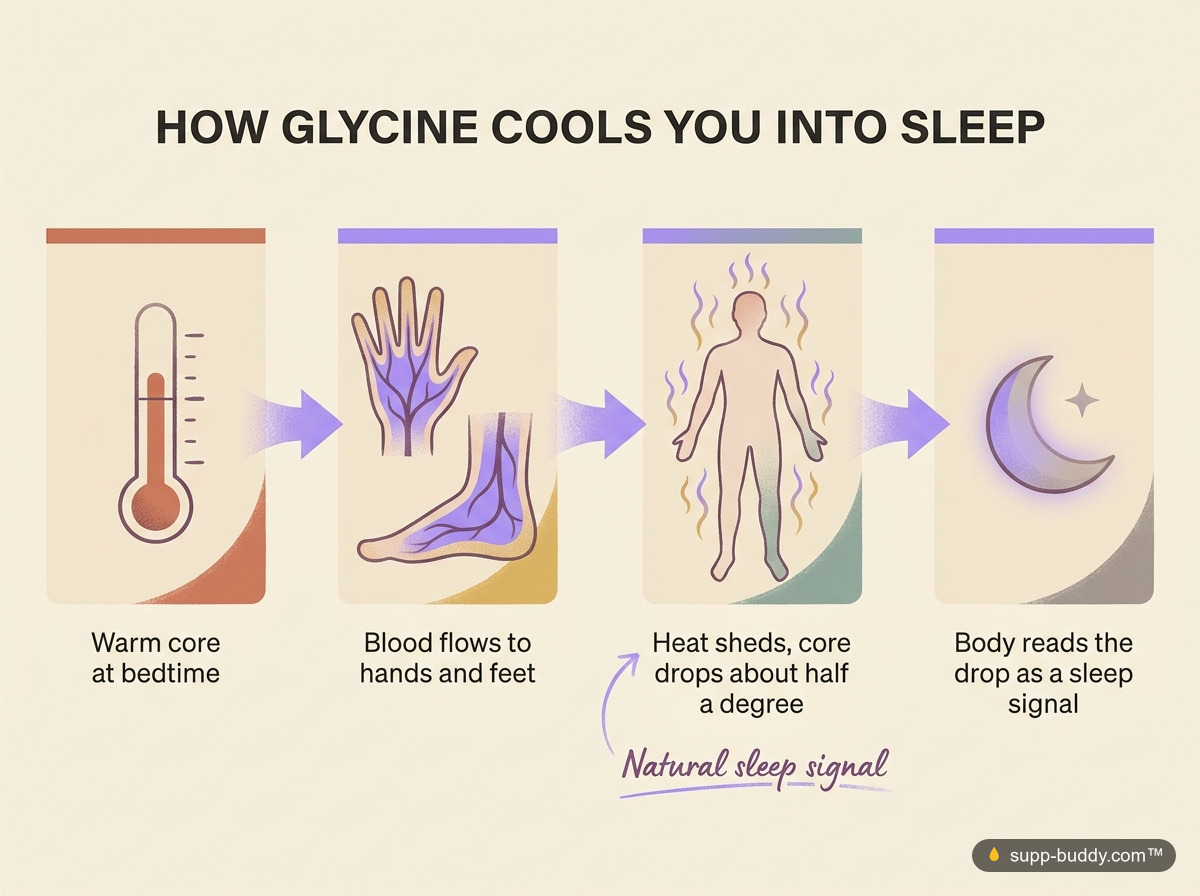
In animal research, glycine acts on a cluster of cells deep in the brain that runs your body clock, the suprachiasmatic nucleus.5 It works through the NMDA receptor (a docking site on the cell that a molecule slots into like a key in a lock). Through that receptor, glycine widens the blood vessels at your hands and feet. More heat leaves, your core temperature falls, and your body reads that drop as a signal that it's time to sleep.
That cooling angle hands you a practical tip. Glycine works with a cool bedroom, not against it. A warm room fights the temperature drop glycine is nudging along, so a hot night can blunt the effect. If you're testing glycine, keep the room cool and the bedding light. You're giving the same mechanism two pushes instead of one.
Glycine has a second job that fits the bedtime story. It's one of the brain's calming messengers, a neurotransmitter (a brain chemical that quiets nerve signals rather than firing them up).11 Where some chemicals act like an accelerator, glycine works more like a brake. There's also early animal work showing glycine can nudge serotonin, a mood and sleep chemical, in one part of the brain. That last thread comes from rats, not people, so hold it loosely.12
None of this makes glycine a sedative. It doesn't knock you out the way a sleeping pill does. It lowers the temperature and quiets the signals that make sleep easier to fall into. That's a gentler effect, and it's worth setting your expectations there before you try it.

Not sure how glycine fits with what you already take at night? Run your current line-up past Your Supp' Buddy. Tell it what's in your routine, and it'll flag any interactions worth knowing and show you where glycine sits against your sleep goal.
Getting glycine from food
Glycine isn't something you have to get from a tub of powder. Your body makes about 3 g of it a day on its own, and a typical diet adds another 3 to 5 g. It's especially rich in the parts of an animal we eat less of now: skin, bones, and connective tissue. That's why old-fashioned foods like bone broth and slow-cooked tough cuts are the best dietary sources.
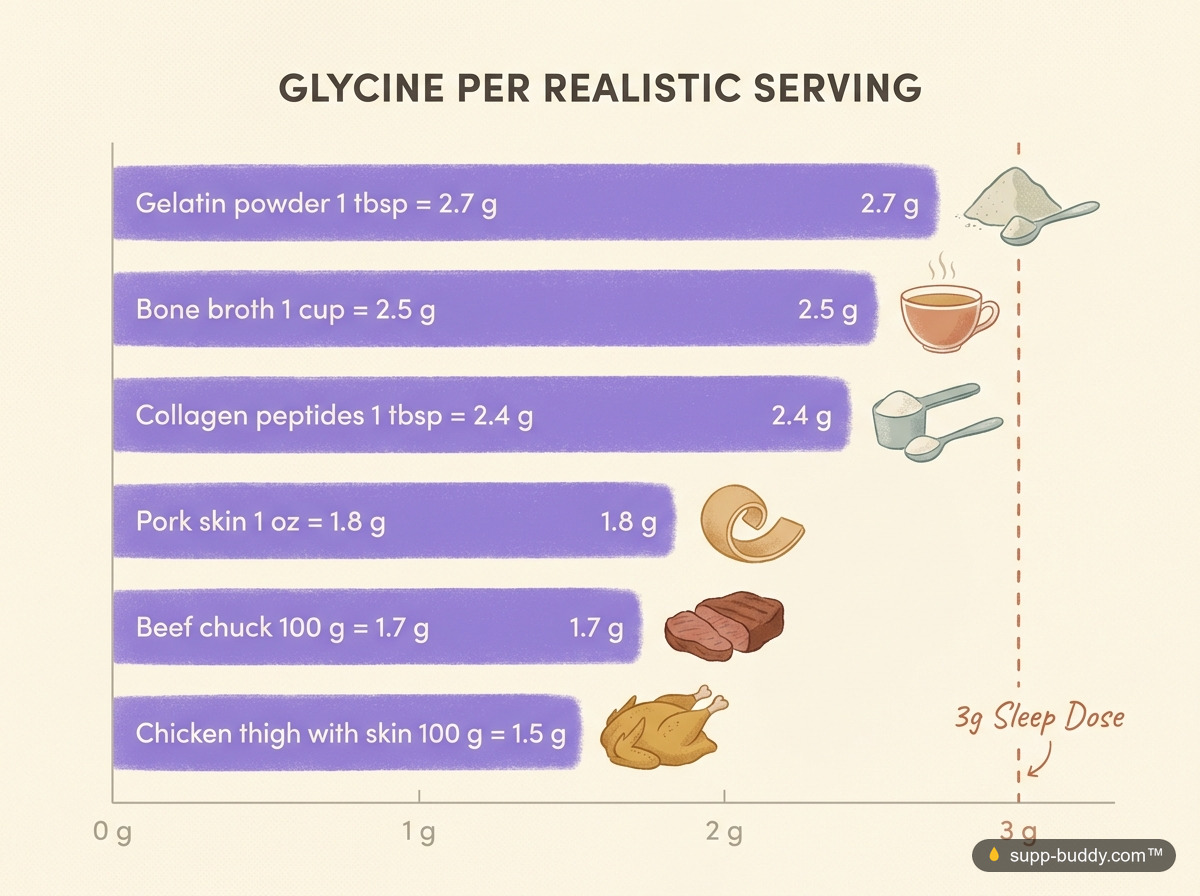
Here's how the richest sources stack up per realistic serving:
| Food | Serving | Glycine |
|---|---|---|
| Gelatin powder | 1 tbsp / 10 g | 2.7 g |
| Bone broth | 1 cup / 240 ml | 2.5 g |
| Collagen peptides | 1 tbsp / 10 g | 2.4 g |
| Pork skin | 1 oz / 28 g | 1.8 g |
| Beef chuck (cooked) | 100 g / 3.5 oz | 1.7 g |
| Chicken thigh with skin | 100 g / 3.5 oz | 1.5 g |
How much, how often: The sleep studies used 3 g before bed. You could hit that with a cup (240 ml) of bone broth plus a tablespoon (10 g) of gelatin in a warm drink. Two tablespoons (20 g) of collagen peptides would also do it. Both are doable as an evening ritual. Lean cuts of meat won't get you there. The skin, the broth, and the connective tissue are where glycine concentrates.
No trial has tested bone broth or collagen head-to-head against plain glycine for sleep. In principle the glycine in those foods is the same molecule as the powder, so a glycine-rich drink should behave like a glycine dose. Treat food as a reasonable route, not a proven one. If you'd rather eat your way there, the broth-and-gelatin path is a fair bet. If you want the exact studied dose with no guesswork, that's where the supplement earns its place. It fills the gap that a normal day's meals leave open.
Nutrient data from USDA FoodData Central.
How to take glycine for sleep
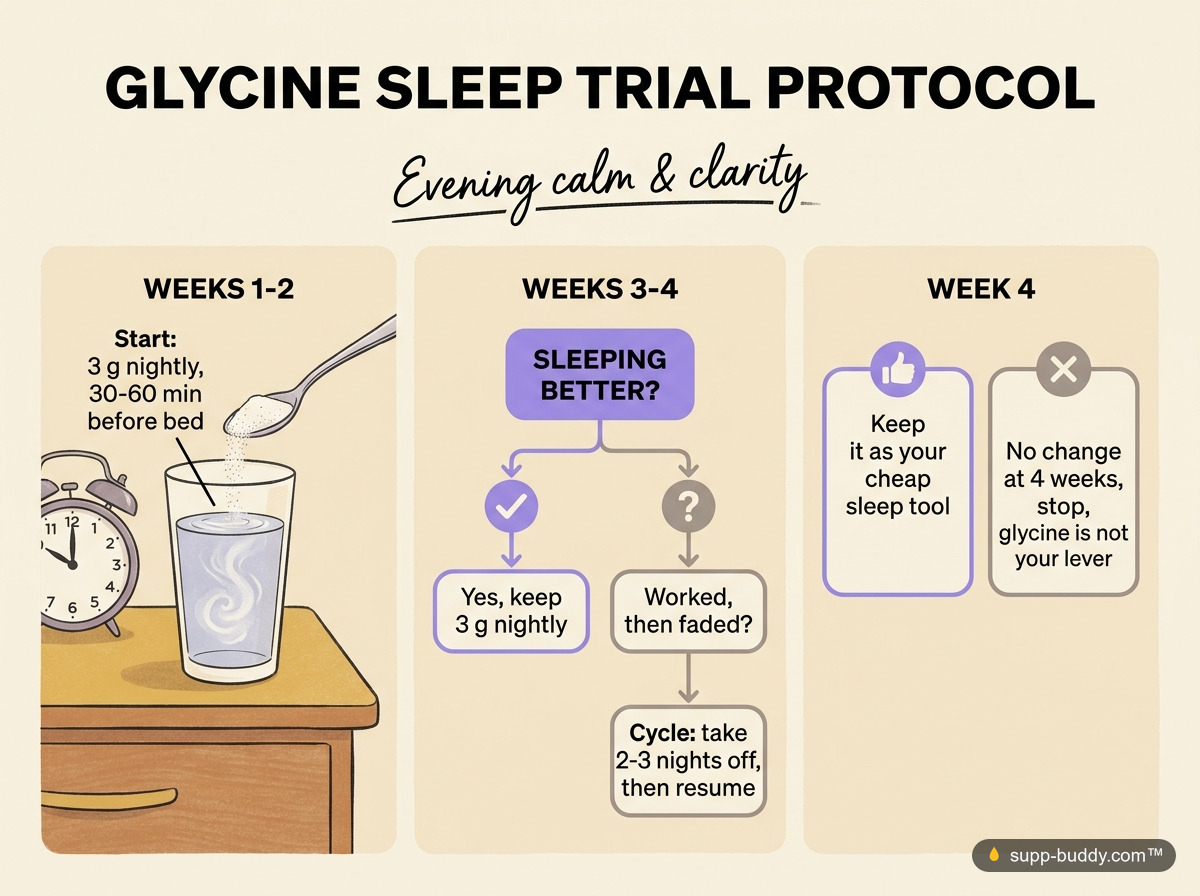
The protocol from the research is refreshingly simple. Take 3 g of plain glycine, dissolved in a glass of water, 30 to 60 minutes before bed.2 The powder is mildly sweet, so it goes down easily. Capsules exist, but you'd swallow five or six to reach 3 g, so the powder is the simpler route. At roughly ten cents a serving, a month's supply costs less than a single coffee.
One question worth settling before you add it: does glycine overlap with anything already in your routine? It won't double up with magnesium, melatonin, or theanine, since those are different substances working in different ways. There's no known direct conflict. Still, no trial has tested glycine and melatonin together. So if you already take melatonin, add glycine on its own first and watch how the pair sits. The one overlap that matters is collagen. If you already take a scoop of collagen at night, you're getting a meaningful glycine dose, and a separate glycine supplement may be redundant. If you'd rather build a fuller nighttime routine than test glycine alone, our deep sleep stack protocol covers what pairs well.
Glycine isn't a knockout pill, so don't judge it on the first night. Give it a couple of weeks of consistent use and watch how rested you feel on waking, not how fast you drop off. The flowchart below maps the whole trial, including what to do if it works at first and then seems to fade.
GlyNAC and the longevity hype
If you've read about glycine lately, you've probably bumped into GlyNAC. It's the biggest story in the research right now, and it's worth understanding, because the headlines run far ahead of the evidence.
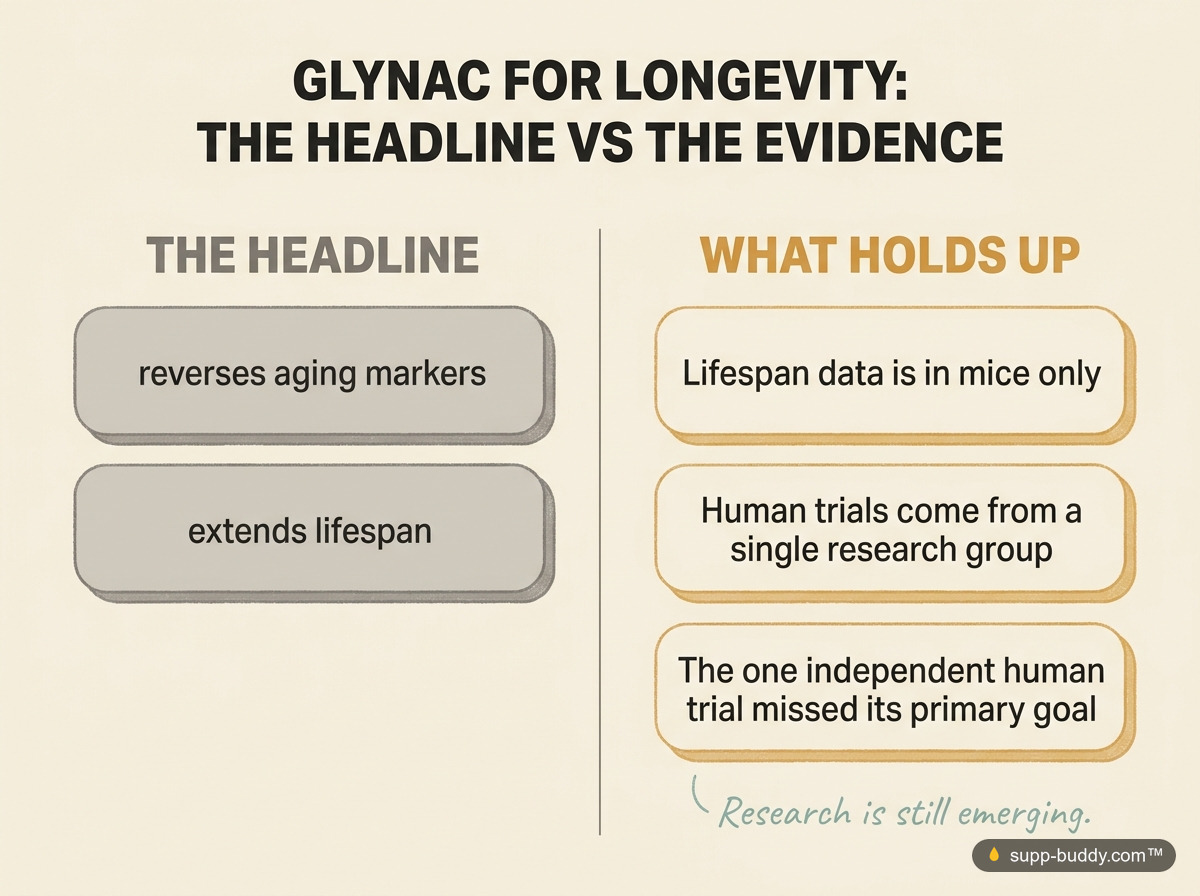
GlyNAC means glycine plus NAC, short for N-acetylcysteine, another amino acid. The idea is that pairing the two helps your cells rebuild glutathione, the body's main built-in antioxidant. Think of it as internal rust-protection that fades with age. A research group at Baylor College of Medicine has run a string of studies on it. Their work suggests GlyNAC restores glutathione in older adults and improves markers tied to aging.67
That sounds enormous, so here's the honest reading. The dramatic lifespan results are in mice, not people. An independent project tested glycine on its own across three separate labs and found it extended the lives of mice.8 A second mouse study found the same for the GlyNAC combination.10 Mouse longevity is an interesting signal in its own right. It is not a promise about human years.
And the human GlyNAC trials nearly all come from that one Baylor lab. When a separate group ran its own controlled trial in healthy older adults, the GlyNAC combination missed its main goal. It didn't beat the comparison on the antioxidant measure the researchers set out to move.9 One independent test falling short doesn't sink the idea, but it's a long way from the breakthrough the headlines sell.
There's also a practical catch. The GlyNAC protocol isn't the easy bedtime dose you'd take for sleep. The human trials used around 7.2 grams a day, split between glycine and NAC, taken for months.7 That's a bigger commitment, a bigger cost, and a harder thing to stick with than a dime's worth of powder at bedtime. For sleep, none of the GlyNAC machinery is needed. If long-term healthy aging interests you, treat GlyNAC as a promising lead under active study, not a settled protocol to buy into today.
Is glycine safe?
For most people, glycine is about as low-risk as supplements get. It's an amino acid your body already makes and eats every day, and regulators treat it as generally safe. In the human studies, side effects were rare and mild, mostly the odd upset stomach.1 There's no known toxic threshold at the doses used for sleep.
A few sensible cautions still apply. If you take clozapine, an antipsychotic medication, skip glycine. Glycine can work against how that specific drug does its job, so it's the one clear interaction worth naming. More broadly, if you take any psychiatric medication, check with your prescriber before adding glycine. Clozapine is the clearest case, but others may apply. If you have kidney or liver disease, your body handles amino acids differently, so check with your doctor first. And as with anything new, tell your prescriber what you're adding so they have your full list.
There isn't enough safety data on glycine supplements during pregnancy or breastfeeding to make a confident call. The cautious move is to skip a glycine supplement during those windows unless your doctor specifically okays it. Food sources like broth, as part of a normal diet, are a different matter and not the concern here.
The bottom line
Our read: glycine is the rare sleep supplement cheap enough to be worth a fair trial. It's also honest enough to admit when it isn't your lever. The independent evidence says it nudges sleep in the right direction for some people, gently, not dramatically. Strip away the funded trials and GlyNAC headlines, and you're left with a safe, ten-cent amino acid that might make your nights a little easier.
So test it like a scientist. Run the simple bedtime protocol from the dose section above, every night for two weeks. Judge it on how rested you feel waking up, not on how fast you fall asleep. If it helps, keep it. If nothing has shifted by week four, glycine isn't your lever. Stop, keep your dime, and look elsewhere.
Common questions
How much glycine should I take for sleep?
The studied dose is 3 g of plain glycine, dissolved in water before bed.2 That's the amount used in the human sleep trials. There's no benefit shown for going higher, so start and stay there.
Does glycine work for sleep?
For some people, modestly. An independent review of the human evidence found glycine before bed helped people fall asleep faster and feel more rested.1 The effect is gentle and varies between people, so treat it as a low-cost experiment rather than a sure thing.
Which is better for sleep, glycine or melatonin?
They do different jobs, and no study has pitted them head-to-head. Melatonin shifts your body clock and suits jet lag or a moved schedule. Glycine helps lower your core temperature and quiet the brain at your normal bedtime.5 Some people use one, some use both.
What are the risks of taking glycine?
Very few at sleep doses. Side effects in the studies were rare and mild, mostly mild stomach upset.1 The clearest caution is the drug clozapine, which glycine can interfere with. Safety data in pregnancy and breastfeeding is thin, so skip the supplement then unless your doctor approves.
Is GlyNAC the same as glycine?
Why did glycine stop working for me after a few weeks?
A number of long-term users report the sleep benefit fading after two to three weeks of nightly use. No published trial has measured this, so it's a community pattern, not a proven effect. A common workaround is to cycle it: take two or three nights off, then resume. If it never worked in the first place, cycling won't change that.