The 3-Supplement Sleep Stack, Graded by the Evidence
You've spent three evenings reading about sleep supplements. You've seen listicles with 20 options, podcast clips, Reddit threads where everyone disagrees. You're more confused now than when you started.
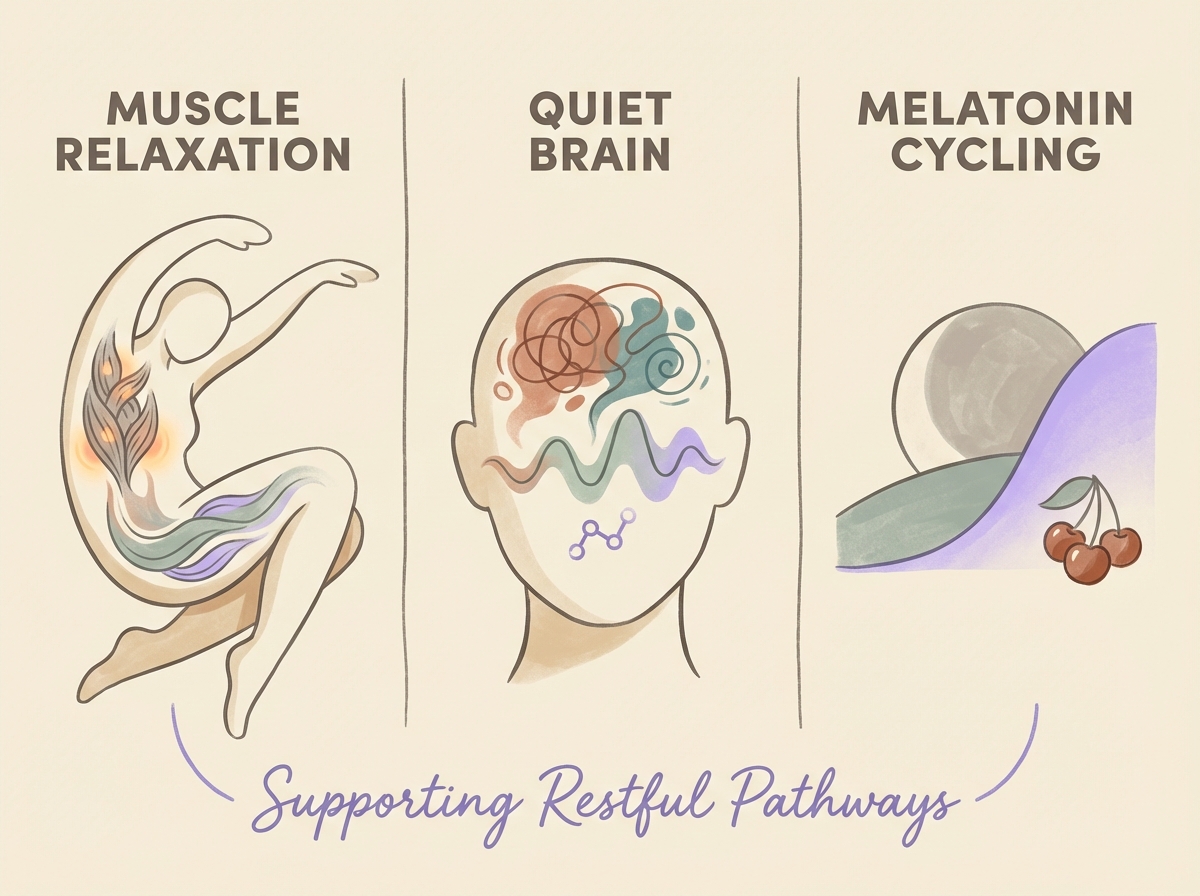
Here's the thing nobody told you: the people who've tried everything and the researchers who've run the trials have landed on the same three supplements. Magnesium glycinate for your body. L-theanine for your brain. Tart cherry for your melatonin cycle. Each one targets a different reason you're lying awake.
This is the protocol. Exact supplements, exact doses, exact timing. What to expect in week one versus week four. And an honest evidence grade for each piece.
Why these three (and not twenty)
Sleep supplement listicles love throwing everything at the wall. Melatonin, valerian, ashwagandha, glycine, GABA, 5-HTP, CBD, passionflower. Pick seven, hope for the best.
The strongest sleep stacks don't work that way. They target different pathways so each supplement does a job the others can't. Magnesium relaxes your muscles and quiets excitatory brain signalling.1 L-theanine dials down the mental chatter that keeps you replaying your day.3 Tart cherry supports your body's own melatonin production without handing it synthetic melatonin at 10x the natural dose.6
People in sleep and supplement communities have been testing this combination for years. One user spent two years trying 15+ sleep supplements and ranked magnesium glycinate and L-theanine as their top two. A night-shift nurse who tested everything called magnesium glycinate "the foundation that everything else builds on."
Community claim: "Melatonin burns out your receptors. Switch to natural alternatives."
What the evidence says: There's no strong evidence that melatonin causes receptor downregulation. But common retail doses (5-10mg) are 10 to 30 times what your body produces naturally. The issue isn't dependency. It's that most people are taking way too much. Tart cherry provides a gentler option: a small amount of natural melatonin alongside compounds that help your body make more of its own.67
The research lines up with the community experience. Two separate reviews confirmed L-theanine improves sleep quality at 200-450mg per day.34 The first large trial testing magnesium glycinate specifically (155 people) found a modest improvement in insomnia scores.2
You might recognise a similar idea from the Huberman sleep stack, a protocol popularised by neuroscientist Andrew Huberman on his podcast, which uses magnesium threonate, apigenin, and theanine. It gets talked about constantly online. This version uses glycinate instead of threonate, drops apigenin (scarce evidence for sleep), and adds tart cherry as a melatonin source. The swap from threonate to glycinate isn't random: Rhonda Patrick, a biochemist and host of the FoundMyFitness podcast, has pointed out that threonate's sleep evidence comes mainly from industry-funded studies and recommends glycinate as her own choice.

Still not sure what's safe alongside what you're already taking? Tell Your Supp' Buddy what's on your nightstand and it'll flag any conflicts before you add to the pile.
How the stack works
Each supplement in this stack targets a different reason you're not sleeping. Think of it as three workers covering three shifts.
Magnesium glycinate: the muscle relaxer
Magnesium helps your brain hit the brakes. It activates GABA receptors (the same system that calming medications target, but gently) and blocks glutamate, an excitatory signal that keeps neurons firing.1 If your body feels tense and restless at bedtime, magnesium addresses that directly. The glycinate form has a bonus: glycine itself is a calming amino acid that may add its own sleep-promoting effect, though this hasn't been tested in glycinate supplementation trials specifically.
L-theanine: the thought quieter
L-theanine is an amino acid from green tea that crosses into your brain and turns up alpha waves. These are the brainwaves associated with being relaxed but alert, like the feeling right before you drift off.3 It doesn't sedate you. It quiets the mental replay loop. People in supplement communities call it "the shut-up-brain pill," and a review of 13 trials backed that framing: it promotes relaxation without causing drowsiness.4
Tart cherry: the melatonin booster
Tart Montmorency cherries contain a small amount of natural melatonin. But the more interesting part is what else they do. Researchers found that a polyphenol compound in cherries blocks an enzyme called IDO that breaks down tryptophan, the raw material your body needs to make serotonin and melatonin.7 Think of tryptophan as the supply line. Your body converts it into serotonin during the day and melatonin at night. Inflammation speeds up the enzyme that chews through that supply. Tart cherry slows the enzyme down, protecting more tryptophan for melatonin production. So tart cherry doesn't just hand you melatonin. It helps your body make more of its own while reducing inflammation at the same time.67
What the evidence says
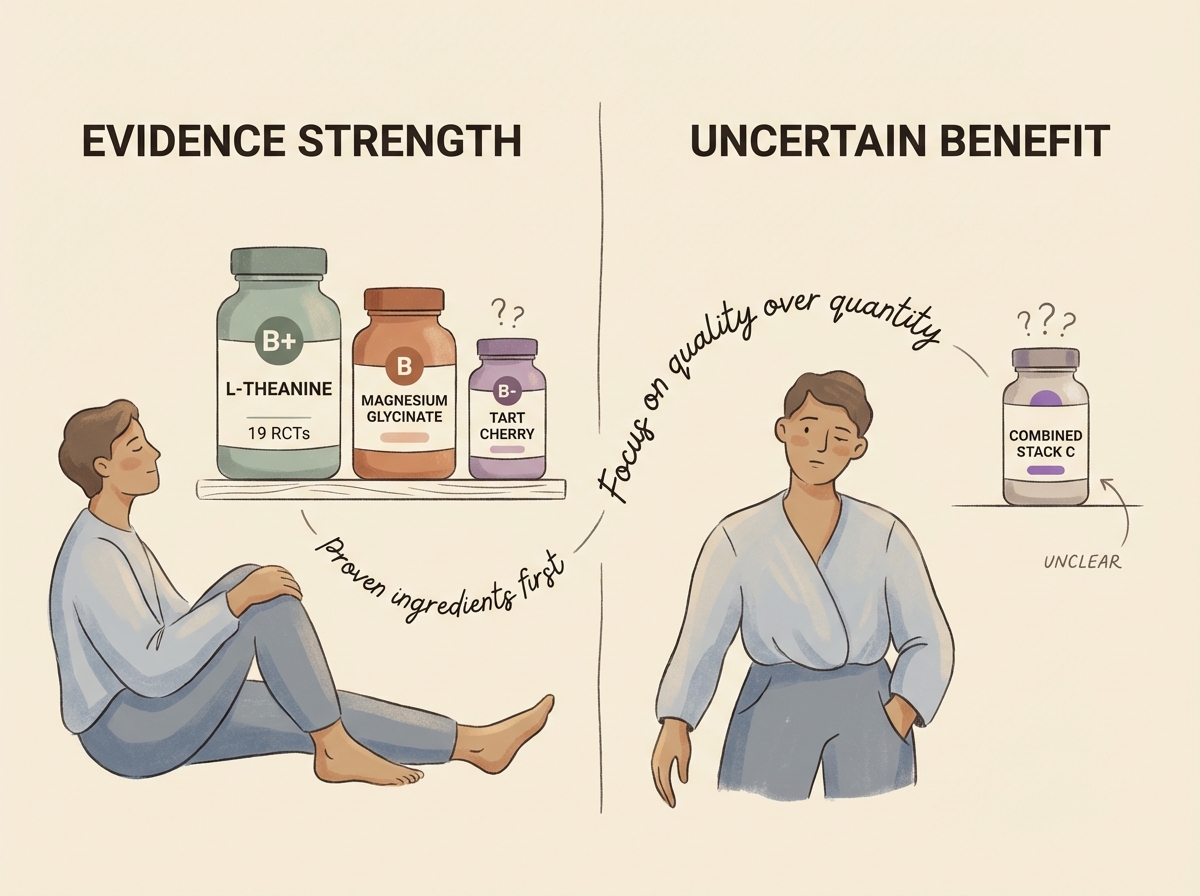
Each supplement has been studied on its own. Here's where the evidence stands, honestly graded.
L-theanine: the anchor
The best evidence in this stack belongs to L-theanine. The largest review pulled together 19 randomised trials with nearly 900 people. It found clear improvements in sleep quality, how long it took to fall asleep, and how groggy people felt the next day.3 A second review of 13 trials confirmed the same findings and concluded that 200-450mg per day is effective and safe.4
Magnesium glycinate: the foundation
A meta-analysis of magnesium and insomnia in older adults found it helped people fall asleep about 17 minutes faster.1 Not life-changing, but noticeable. The first large trial to test magnesium glycinate specifically (155 people, placebo-controlled) found a small but repeatable improvement in insomnia scores, especially in people who weren't getting enough magnesium from food.2 According to the NIH Office of Dietary Supplements, roughly two in five adults fall short of the recommended daily intake.
Tart cherry: the wildcard
The evidence here is thinner. One small trial found tart cherry juice raised melatonin levels and improved sleep time and efficiency in 20 healthy adults.6 A pilot study with just 8 people saw an 84-minute increase in sleep time and identified the tryptophan-preserving mechanism.7 But two larger studies found no significant effect: one in 34 people with overweight using 500mg powder8 and one in 44 healthy adults.9 A systematic review concluded the evidence is too thin and mixed to draw firm conclusions.5
What about all three together? One small trial tested a blend of these supplements alongside tryptophan and glycine.11
The protocol
Here's what to take, when to take it, and in what form. If the idea of adding three new supplements at once feels like a lot, there's a simpler way in (see "How to start" below the table).
| Supplement | Form | Dose | When | Trial period |
|---|---|---|---|---|
| L-Theanine | Capsule | 200-400mg (start at 200) | 30-60 min before bed | 4-8 weeks |
| Magnesium Glycinate | Capsule or tablet | 200-350mg elemental | 30-60 min before bed | 4-12 weeks |
| Tart Cherry | Juice concentrate (preferred) or capsule (1g+) | 30ml concentrate 2x daily OR 1g+ capsule | Evening, 1-2 hours before bed | 2-4 weeks |
Know what you want to take but not sure when to fit it in? Give Your Supp' Buddy your sleep goal and what you're already taking and it'll map out a timing plan that fits your evening.
How to start (the overwhelmed-beginner version)
You don't have to buy three things and start everything tonight. In fact, the evidence suggests a better approach: add one supplement at a time so you know what's working and what isn't.
Week 1: Start with L-theanine alone (200mg, 30-60 minutes before bed). It has the strongest evidence and the fastest onset. You'll know within a few nights whether it helps quiet your mind at bedtime.
Week 2: Add magnesium glycinate (200mg elemental). Take it at the same time as the theanine. If you get any GI looseness (uncommon with glycinate, but possible), drop to 100mg and work back up.
Week 3-4: If you want to add tart cherry, start now. 30ml concentrate with dinner is the form that worked in trials; a 1g+ capsule is an alternative if you want to skip the sugar. This one has the weakest evidence, so it's optional. Some people skip it entirely and stick with the two-supplement version.
By week 4, you're running the full stack and you have a baseline for each piece. If something isn't sitting right, you know exactly which one to adjust.
Which magnesium form to buy
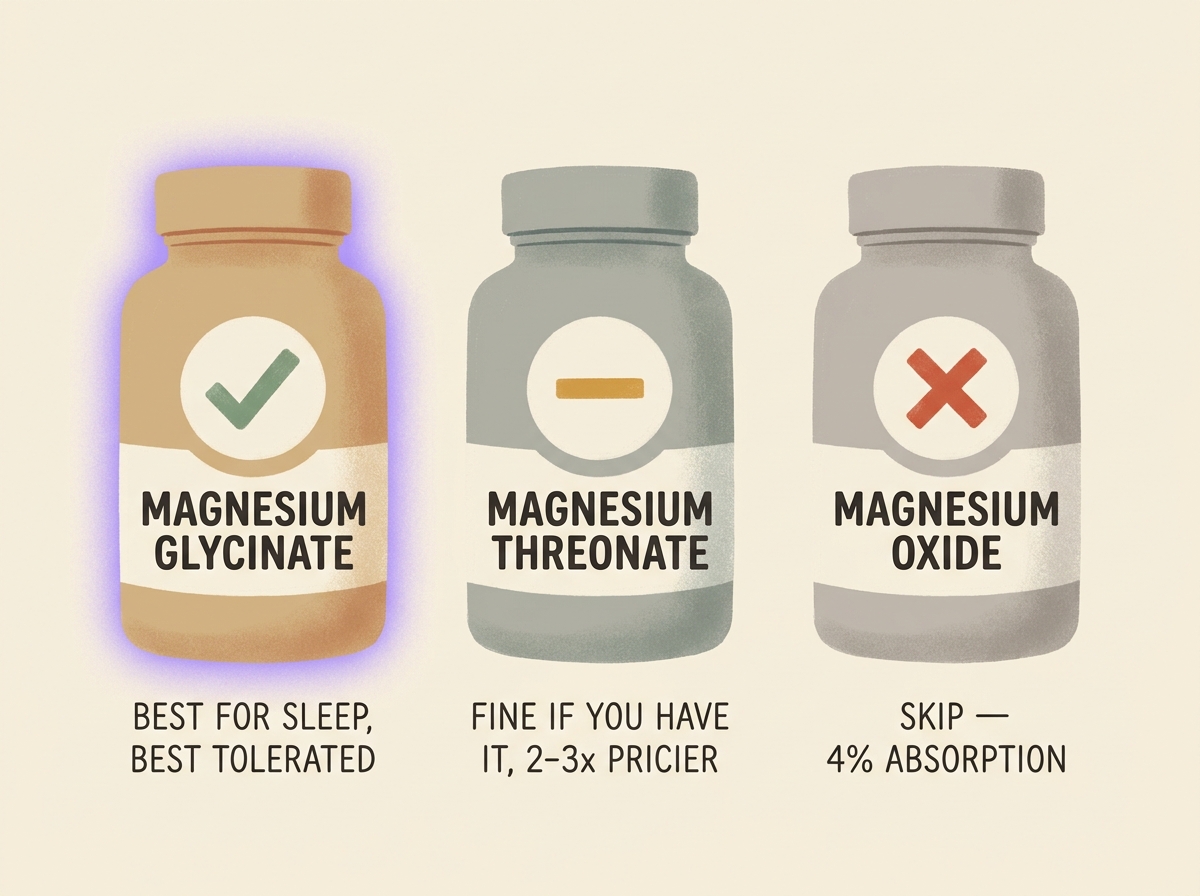
If you're standing in the supplement aisle staring at six different magnesium bottles, here's the short version.
Magnesium glycinate (bisglycinate): the best-tolerated form for sleep. It's the only form with a dedicated sleep trial of 155 people.2 Doesn't cause the GI issues that cheaper forms do. This is the one to buy.
Magnesium threonate: marketed for brain health, costs 2-3x more than glycinate. Threonate is fine if you already have it. You don't need to pay the premium.
Magnesium oxide: about 4% absorption. The community calls it "expensive poop pills" and the evidence supports their skepticism. Skip it.
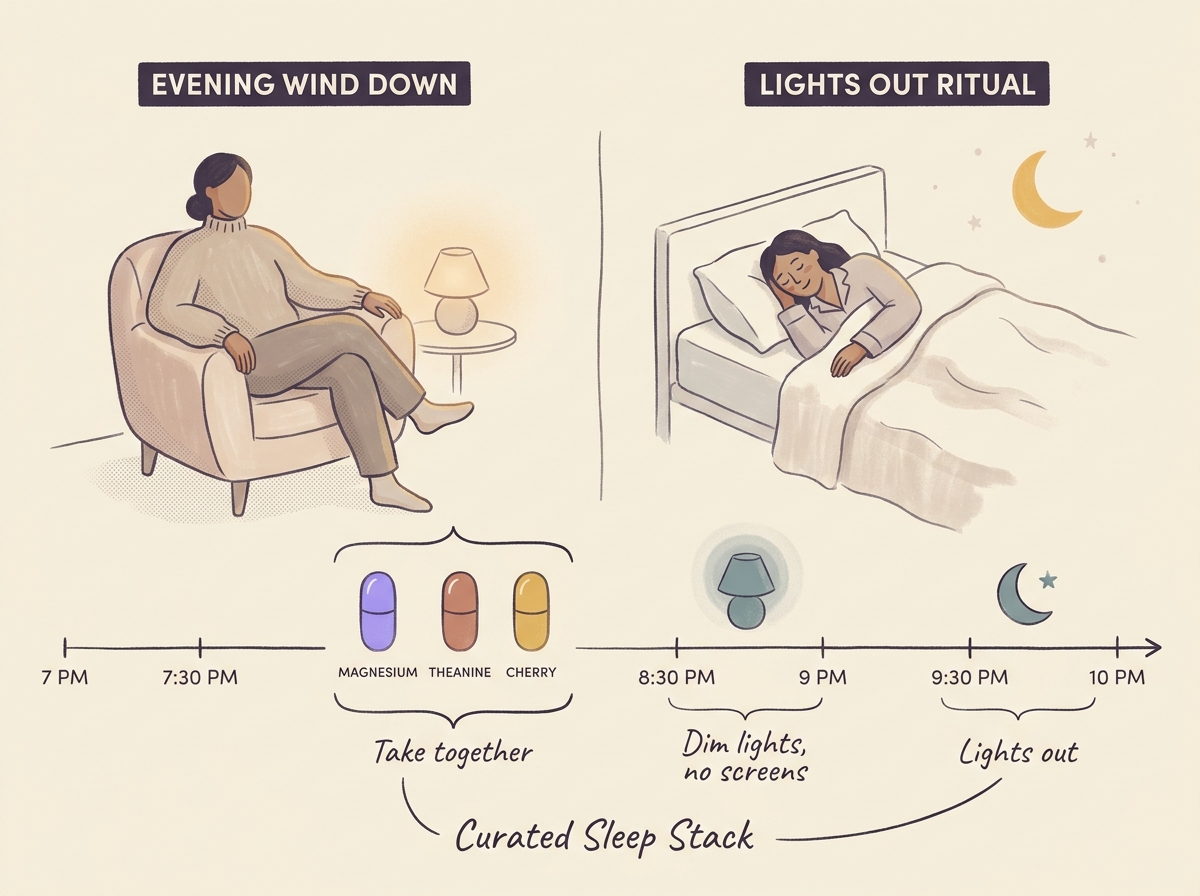
What to expect week by week
Week 1: L-theanine tends to show up first. You may notice your mind quiets down faster at bedtime. The mental replay of your day gets shorter. Some people feel this on night one. Magnesium takes longer. Don't judge it yet.
Weeks 2-3: Sleep onset should feel slightly smoother. The "tossing and turning because your body won't relax" feeling should ease if magnesium is doing its job. If you're waking less during the night, that's a good sign. If tart cherry is going to help, you'll start noticing around now.
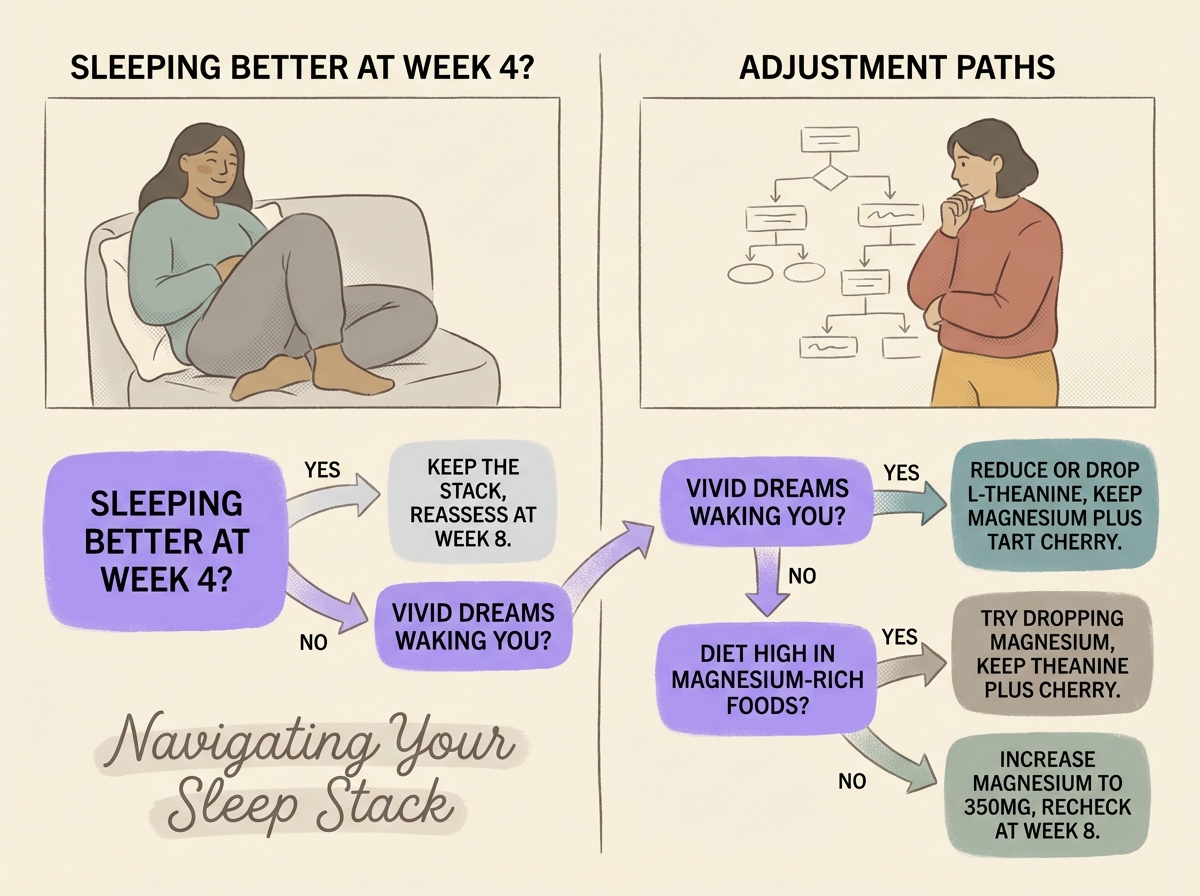
Week 4: This is your checkpoint. The glycinate trial found modest improvement in insomnia scores by week four.2 If you don't notice any difference by now, and your diet already includes plenty of magnesium-rich foods (dark leafy greens, nuts, seeds, whole grains), the magnesium piece may not be doing much for you. That's useful information, not a failure. It means you weren't deficient, and the theanine is probably doing the heavy lifting.
Week 8: If the stack is working, you should feel a reliable difference in how quickly you fall asleep and how rested you wake up. Not dramatic. But reliable. If it's not working, the flowchart below walks you through what to adjust first. And if nothing's moved by week 8 despite trying adjustments, talk to your doctor. The problem may not be one that supplements can fix.
Safety and adjustments
This stack has a clean safety profile. A few things deserve attention.
Magnesium interactions: if you take bisphosphonates (for bone density), separate them by 2+ hours. Same for tetracycline and quinolone antibiotics (2-4 hours apart). Long-term PPI use (like omeprazole) can lower your magnesium levels, which means this supplement might help more than average. The NIH sets the upper limit at 350mg per day from supplements (food sources don't count toward this cap), which is why the dosage table caps the range there.
L-theanine: may add to the effect of sedatives and benzodiazepines. If you take anything for sleep or anxiety that makes you drowsy, start theanine at 100mg and see how the combination feels. Across all 19 trials in the largest review, no serious adverse effects were reported.3
If you take an SSRI or SNRI: L-theanine works through different pathways than serotonin-based medications, so it shouldn't carry the serotonin-stacking risk that 5-HTP does. But this hasn't been tested in dedicated drug-interaction trials. A review of theanine in people with mental health conditions found it well-tolerated alongside standard psychiatric medications, but that's observational tolerance, not a controlled interaction study.10 Mention it to your prescriber so they have the full picture. Magnesium is also safe alongside most psychiatric medications. Tart cherry has no documented interactions with SSRIs or SNRIs.
Tart cherry: no significant drug interactions documented. The main caution is practical: juice concentrate contains 30-40g of sugar per serving, which adds up fast if you're drinking it twice a day. Capsules avoid this entirely and are easier to dose accurately.
Pregnancy and breastfeeding: magnesium is generally considered safe during pregnancy (many prenatal vitamins include it), but check the dose with your OB. L-theanine and tart cherry don't have enough safety data in pregnancy to recommend. Skip those two if you're pregnant or nursing.
The vivid dreams issue: L-theanine can intensify dreams in some people. If vivid or disturbing dreams start waking you up, that's the theanine. Huberman has warned on his podcast that people prone to vivid dreams should skip theanine entirely. Our recommendation is more graduated: try reducing to 100mg first. If the vivid dreams persist, then drop it. Magnesium glycinate plus tart cherry still covers the relaxation and melatonin pathways.
Where the sleep stack lands across the 8 pillars
Sleep leads at 72. Stress (55) and Mood (50) get a secondary lift from L-theanine. Recovery sits at 45 from tart cherry's anti-inflammatory properties. Everything else is weak. This stack does one thing well.
Key takeaways
- Start with L-theanine (200mg) and magnesium glycinate (200mg), taken together 30-60 minutes before bed. These two are the core.
- Add tart cherry (30ml concentrate twice daily or 1g+ capsule) if you want melatonin support without the synthetic stuff. Weakest evidence of the three, but the most interesting mechanism.
- Buy glycinate, not threonate or oxide. Best combination of evidence, tolerability, and price.
- Give it four weeks. Week one isn't the test. Week four is.
- If vivid dreams start waking you, reduce or drop the theanine. Magnesium plus tart cherry still covers two of three pathways.