

Magnesium for Sleep: Which Form Has the Best Evidence
You've seen "Magnesium 500 mg" on the front of a bottle. Two different forms can both say 500 mg and deliver wildly different amounts of the part your body absorbs. That's the gap between people who say magnesium worked and people who say it did nothing.
The fix isn't complicated. Read the elemental number on the back, pick a form with absorption behind it, and give it the runway the trials gave it.
Why most magnesium doesn't help with sleep
Most magnesium supplements underdeliver because the milligrams on the front are the weight of the whole compound, not the weight of the magnesium inside it. Magnesium has to be bound to something to stay in capsule form. The "something" takes up most of the weight.
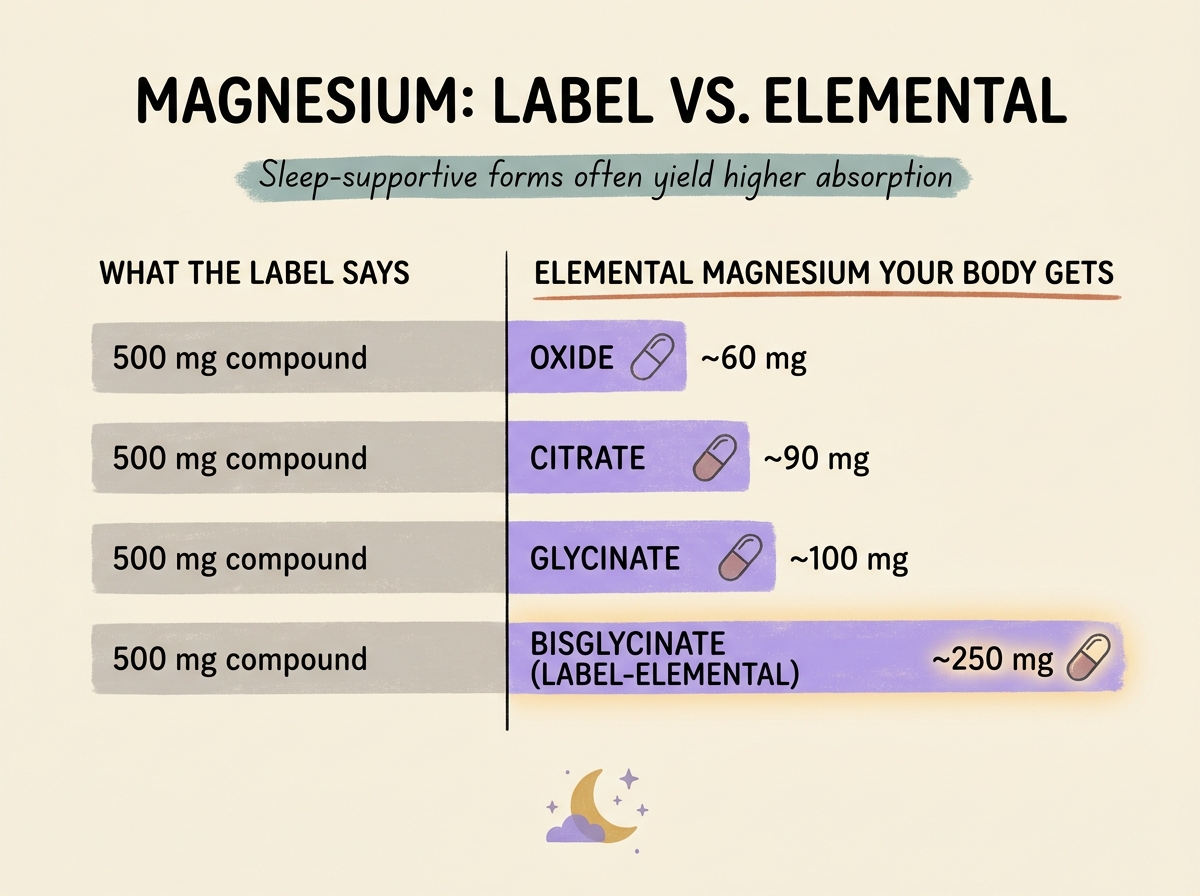
Magnesium oxide is the cheap form most multivitamins use. A 500 mg oxide capsule contains magnesium, but oxide is poorly absorbed — only a small share crosses into your blood. By the time the math is done, the body ends up with roughly 60 mg of usable magnesium per 500 mg oxide capsule. Citrate at 500 mg of compound gives you around 90 mg of elemental magnesium (the magnesium inside the molecule), with moderate absorption. Glycinate (magnesium bound to the amino acid glycine) sits around 100 mg elemental in a 500 mg dose. It has the best absorption of the common forms. A bottle that says "250 mg elemental bisglycinate" is already counting the elemental part for you.
Clinical sleep trials hit 200 to 500 mg of elemental magnesium per night, using well-absorbed forms. If you're taking one 500 mg oxide capsule, your body absorbs roughly 60 mg. The label says you took 500. Your body got 60.
Which magnesium form has the evidence for sleep
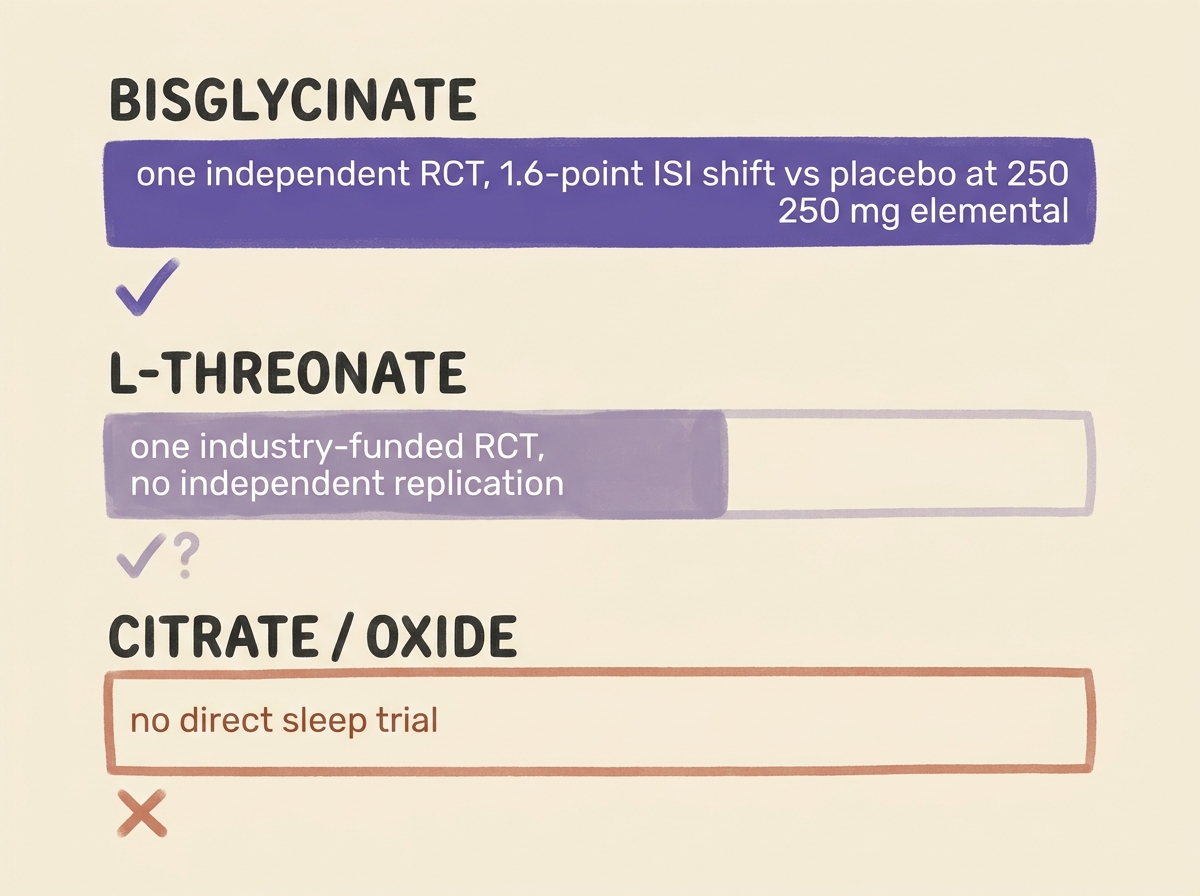
Bisglycinate has the only independent trial that specifically tested a form for sleep. Everything else either lacks direct evidence or has a manufacturer-funding problem. Here's the hierarchy honestly, one form at a time.
Bisglycinate: the one with the best data
A 2025 trial in adults with poor sleep gave half the group 250 mg of elemental magnesium as bisglycinate nightly. The other half got placebo. The bisglycinate group's Insomnia Severity Index (ISI) scores improved by about 1.6 points more than placebo on a 28-point scale.2 Secondary measures of sleep quality and daytime fatigue also favoured bisglycinate.2
The 2021 review of older-adult trials pointed the same direction.1 Oral magnesium reduced the time it took to fall asleep versus placebo.1
A 1.6-point ISI shift is measurable but small. If your sleep is already fine, you probably won't feel anything. If you're running low on dietary magnesium, and most adults are, the chance you'll notice something goes up.
Bisglycinate is also the form that's least likely to send you to the bathroom. The glycine it's bound to is gentle on the gut. That matters because the studied doses sit above what oxide or citrate can deliver without GI side effects (per NIH ODS).
L-threonate: the brain marketing versus the single study
Magnesium L-threonate is the form Andrew Huberman and most "brain-optimised" stacks recommend. The pitch is that it crosses the blood-brain barrier more readily than other forms. The data is a different story.
Only one randomised controlled trial (RCT — a placebo-controlled study design) has been published on L-threonate (sold as Magtein®) for sleep.5 The trial reported improved subjective sleep quality and daytime functioning at 1 g per day of the compound (~144 mg elemental). The catch is the conflict of interest. Three of the six authors work for the ingredient supplier. No independent group has replicated the finding.
Worth the price premium? Probably not yet. L-threonate costs roughly three to five times more per dose than bisglycinate. Until an independent trial replicates the result, you're paying for the brain-penetration marketing angle rather than a stronger evidence base for sleep.
Citrate and oxide: not the right tool for sleep
Magnesium citrate is the form people reach for when they're constipated. It works for that. There is no direct trial of citrate for sleep. The dose that would match the bisglycinate studies tends to cause loose stools before it does anything else. Magnesium oxide is the cheapest form and the one with the lowest absorption. It's fine for label-padding in a multivitamin. At sleep-relevant doses it causes GI distress before it does much else.
Does magnesium also help with anxiety?
This is the question the anxious-sleeper crowd asks more than any other: which magnesium is best for sleep and anxiety? The honest answer is that the direct anxiety effect didn't separate from placebo in the only independent bisglycinate trial.2 A 2024 review that looked at magnesium for self-reported anxiety and sleep together reached the same conclusion.3 Limited direct evidence for the anxiety endpoint at current doses.
The "calmer baseline" most people describe is probably a thing. It's just coming through better sleep, not through magnesium acting like a benzodiazepine (a prescription anti-anxiety class). Magnesium's mechanism touches the same systems that calm the nervous system down. It dampens NMDA receptors (the brain's main accelerator signal) and supports GABA-A receptors (the brain's main brakes).6 Those pharmacological effects (the changes prescription drugs drive at those receptors) show up at drug-level doses far above what supplements deliver. At supplemental doses the mechanism is present but its size is below what trials can pick up.
Magnesium is generally safe alongside common medications like SSRIs (selective serotonin reuptake inhibitors, a common antidepressant class), benzodiazepines (anti-anxiety drugs), and blood-pressure drugs. The right move is to mention it to your prescriber so they have your full list (per NIH ODS).
If anxious thoughts are the main thing keeping you awake, magnesium alone is probably the wrong tool. The ashwagandha and L-theanine stack targets the stress side more directly and stacks cleanly with a nightly glycinate dose.
Not sure if your stack is going to clash with magnesium? Ask Your Supp' Buddy. Scan the bottles you're already on and name what you're trying to fix. It'll flag interactions and tell you if a glycinate dose makes sense.
Getting magnesium from food
Most adults eat below the RDA. The typical US diet delivers around 268 mg per day. The RDA is 310 to 420 mg per day depending on age and sex (per NIH ODS). Food won't get you to the studied sleep dose alone. It closes part of the gap and changes what your supplement needs to do.
| Food | Serving | Amount |
|---|---|---|
| Pumpkin seeds (pepitas) | 1 oz / 28 g | 156 mg |
| Chia seeds | 1 oz / 28 g | 111 mg |
| Almonds (raw) | 1 oz / 28 g | 80 mg |
| Spinach (boiled) | ½ cup / 90 g | 78 mg |
| Cashews | 1 oz / 28 g | 74 mg |
| Dark chocolate (70–85%) | 1 oz / 28 g | 65 mg |
| Black beans (cooked) | ½ cup / 86 g | 60 mg |
How much, how often. An ounce of pumpkin seeds (28 g) plus an ounce of almonds (28 g) hits around 236 mg. Add half a cup of cooked spinach (90 g) and you're at roughly 314 mg for the day. That lands inside the RDA window. A 200 mg elemental glycinate at night sits in the lower end of the dose the trials used. Food fills part of the gap. The supplement closes the rest.
Nutrient data from USDA FoodData Central.
How much, which form, when to take it
For most people starting out: 200 to 300 mg of elemental magnesium as glycinate or bisglycinate, taken 30 to 90 minutes before bed. The trials didn't enforce a fixed pre-bed window. This range is the practical one most people land in. Starting at 200 mg gives gut-sensitive beginners room to increase, and sits just below the doses pooled in the older-adult trial review.
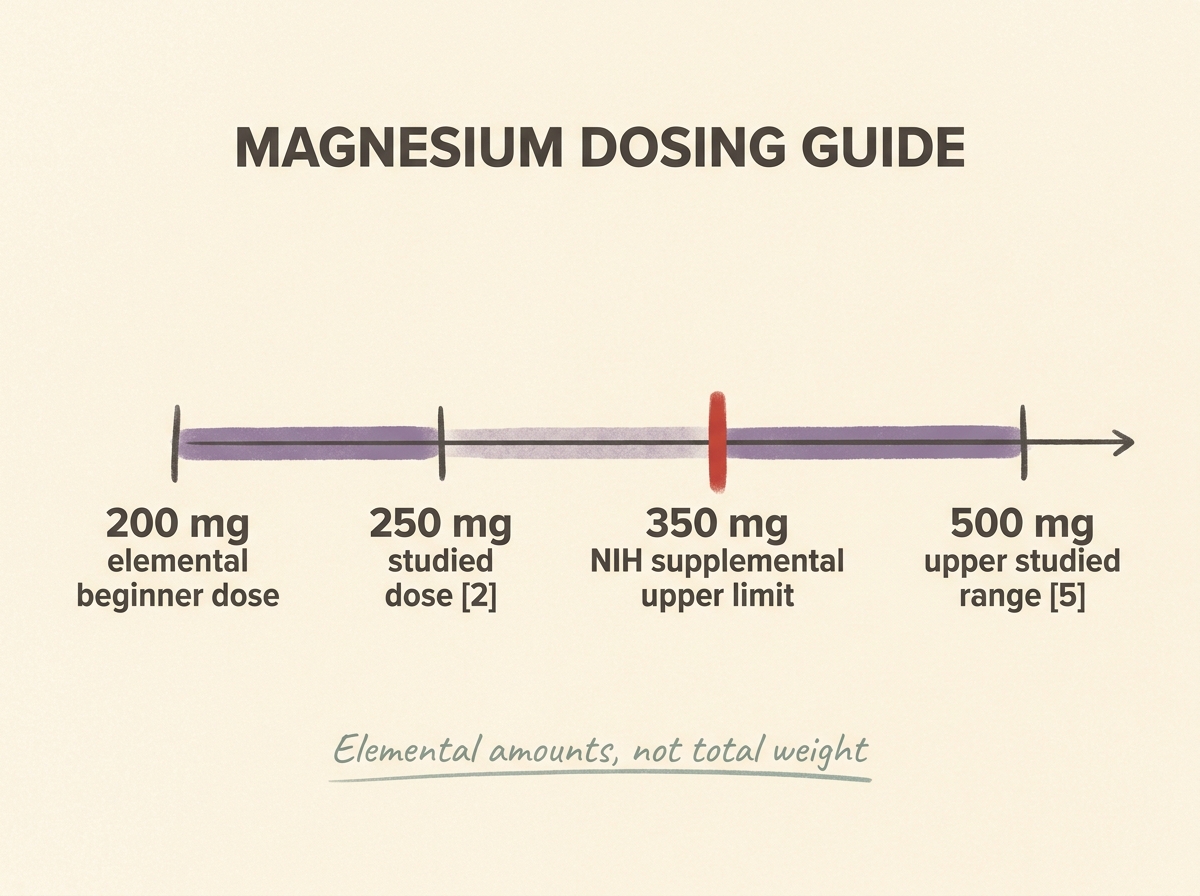
The number to read on the label is "elemental magnesium," not the compound weight. If the bottle only lists the compound weight, every 500 mg of bisglycinate carries about 100 mg of elemental magnesium. Two capsules of a 500 mg bisglycinate product gets you to roughly 200 mg elemental. Three gets you into the studied range.
Give it four to eight weeks. The trials ran in that window before the difference showed up.24 A few nights isn't long enough to tell. If you're going to make a call on whether it works for you, give it the same runway the studies gave it.
If your gut complains at 250 mg taken once, split it. Half with dinner, half before bed. No trial has tested split dosing for the sleep effect — community reports are the only signal here.
Our editorial position: magnesium glycinate is the most reliable foundational layer in a sleep stack. Getting to sleep is a little easier and staying asleep is a little smoother. It's not a knockout effect. It's a "this works quietly, week after week" effect, which is the right shape for a foundational supplement. For L-threonate and citrate the picture is thinner — one industry-funded trial for L-threonate, and no direct sleep trial for citrate at sub-laxative doses. The decision flowchart above shows the week-by-week version of the protocol.
Safety and who should be careful
At studied doses, magnesium is well tolerated by most adults. The main risk is GI, and it's almost entirely form-dependent. Oxide and citrate at higher doses cause loose stools more often than glycinate does. That's not a dangerous side effect, but it's why we keep pointing people at glycinate first.
Two reference numbers worth keeping in mind. The adult RDA is 310 to 320 mg per day for women and 400 to 420 mg per day for men (per NIH ODS). Food magnesium counts toward the RDA; supplemental magnesium has a separate ceiling of 350 mg per day. At 200 to 300 mg of supplemental bisglycinate, you're inside that ceiling — food intake on top is what helps you land closer to the RDA. Going higher on supplements chronically without a reason is where the GI and, rarely in people with reduced kidney function, the cardiac risk show up.
Interactions worth knowing about (per NIH ODS):
- Bisphosphonates (osteoporosis drugs) and certain antibiotics, tetracyclines and quinolones, bind to magnesium and don't get absorbed. Space these two to six hours apart from your magnesium dose.
- Loop and thiazide diuretics can deplete magnesium over time, which sometimes raises your supplemental need.
- Long-term proton pump inhibitor use (omeprazole, esomeprazole) is associated with low magnesium. Worth flagging to a prescriber if you've been on a PPI for years.
Talk to your obstetric provider before starting magnesium during pregnancy or while breastfeeding. RDAs differ during these life stages and supplemental-form safety data beyond food intake is limited. Default to your provider's call until that data is available.
Skip if you have significant renal impairment, because your kidneys clear magnesium and accumulation becomes a concern. Also skip if you have myasthenia gravis (a condition that causes muscle weakness because nerve-to-muscle signals don't get through properly). Magnesium can worsen the weakness in that condition.
The bottom line
Our read on the evidence: the magnesium-for-sleep story holds up, just smaller than the marketing wants it to be. The form decides whether the dose on the label has a chance of mattering. Bisglycinate has the only independent trial that ran on a specific form for a specific outcome. L-threonate's case is thinner, and the form comparison above explains why.
If you want to test this: 200 mg of elemental glycinate each night, timed per the dosage section above. Track whether falling asleep gets easier and whether you wake up less. One week isn't long enough to tell. If sleep is the reason you're looking at magnesium, this is the form to start with. Once magnesium is in place and you want the layered version, the deep sleep stack protocol covers what stacks well on top of it.
Common questions
Is magnesium safe for kids who can't sleep?
Direct sleep-trial evidence for primary insomnia in children is thin. Age-banded RDAs from NIH ODS apply. Supplemental dosing in kids without a clinical reason is a conversation for a paediatric clinician, not a self-managed call. If your child has a persistent sleep issue, the right step is talking to their doctor before reaching for a supplement.
How long before bed should I take magnesium?
30 to 90 minutes before bed. Either with dinner or right before bed works. The full dose breakdown is in the dosage section above.
Can I take magnesium with melatonin?
Yes, these don't interact pharmacologically (they work through different body systems). Stacking them is common. If you respond modestly to each, the combination is reasonable.
What's the difference between magnesium glycinate and bisglycinate?
Practically nothing. "Bisglycinate" means two glycine molecules are bound to one magnesium atom. That's the typical chelation (a stable chemical bond designed for absorption). Most products labelled "magnesium glycinate" are bisglycinate by chemistry. Look at the elemental magnesium number on the supplement facts panel, not the name on the front.
What about magnesium for sleep side effects?
The main one is loose stools, and it's mostly form-related. Oxide and citrate at sleep-relevant doses cause it most often, glycinate the least. Staying inside the 350 mg per day supplemental upper limit (per NIH ODS) keeps most adults clear of trouble. People with reduced kidney function or myasthenia gravis should not supplement without medical supervision.
Will magnesium fix true insomnia?
No. The evidence is consistent on this. Magnesium produces a modest improvement in sleep-quality measures, not a dramatic one. If your insomnia is severe enough to disrupt daily functioning, magnesium is a foundational supportive piece, not the primary intervention. CBT-I (cognitive behavioural therapy for insomnia) has stronger evidence and is the first-line non-drug recommendation in most clinical guidelines.