Best Supplements for Energy: Test Before You Buy Them
You're tired in a way coffee stopped fixing a while ago. Maybe you've tried a B-complex, or a magnesium that did nothing. Maybe you're just standing in front of a wall of bottles with no idea where to start. Either way, one thought keeps nagging: your bloodwork came back normal, so why do you still feel like this? The "best supplements for energy" lists never answer that. We will.
The best supplements for energy depend on what you're missing
The honest answer might be annoying: the best supplement for energy isn't one product. It's whichever gap your body happens to have. So the smartest first move isn't buying. It's testing.
Fatigue splits into two buckets. The first is a missing nutrient: low iron, low vitamin B12, low vitamin D, or low magnesium. Fix the gap and the tiredness often lifts. The second bucket is everything else: gentle helpers like CoQ10, ashwagandha, and creatine that nudge your energy rather than flip a switch.
Here's the part worth tattooing on the bottle. Iron is the only supplement here that makes a big difference for tiredness, and only if you're low. Everything else is either deficiency-dependent or modest. That's not a downer. It's the thing that saves you from spending $200 on the wrong jar.
And before any of this, the biggest energy levers usually aren't in a bottle at all. Steady sleep, enough protein and iron-rich food, and keeping stress in check beat every supplement on this list for most people. Supplements fill specific gaps. They don't replace the basics.
Why your "normal" blood test missed it
Here's what a standard panel doesn't tell you: "normal" and "enough to feel good" are not the same range. A result can sit inside the lab's normal band and still be low enough to drain you. That gap is where most tired-but-"healthy" people get stuck.
Iron is the worst offender. A basic test often checks serum iron (the iron floating in your blood right now). But the number that matters for fatigue is ferritin, your stored-iron level. Ferritin can be scraping the bottom while serum iron looks fine, and that low ferritin is enough to flatten you.
In the big supplement and women's-health threads on Reddit, the same line keeps coming up. Ferritin, not serum iron, is what makes or breaks people's energy. The community is right about this one, and most standard panels still skip it.
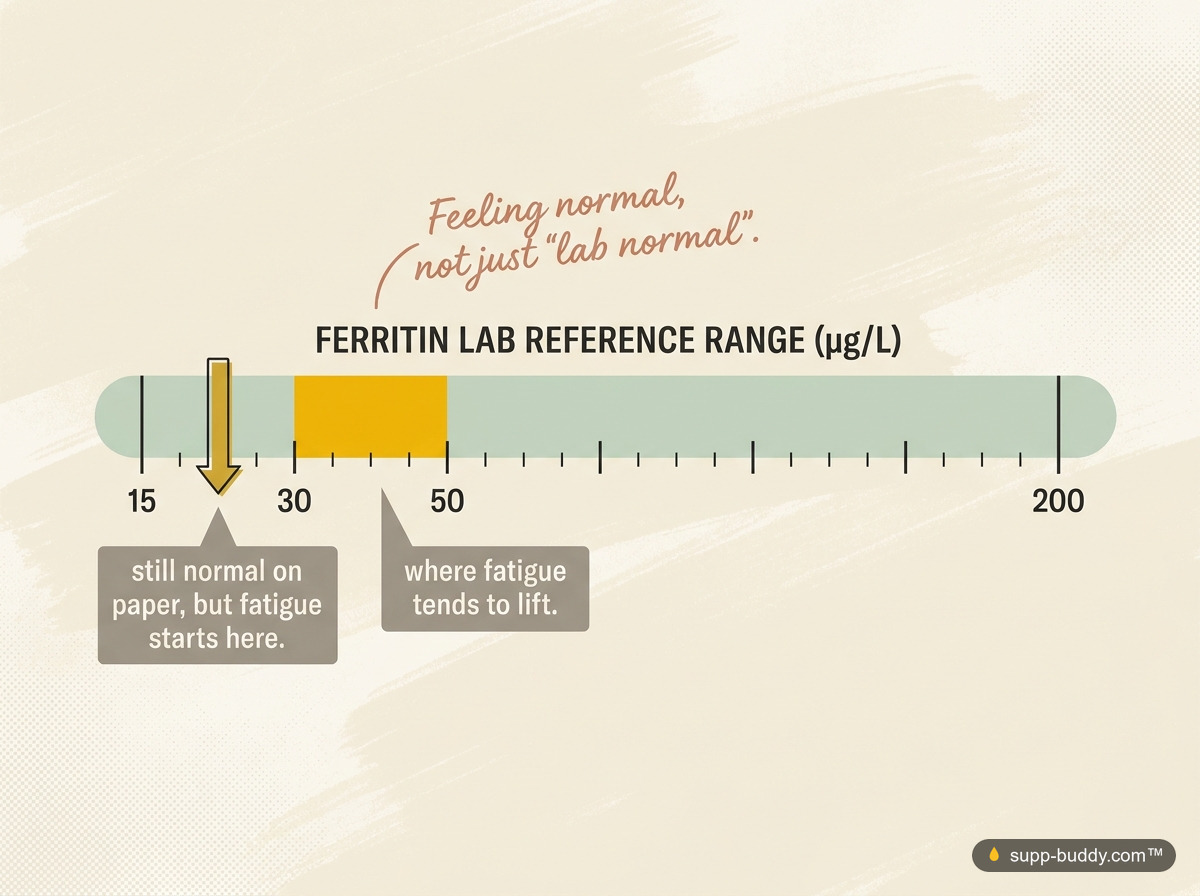
So what counts as low? For ferritin, fatigue can start once you drop below about 30 micrograms per litre. Many labs only flag you under 15. That's the trap. You can be "in range" and still be running on fumes.
If you take one thing from this article, make it this short test list. Ask your doctor for three numbers: ferritin (stored iron), 25-hydroxy vitamin D (the standard vitamin D blood test), and active B12. A basic panel of all three runs about $30 to $60. That's cheaper than two months of guessing with the wrong supplement.
The logic from there is simple, and it fits on one page.
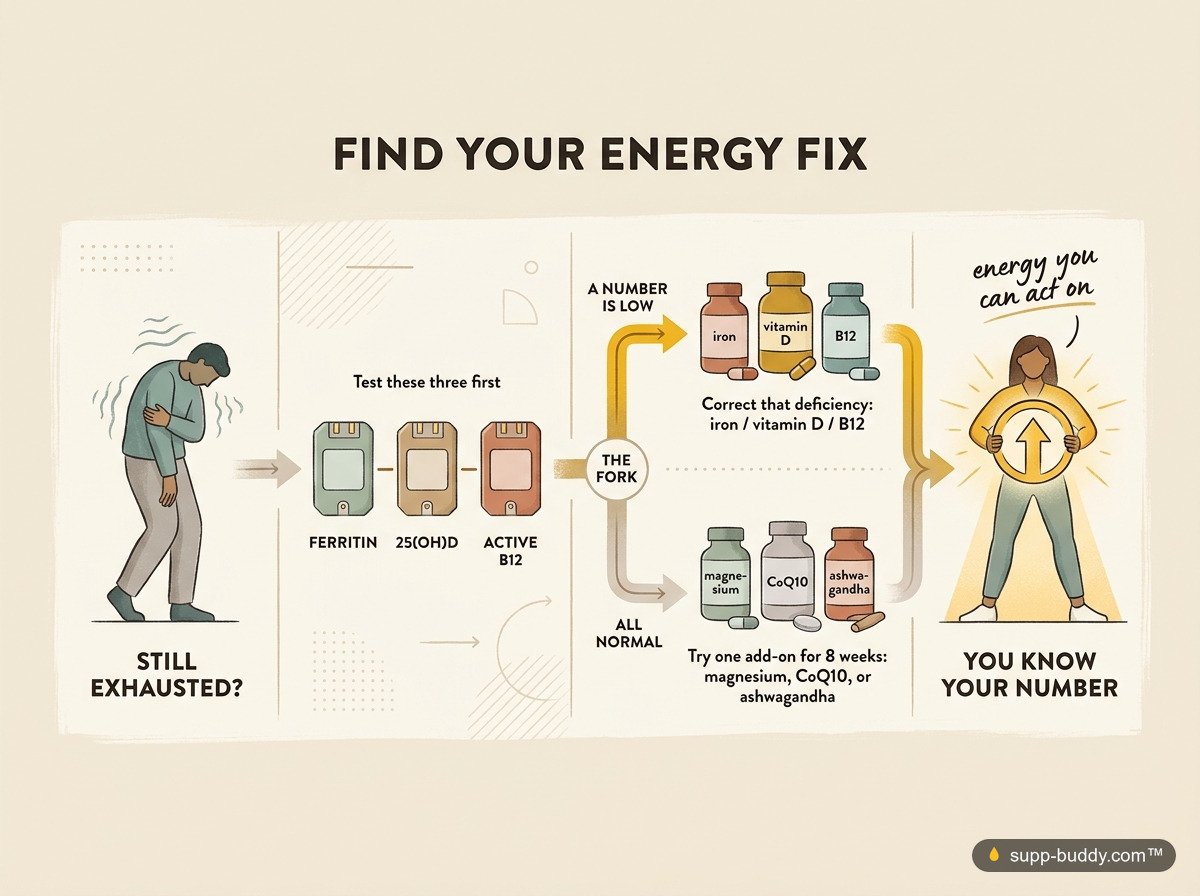
If a number comes back low, you've found your answer: correct that specific deficiency (iron, vitamin D, or B12) and give it time. If all three are normal, a missing nutrient probably isn't your problem. In that case the gentle add-ons (magnesium, CoQ10, or ashwagandha) are a reasonable eight-week experiment. Either way, you stop guessing.

Not sure which of those numbers to ask for, or whether a supplement even fits your situation? Tell Your Supp' Buddy what you're dealing with and what you already take. It'll talk you through which markers are worth requesting and whether any supplement here is worth your money, before you spend it. Free to start.
Iron: the one that can fix your energy, if you're low
Iron has the strongest evidence of anything on this list, and it's not close. Reviews of iron in people who are low but not yet anemic keep finding that it eases unexplained tiredness.1 A 2026 trial in 164 iron-deficient women who weren't anemic saw their fatigue scores drop on a daily iron pill.2
A 2025 review that pooled 18 studies of iron in non-anemic people found the same pattern: less fatigue, and better focus and mood.3 The benefit lives below the anemia line, down at the stored-iron level a basic panel ignores.
Some people are far more likely to run low than others. Menstruating women, vegetarians and vegans, endurance athletes, and regular blood donors top that list. If that's you and you're wiped out, ferritin is the first number to check.
Now the catch, and it's a big one: iron does nothing for your energy if you're not low, and taking iron you don't need can hurt you.
Before you touch iron
- It only helps if your stored iron is low. If your level is normal, iron won't lift your energy.
- Your body has no easy way to dump the excess, so too much builds up and damages tissue.
- This is the one supplement you should never take on a hunch. Confirm low ferritin first, then supplement.
On dose: an over-the-counter iron tablet (around 18 to 45 mg of elemental iron) is plenty for topping up mild shortfalls. Correcting a deficiency often needs more, roughly 100 to 200 mg a day. That higher range belongs under a doctor's eye, not a guess. Taking it every other day, with a little vitamin C, eases the stomach upset and can absorb just as well.
B12 and vitamin D: only if you're deficient
These two follow iron's rule: they fix tiredness when you're short of them, and do little when you're not. Start with B12. A review of more than 6,000 people found that B12 supplements didn't reliably improve memory or mood across the board.4 The people who feel a difference are the ones who were deficient to begin with: many vegans, older adults, and long-term metformin users.
If your levels are already normal, high-dose B12 doesn't add anything you'll feel. The energy "boost" people describe after a B12 shot is almost always a deficiency being corrected, not a healthy person gaining superpowers. If you do need it, high-dose oral B12 works well for most people, and injections are saved for severe cases.
Vitamin D is the same story, and a common one. Around 41% of US adults are low in it, so the odds you're affected aren't small. A 2026 trial in 91 people with ME/CFS and post-COVID symptoms found fatigue improved on a vitamin D protocol.5 A 2024 trial of vitamin D supplementation reported less fatigue.6 And a 2026 study of 100 perimenopausal women linked better vitamin D to less fatigue and steadier mood.7
The effect shows up in people who are deficient. If your level is already healthy, more vitamin D won't lift your energy. One nuance the community gets right: some people normalise their vitamin D and still feel flat. Often that's because magnesium and vitamin K2 help D do its job. If you're in perimenopause, it's worth checking, and our guide to supplements for perimenopause goes deeper.
Magnesium: the helper mineral your cells run on
Magnesium has the best mechanism story of any supplement here. Your cells run on a fuel molecule called ATP (your cells' energy currency), and ATP only works when it's paired with magnesium. The NIH notes that ATP is active only in its magnesium-bound form. A 2025 review of magnesium and energy metabolism backs up how central that role is.8 No magnesium, no usable fuel.
The honest gap is in the clinic. The mechanism is rock-solid, but trials of plain magnesium for tiredness in otherwise-healthy people are thin. A 2024 review found magnesium eased muscle soreness after exercise.9 A 2019 review of magnesium with malic acid for fibromyalgia found little clear benefit for pain.10 That thin clinical picture is part of why magnesium's case stays modest.
The most useful angle for everyday tiredness is sleep. Magnesium glycinate has a mild calming effect, and better sleep is its own energy fix. The community leans hard on glycinate for this, though head-to-head form comparisons are limited. For daytime energy, some people prefer the malate form. If sleep is your main leak, our guide on which magnesium form has the best sleep evidence breaks down the choice.
CoQ10 and ashwagandha: the modest add-ons worth a trial
These are the supplements to try when your bloodwork is clean but you still want to nudge your energy. Set expectations first: both give a small but worthwhile lift, not a switch-flip. Treat them as an eight-week experiment, not a rescue.
CoQ10 is the most evidence-backed of the cellular-energy options. A 2022 review pooling 13 trials, about 1,100 people in all, found CoQ10 produced a small but steady drop in fatigue.11 It's the spark your mitochondria, your cells' tiny power plants, use to make fuel. Your own supply dips with age and on statin drugs. A 2025 review of fatigue in ME/CFS counted it among the options with a signal worth trying.12 If you're on a statin, it has the clearest case of anyone here.
Ashwagandha works on a different lever: stress. It's best known for lowering cortisol, your main stress hormone, and easing the wired-but-tired feeling, rather than stimulating you like caffeine. Examine, an independent research site, grades its stress and anxiety evidence highly. The energy link runs through that calm-down effect. There's no clean energy-specific number to quote here. But a 2024 trial in 59 adults found 30 days of a standardised extract sharpened attention, memory, and reaction time.13
Creatine: the energy supplement hiding in the gym aisle
Creatine almost never shows up on energy lists, which is odd, because for raw evidence it's the strongest name here. It's been studied for decades, mostly for strength and power, and the safety record is long and clean. The newer story is brain energy. Your brain runs on the same fuel system your muscles do, and creatine helps top up the tank.
That brain-energy angle is the most-shared idea in the online energy conversation right now, especially for mental fatigue and older brains. The standard dose is 3 to 5 grams a day, taken any time, with no loading needed. Creatine is a big topic on its own. We've put the full evidence in our deep dive on creatine for brain and muscle.
What about NAD+ boosters and ginseng?
NAD+ boosters like nicotinamide riboside (NR) get a lot of hype. NR reliably raises NAD+, a molecule your cells use to make energy, by 50 to 300%. The problem is what happens next: in healthy adults, that bigger number doesn't translate into feeling more energetic. The clearer benefits show up in aging and disease, not in a tired-but-healthy 30-something. That's the gap between what looks promising on paper and what a healthy adult actually feels, which is why we rate it below the rest.
Ginseng gets a brief nod too: the evidence for energy is thin but real, and lighter than the others, so it's a maybe, not a staple.
Getting energy nutrients from food
Before any pill, it's worth knowing what food can and can't do here. The short version: food keeps a healthy level topped up. But once a store is drained, eating your way back is slow or close to impossible. That's the line between maintenance and correction.
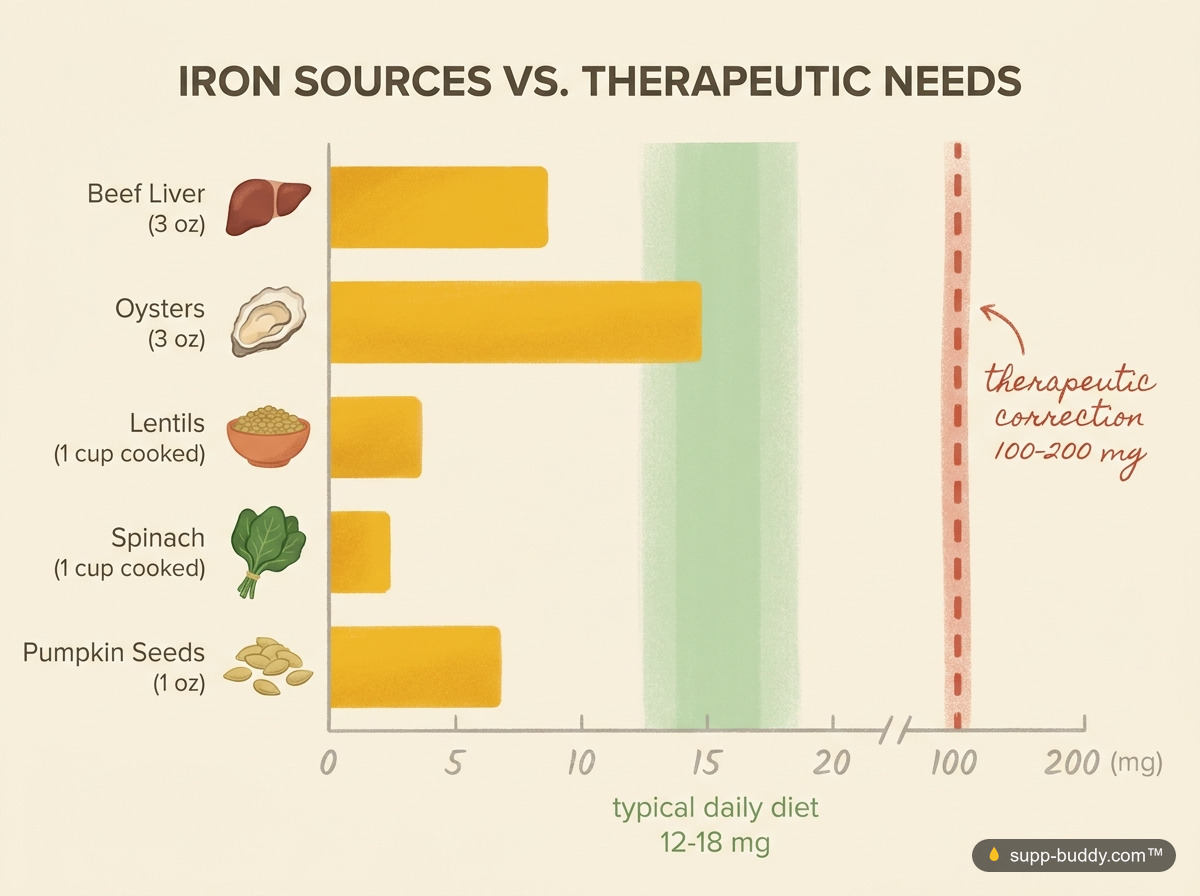
Iron is the clearest example. Beef liver gives about 6 mg per 3-ounce (85 g) serving, oysters around 8 mg, and cooked lentils about 3 mg per cup (198 g). A typical day's eating lands somewhere around 12 to 18 mg of iron. That's fine for staying topped up, but correcting a deficiency can take 100 mg or more a day, which no plate delivers. Spinach is the famous "iron food," yet the iron in it absorbs poorly, so it punches well below its label.
The same gap shows up across the board, just in different shapes. For vitamin B12, omnivores easily clear the daily target from meat, fish, and dairy, but vegans get almost none and have to supplement. For vitamin D, food barely moves the needle. A 3-ounce (85 g) salmon fillet gives about 570 IU, well short of the 1,000 to 4,000 IU a low person needs. A supplement, or regular sun exposure, is the only realistic route.
Magnesium sits in the middle. A typical diet runs short by 75 to 185 mg of magnesium a day. Pumpkin seeds, almonds, leafy greens, and beans can close that gap if you make a point of eating them. CoQ10 is the extreme case: food can't get you anywhere near a useful dose, so a capsule is the only way. And two on this list, ashwagandha and NR, aren't foods at all, so the supplement is the only route.
One more reason iron deserves its own caution: how much you need swings hard by life stage. Adult men and postmenopausal women need about 8 mg a day, premenopausal women about 18 mg, and pregnancy pushes it to 27 mg. That's why a dose that's right for one person is wrong, or even risky, for another.
Food nutrient data from USDA FoodData Central.
How to take them, and who should be careful
Here's the whole shortlist in one place: form, dose, timing, how strong the evidence is, and the safety catch for each.
| Supplement | Form | Dose | Timing | Evidence | Safety |
|---|---|---|---|---|---|
| Iron | Ferrous sulfate (elemental) | 18-45 mg/day to top up; 100-200 mg/day to correct, supervised | Every other day, with vitamin C | A | Test ferritin first; never take on a hunch |
| Vitamin B12 | Cyano- or methylcobalamin | 500-1,000 mcg/day | Morning, any time | B | Safe; vegans and metformin users should test |
| Vitamin D | D3 (cholecalciferol) | 1,000-4,000 IU/day | With a fatty meal; add K2 at higher doses | B | Check your vitamin D level before high doses |
| Magnesium | Glycinate or malate | 200-400 mg/day | Glycinate at night | B | Over 350 mg from pills can loosen stools; skip oxide |
| CoQ10 | Ubiquinone (ubiquinol if older) | 100-300 mg/day | With fatty food | B | Can blunt warfarin; monitor with your doctor |
| Ashwagandha | Standardised root extract (KSM-66) | 300-600 mg/day | With food; give it 8-12 weeks | B | Avoid in pregnancy; thyroid and liver cautions |
| Creatine | Monohydrate | 3-5 g/day | Any time, no loading | A | Long, clean safety record |
| NR | Nicotinamide riboside | 250-300 mg/day | Morning | B- | Safe; little payoff for healthy adults |
A few safety notes that matter more than the doses. Iron is the big one. Don't supplement it without a confirmed low ferritin, because excess iron builds up and damages tissue. It's especially dangerous for anyone with the iron-overload condition hemochromatosis. The NIH puts the no-supervision ceiling at 45 mg of elemental iron a day.
Magnesium above roughly 350 mg from supplements can loosen your stools. Anyone with kidney disease should clear it with a doctor first, since the body clears magnesium through the kidneys. CoQ10 can blunt the blood thinner warfarin, so don't add it without telling whoever manages your dosing. If you take metformin for blood sugar, it slowly drains B12, which is a good reason to test yours. Ashwagandha can nudge thyroid hormones, so be careful if you're on thyroid medication.
If you're pregnant or breastfeeding, the rules change. Iron needs rise, with the pregnancy target near 27 mg a day, but take only what your prenatal care team recommends. And skip ashwagandha entirely, since it isn't considered safe in pregnancy.
The bottom line
Our read on the evidence: energy isn't a shopping problem, it's a diagnosis problem. The reason the last supplement did nothing probably isn't the brand. It's that you were treating a gap you don't have, or missing one nobody tested for. Spend the $30 to $60 on the ferritin, vitamin D, and B12 tests first. If one comes back low, you've found the supplement that will work for you. If all three are fine, pick one gentle add-on, give it eight honest weeks, and judge it then. That order beats any list of nine equals, every time.
Common questions
What supplement gives you the most energy?
There's no universal winner, and that's the honest answer. If your stored iron is low, iron will do the most, by a wide margin. If your ferritin, vitamin D, and B12 are all normal, no supplement will boost you much. In that case the gentle add-ons (magnesium, CoQ10, creatine) are your best bet for a small lift. Test first, then you'll know which group you're in.
How long does it take for iron to help with fatigue?
Plan on weeks, not days. People often feel a shift in three to six weeks, but fully rebuilding depleted iron stores can take a few months. Take iron every other day with vitamin C to absorb it well and spare your stomach. If nothing changes after a couple of months, recheck your ferritin rather than just pushing the dose higher.
Should I take iron with vitamin C?
Yes. Vitamin C makes the iron in your gut easier to absorb. Even 25 to 100 mg alongside your iron can roughly double how much you take in. A glass of orange juice or a small vitamin C tablet does the job. Keep iron away from coffee, tea, and calcium, which all block it.
Can I take these supplements together?
Mostly yes, with a couple of spacing rules. Keep iron separate from magnesium, calcium, and your coffee by a couple of hours, since they compete for absorption. Take vitamin D and CoQ10 with a meal that has some fat. The bigger question isn't whether they're safe together, it's whether you need all of them, which is what the tests answer.
What supplements are good for energy and fatigue?
The short list is iron, vitamin B12, and vitamin D for deficiency-driven tiredness, plus magnesium, CoQ10, ashwagandha, and creatine as modest add-ons. The first three only help if you're low, so a blood test decides whether they're worth it. The add-ons are worth a patient eight-week trial when your levels are already normal.