
Alpha Lipoic Acid Benefits: What Holds Up, What Doesn't
You might have seen alpha lipoic acid pushed for almost everything. Or maybe you're looking at it for the first time. Blood sugar, nerve pain, glowing skin, sharper focus, slower aging. Maybe you're weighing your first bottle. Maybe one's already in your cabinet. Either way, the pitch sounds equally confident for every benefit. That's the problem. The evidence isn't spread evenly. Here's the honest split.
Which alpha lipoic acid benefits hold up
Strip away the marketing and the alpha lipoic acid benefits sort into two clear winners and four maybes. The winners are blood-sugar control and diabetic nerve-pain relief. Both have years of trials behind them. One has been a prescription treatment in Germany for 20 years.
The other four range from modest to mostly-hope. ALA lowers inflammation markers in your blood, but no one has shown that means fewer heart attacks. It trims a little fat in people with metabolic disease, and close to nothing in people without it. The skin and brain claims, the ones plastered across product pages, rest on the thinnest evidence of all. So if you're buying ALA for younger skin or a sharper memory, the honest answer is probably not. For blood sugar or burning feet, read on.
How alpha lipoic acid works in your body
Your body makes a little alpha lipoic acid on its own. It sits inside your mitochondria, your cells' tiny power plants. There it works as a cofactor (a helper molecule that lets cells turn food into energy). That's the day job. The supplement is a different story. A capsule delivers roughly a thousand times what your body makes or food provides. That pushes it from a nutrient toward something closer to a drug.
At those doses, two things matter. First, ALA is an unusual antioxidant. Most antioxidants work only in the watery parts of a cell, or only in the fatty parts. ALA works in both. It also recharges your spent vitamin C, vitamin E, and glutathione, the main antioxidant your body builds for itself. That recycling is why it gets called the antioxidant's antioxidant.
Second, it nudges your blood sugar. ALA switches on an energy sensor in your cells called AMPK, the same one that flips when you exercise or fast. With AMPK on, your muscles pull more sugar from the blood and your liver makes less of its own. It also crosses the blood-brain barrier, the filter that keeps most compounds out of your brain. And it grabs onto reactive metals like iron and copper, which chemists call chelation. Those last two traits are the theory behind every brain claim on most product pages.
Alpha lipoic acid benefits, graded one by one
Here's the whole picture at a glance, then the detail on each. These are our evidence grades. They weigh study quality, size, and how directly each trial measured the thing you care about.
| Benefit | Our evidence grade | What that means in plain terms |
|---|---|---|
| Blood sugar & metabolic | A− | Consistent, useful drops in blood sugar; strongest in type 2 diabetes, weak without it |
| Diabetic nerve pain | A− | Large, repeated relief of burning and tingling; reduces symptoms, does not regrow nerves |
| Antioxidant & inflammation | B+ | Reliably lowers inflammation markers in blood; no proof yet of fewer heart attacks |
| Weight & body composition | B | Small fat-mass drop in metabolic disease; nothing in overweight people without it |
| Skin & anti-aging | B− | Some support for topical creams; swallowed ALA for skin is barely studied |
| Brain & cognition | C | Good theory, animal results, no solid human trials yet |
Blood sugar and metabolic health
This is where ALA earns its reputation. Researchers pooled 63 trials in a 2026 review. People taking ALA saw their fasting blood sugar fall by about 5 mg/dL. Their HbA1c, a three-month average of blood sugar, dropped by roughly 0.4 of a percentage point.1 Those numbers are small. But they show up again and again, which is what matters.
One catch decides whether it works for you. The effect is strongest in people with type 2 diabetes or metabolic syndrome. A separate 2025 review looked only at overweight adults without diabetes. There, the metabolic benefits mostly disappeared.2 So ALA is a useful add-on if your blood sugar is already a problem. It does much less if you're overweight but don't yet have diabetes or metabolic problems. It does not replace metformin or any prescription. A 0.4-point HbA1c drop helps next to your medication, not instead of it.
Alpha lipoic acid produces consistent, clinically useful improvements in blood sugar and HbA1c, strongest in type 2 diabetes and metabolic syndrome
Alpha lipoic acid produces consistent, clinically useful improvements in blood sugar and HbA1c, strongest in type 2 diabetes and metabolic syndrome
Across 63 trials, ALA lowered fasting blood sugar and HbA1c by small but repeatable amounts.1 The clearest results were in people who already have type 2 diabetes or metabolic syndrome.
The honest limit: the drop is adjunct-sized, not treatment-sized. It also fades in people without metabolic disease.2 Treat it as a helper next to your medication, never a swap.
Diabetic nerve pain
This is the strongest case ALA has, and the longest-running. Germany has used it as a prescription treatment for diabetic nerve pain for over twenty years. A 2026 review of 15 studies found a large drop in the burning, tingling, and pins-and-needles feeling that diabetic nerve damage causes. Doctors call that paresthesia.3 The biggest effects came from IV treatment, with oral doses helping less. Even so, the oral pill still eases symptoms in those trials.3 Other trials and reviews of diabetic nerve complications point the same way.56
Community claim: "Alpha lipoic acid cured my neuropathy. It fixed the nerves."
What the evidence says: ALA reliably calms the symptoms of diabetic nerve pain, the burning and tingling. It does not regrow nerves or restore lost feeling. Symptom relief is the realistic win, and a worthwhile one. Expecting a cure sets you up to quit before the relief arrives.
One more honest caveat. Every one of those trials ran in people whose nerve damage came from diabetes. Say your nerve pain comes from multiple sclerosis, chemotherapy, or an unknown cause. The diabetic evidence doesn't automatically carry over. The studies didn't test those situations, so we can't promise it works for them.
Alpha lipoic acid reliably reduces diabetic nerve-pain symptoms such as burning, tingling, and paresthesia; it reduces symptoms and does not reverse nerve damage
Alpha lipoic acid reliably reduces diabetic nerve-pain symptoms such as burning, tingling, and paresthesia; it reduces symptoms and does not reverse nerve damage
Across 15 studies, ALA produced a large drop in diabetic nerve-pain symptoms.3 The biggest effects came from IV treatment, with oral doses helping less.
The honest limit: it eases symptoms, it does not repair the underlying nerve damage. And the proof is in diabetic patients only.14
Antioxidant and inflammation
ALA does lower inflammation in your blood, and the evidence here is solid. A 2023 review pooled 20 trials with nearly a thousand people. It found ALA reduced two standard markers of inflammation.4 One is CRP, a blood marker that rises when your body is inflamed. The other is IL-6, a signalling molecule that drives it. A separate review in people with heart disease found the same direction.7
The honest ceiling: these are markers in a blood test, not outcomes you can feel. Lower CRP looks good on paper. No one has yet shown it means fewer heart attacks, less cancer, or a longer life. So if you take ALA as a general antioxidant, you're betting on a mechanism that makes sense, not a proven drop in heart attacks or disease.
Weight and body composition
ALA is not a weight-loss supplement, whatever the ads imply. In that big 63-trial pool, it shaved off roughly half a kilo of body weight and about 1.4 kg of fat mass on average.1 Modest at best. And in the review of overweight people without diabetes, even that small effect vanished.2 The pattern matches blood sugar. The small fat-loss signal shows up in the broad trials, then fades once you look only at overweight people without diabetes. If weight loss is your goal, spend your money elsewhere.
Skin and anti-aging
Here the story splits in two. Creams you rub on, topical ALA at around 5%, have some small-trial support for smoothing fine lines and sun-aged skin. That's plausible. Sunlight creates damaging molecules in skin, and ALA mops them up. But there's a footnote. A 2026 review flagged ALA as an emerging skin allergen, so a patch test is wise first.11
The capsule is a different question. Swallowed ALA for skin is barely studied in people. The closest evidence is an animal study where ALA helped wounds heal. But faster wound healing in a rat can't tell you whether a daily pill smooths human wrinkles.12 So the short version: a topical product might help a little, an oral one almost certainly won't for everyday anti-aging. Skin is not a strong reason to buy ALA.
Brain and cognition
This is the gap between a good story and good proof. On paper ALA looks made for the brain. It crosses into brain tissue, calms oxidative stress, and grabs the reactive metals tied to nerve aging.910 Animal studies back the theory, including work in rodents.8
What's missing is the part that counts. There are almost no properly sized human trials measuring memory, focus, or dementia risk. So cognition sits in emerging territory, where the mechanism runs well ahead of the evidence. If brain fog or focus is your goal, supplements with stronger human data exist. Our guide to supplements for brain fog and focus covers what the trials support.
R-ALA, racemic, or Na-RALA: which form should you take?
This is where the technically-minded crowd spends its time, and for once the obsession is earned. Most bottles labelled "alpha lipoic acid" contain a racemic mixture. That's a 50/50 blend of two mirror-image versions, R and S. The R form is the one your body makes and uses. The S form is its mirror twin, less useful. At high doses S may even crowd out R, competing for the same path into your gut. R-ALA on its own, and a stabilised salt called sodium R-lipoate (Na-RALA), are absorbed better per milligram (per Examine.com).
So is the pricier R form worth it? Here's the measured answer. ALA is short-lived in the body and not absorbed well by mouth, so quality and form do matter. But the big neuropathy trials that built ALA's reputation used plain racemic. So racemic has the most evidence behind it. Our take: if cost matters, racemic at the studied dose is a fine default. If you want more per milligram, or higher racemic doses upset your stomach, R-ALA or Na-RALA is the upgrade worth paying for. The same molecule-matters logic shows up with omega-3, where the form changes the result. Our EPA vs DHA comparison walks through that one.

Got a bottle of ALA but not sure it's the right form, the right dose, or safe alongside your metformin? Tell Your Supp' Buddy what you take and which diabetes or thyroid meds you're on. It'll flag a form or dose mismatch, sort the empty-stomach timing, space it from your thyroid pill, and remind you to watch your blood sugar.
Getting alpha lipoic acid from food
Short version: you can't eat your way to a useful dose. Your body makes a trickle of ALA on its own. A few foods carry trace amounts. But the gap between your plate and the studied dose is enormous.
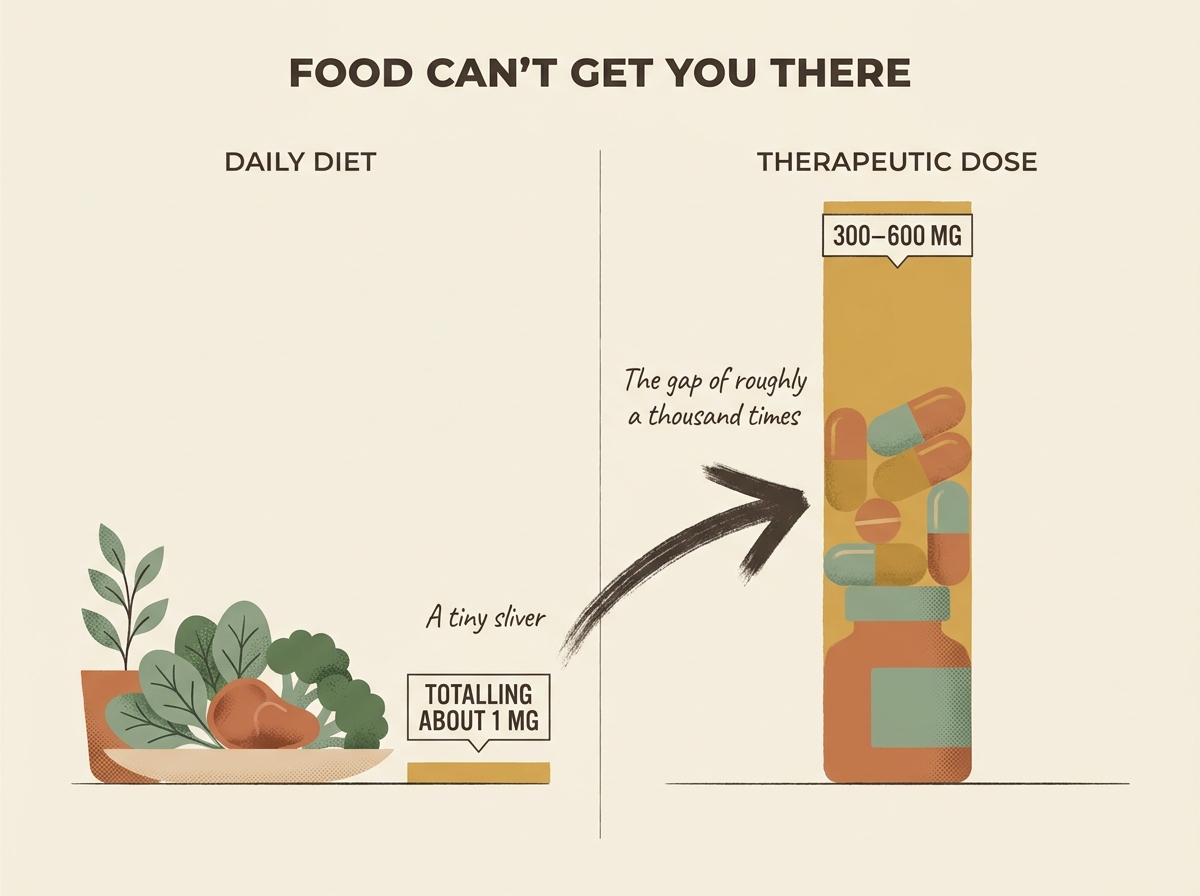
A typical day's diet gives you about 1 mg of alpha lipoic acid. The doses used in trials run from 300 to 600 mg. That's a gap of roughly a thousand times. No realistic amount of food closes it. The richest sources are organ meats and a few vegetables. Even the best of them is measured in fractions of a milligram per serving.
| Food | Serving | Alpha lipoic acid |
|---|---|---|
| Beef liver | 3.5 oz / 100 g | about 0.72 mg |
| Spinach | 3.5 oz / 100 g | about 0.20 mg |
| Broccoli | 3.5 oz / 100 g | about 0.13 mg |
| Red meat (beef) | 3.5 oz / 100 g | about 0.10 mg |
| Brussels sprouts | 3.5 oz / 100 g | about 0.08 mg |
How much, how often: to reach even 50 mg from spinach, you'd need to eat around 25 kg of it in one day. The math never works. Eat these foods because they're good for you, not to dose ALA.
This is one of the rare supplements where food cannot stand in for the capsule. Your diet covers your body's everyday needs. The supplement fills the gap to reach the amounts the trials studied. It doesn't replace good food. It does something food can't.
Food values are estimates from the Linus Pauling Institute.
How much to take, and when
For general use and blood sugar, most trials use 300 to 600 mg of racemic ALA daily. For diabetic nerve pain, the higher end of that range is standard. Take it on an empty stomach, about 30 to 60 minutes before food. This matters more than people expect. Food, especially carbohydrate, blunts how much ALA you absorb. Taking it with breakfast quietly wastes part of your dose. If your stomach rebels, splitting the dose across the day helps.
| Form | Daily dose | Timing | Notes |
|---|---|---|---|
| Racemic ALA (50% R + 50% S) | 300–600 mg | Empty stomach, 30–60 min before food | Most-studied form; the standard nerve-pain dose sits at the top of this range |
| R-ALA (natural form) | 100–300 mg | Empty stomach | More absorbed per mg; less long-term trial data |
| Sodium R-lipoate (Na-RALA) | 100–200 mg | Empty stomach | Stabilised salt; best-absorbed of the R forms |
| IV ALA (clinic only) | By drip | In-clinic infusion | Beats oral for nerve pain; not sold over the counter |
One practical add-on worth knowing. At higher doses, ALA competes with biotin (vitamin B7) for the same doorway into your gut. So long-term high-dose users can run their biotin low over time. That's awkward, because low biotin can itself cause nerve problems. Some clinical protocols add 1 to 5 mg of biotin alongside ALA to cover the gap.
Is alpha lipoic acid safe? Side effects and interactions
For most healthy adults, ALA in the usual range is well tolerated. The most common complaints are mild stomach issues: nausea, an upset stomach, or loose stools. They tend to track with the dose. Above roughly 1,200 mg a day side effects climb. Very large single doses, in the 4.5 to 6 gram range, have caused acute poisoning. There's no reason to chase mega-doses. One side effect is rarely on labels. At higher doses ALA can give your sweat and urine a faint sulfur smell, a quirk of its sulfur chemistry. It's harmless, but it surprises people enough to make them quit. Worth knowing up front.
Who needs to take more care depends on what else you take.
| If you... | What to do |
|---|---|
| Take insulin, metformin, or other diabetes medication | ALA lowers blood sugar too, so the effects add up. Monitor your glucose, especially in the first few weeks, and start at a lower dose. |
| Take levothyroxine for your thyroid | ALA can cut how much thyroid hormone you absorb. Separate the two by at least 4 hours. |
| Take high-dose ALA long term | It competes with biotin for absorption; some protocols add 1–5 mg biotin. It binds iron in the lab, but a systematic review found no meaningful effect on iron status.15 |
| Are pregnant or breastfeeding | Controlled safety data are missing, so the cautious call is to avoid ALA unless your doctor specifically clears it. |
| Are rarely, genetically susceptible | ALA has been linked to a rare condition called insulin autoimmune syndrome, which can cause sudden low blood sugar.13 Uncommon, but documented. |
None of this makes ALA a dangerous supplement. The adverse-event reports filed with the FDA are mostly the same mild stomach complaints, and they're low against how many people take it. The point is simpler. If you're on diabetes or thyroid medication, loop in the person who prescribed it before you start.
The bottom line
Our read on the evidence: alpha lipoic acid is two good supplements wearing one label. For blood sugar in type 2 diabetes, and for the burning and tingling of diabetic nerve pain, it does something measurable and worth the money. For skin, weight, energy, and brain, it mostly rides the reputation it built doing those first two jobs. The trick is matching your reason for buying it to the column where the evidence lives.
Want to test it? Take it once a day, on an empty stomach, 30 to 60 minutes before breakfast, and give it a couple of months. Start at the lower end if you're on diabetes meds, clear it with your prescriber, and watch your blood sugar. Judge it on what you feel, not on what the bottle promises.
Common questions
Can I take alpha lipoic acid with metformin?
Generally yes. ALA and metformin work through different routes and often pair well. The thing to watch is that both lower blood sugar, so the effects can add up and tip you toward a low. Monitor your glucose, especially early on. Many people take the two at different times of day.
Should I take R-lipoic acid or regular alpha lipoic acid?
R-lipoic acid is more bioavailable per milligram, but regular racemic ALA has the deeper trial record, including the big neuropathy studies. If cost is your priority, racemic at the studied dose is the evidence-backed pick; if you want more per milligram, R-ALA or Na-RALA is the upgrade worth paying for. The full comparison is in the form section above.
How long does it take to work for nerve pain?
Many people notice the burning and tingling ease within the first few weeks, and more improvement usually builds over the following weeks. The trials themselves typically run from about a month to several months. If nothing has shifted after a few months, it probably isn't your answer.
Is alpha lipoic acid safe for long-term use?
It has a good long-term safety record across the trials that have studied it. The most common side effects are mild stomach issues, which often settle if you split the dose. If you use a high dose long term, cover your biotin and keep an eye on iron.
Can alpha lipoic acid cause low blood sugar?
On its own it rarely causes a true low. But it can amplify diabetes medications that do. If you're on insulin or a glucose-lowering drug, start at a lower dose and check your blood sugar closely for the first few weeks. Talk to your prescriber before adding it.
Can I take it with other antioxidants?
Yes, and they tend to get along. ALA helps regenerate vitamins C and E, so pairing it with them, or with selenium or NAC, is generally fine. It may even stack the antioxidant support. There's no need to space it apart from other antioxidants.