

Why Your Magnesium for Sleep Isn't Working Yet
You bought glycinate because everyone said it was the good form. You take it before bed. And you're still lying awake at 2 a.m., wondering if you wasted $35. Magnesium glycinate for sleep does work for a lot of people. Whether it works for you comes down to two things most people get wrong: form confusion and impatience. Here's the protocol that fixes both.
Start with the one magnesium move that fixes most sleep stacks
Glycinate is the practical starting point for most people. It isn't the most heavily studied form for sleep specifically. It's the most consistently well-tolerated one, which matters more than you'd think.5 Sleep quality changes slowly. Trials show improvements appearing between weeks two and eight, and the common failure is quitting before week four because nothing dramatic happened.5
Baseline: 200 mg of elemental magnesium from glycinate, 30 to 60 minutes before bed. Build from there only if you tolerate it well and your sleep log isn't moving after two weeks.
Want a dose that fits you, not a textbook? Tell Your Supp' Buddy what you're taking and what you're after. You'll see where magnesium belongs in your routine, or whether it's worth the shelf space.
Start here tonight
- Pick magnesium glycinate, not oxide, not a "proprietary blend" that hides the form.
- Find the elemental magnesium amount on the label. That's your real dose. The serving size number is usually larger and doesn't mean much on its own.
- Start at 200 mg, 30 to 60 minutes before bed, same time every night.
- Give it at least two weeks before making any judgment.
- Track three things each morning: time to fall asleep, number of wake-ups, rested rating 1–10.
Decode what people are saying about magnesium glycinate for sleep
The community protocol that keeps surfacing (200 to 400 mg elemental, 30 to 60 minutes before bed, sometimes with glycine or L-theanine) lands close to what the research actually shows. Where it goes wrong is the promise. The dramatic "I sleep solid now, alarm wakes me" posts usually come from people who corrected a real dietary magnesium deficit. If your baseline is already adequate, you'll notice something. It just won't feel like a switch flipped.5
What people say online: "Magnesium glycinate gave me the best sleep of my life. Deeper, longer. Wake up to the alarm instead of 3 a.m."
What the evidence says: Most people do experience improvement in how they rate their own sleep, but it's typically modest and builds gradually. The biggest responders are people with lower magnesium intake from food, or those over 50.51
Drowning in conflicting magnesium advice? Ask Your Supp' Buddy to cut through it. Pick one thing that matters most to you and get the evidence turned into a plan you can actually follow.
Use the evidence grades to set realistic sleep expectations
The overall verdict is B minus. That's not a bad grade. It means the evidence is real, the direction is positive, and a meaningful subset of people do benefit, but the effect is modest for most and uneven across the population. When researchers pool sleep trials, magnesium consistently improves how people feel about their sleep (falling asleep faster, fewer nighttime wake-ups) more than the objective metrics a tracker picks up.5 The proposed mechanism is GABA support. Magnesium appears to modulate the same receptors many sleep and anxiety medications target, which is why people describe it as "racing thoughts eased off," not "I blacked out for eight hours."5
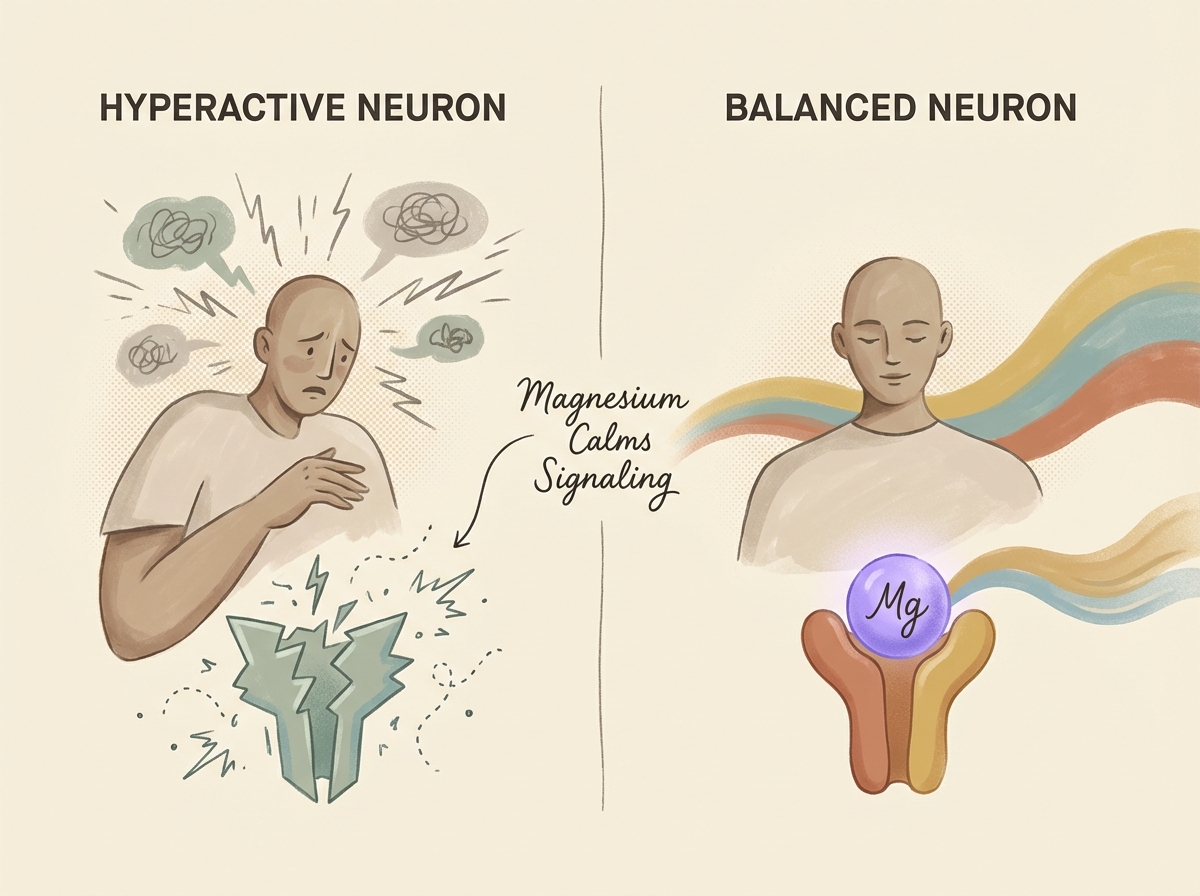
Two groups consistently see bigger gains. First, older adults, because magnesium intake and absorption both decline with age. Second, anyone whose diet is light on magnesium-rich foods like leafy greens, nuts, and legumes.56 Cross-sectional data in healthy adults also links higher dietary magnesium intake to better sleep quality scores, which lines up with the "correcting a deficit" framing.23
Grade: B- | Moderate confidence
Multiple systematic reviews show consistent but modest improvements in how people rate their own sleep. Most trials used mixed magnesium forms rather than glycinate specifically. The glycinate inference rests on tolerability and bioavailability, not direct head-to-head sleep trials.
Grade: B (subgroup) | Moderate-strong confidence for older adults and those with low dietary magnesium
Small trials in older adults and people with below-average dietary magnesium show consistent sleep improvements. Trials are small and often use combined supplements, but the direction is consistent and the mechanism is well supported.5
Build your magnesium glycinate sleep protocol in 3 steps
Trials show sleep improvements between weeks two and eight because tissue magnesium levels take time to rise.5 You're correcting a deficit that built slowly, so the correction runs slowly too. The usual failures: changing too many things at once, or quitting at day ten because nothing dramatic happened. Both leave you with no way to tell whether magnesium is helping.
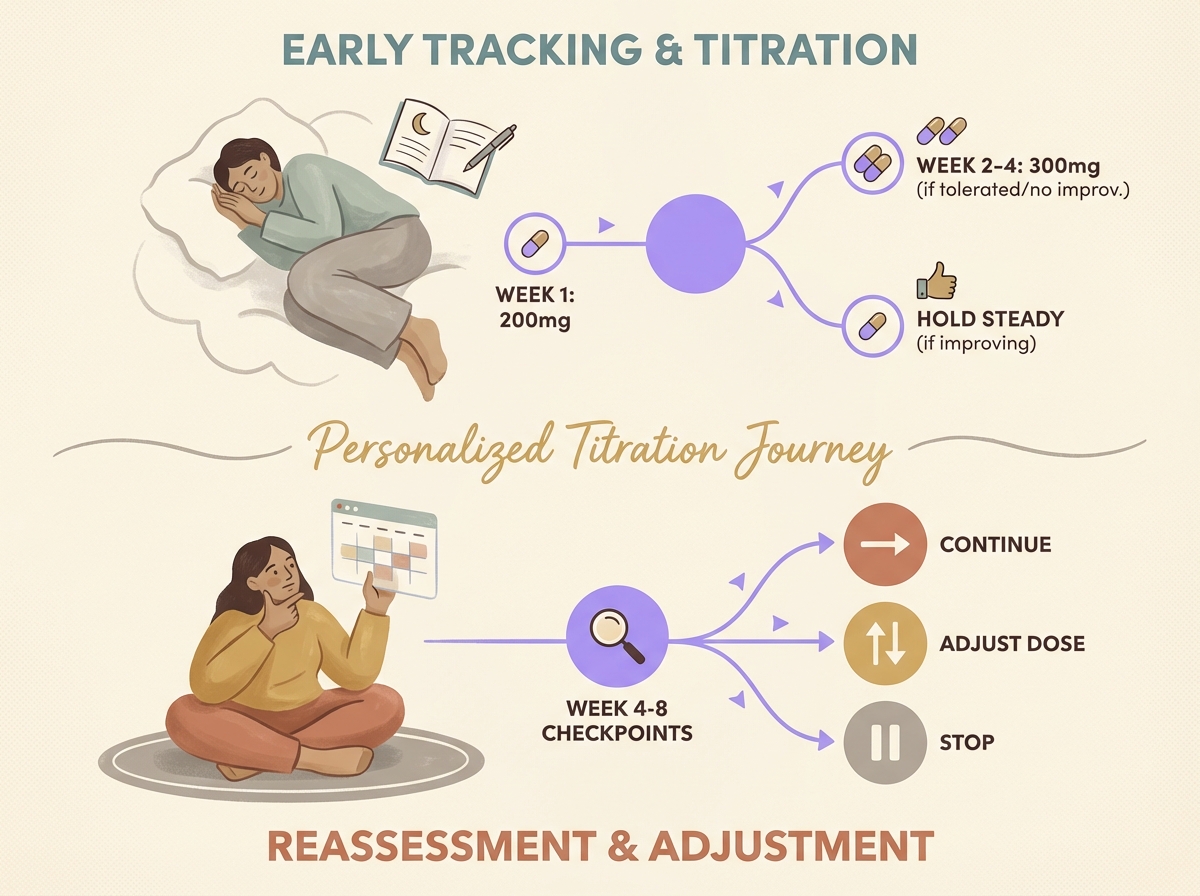
Step 1: Establish your baseline (week 1)
Take 200 mg elemental magnesium from a glycinate supplement, 30 to 60 minutes before bed. Keep everything else the same: caffeine timing, screen habits, sleep schedule. You're isolating the variable.
Each morning, note three things in your phone: how long it took to fall asleep, how many times you woke up, and a 1–10 rating for how rested you feel. That's your week one baseline. No tracking app needed.
Step 2: Titrate if needed (weeks 2–4)
If 200 mg is sitting well (no GI discomfort) and your sleep log shows no change after two weeks, step up to 300 mg. Give that another two weeks.
One rule: don't change two things at once. If you raise the dose, don't also add glycine or L-theanine that same week. You want to know what's moving the needle.
Two weeks in and don't know what "working" should feel like? Give Your Supp' Buddy your dose and where your sleep started. You'll get a clear read on what to watch for, and when to call it.
Step 3: Reassess at week 4, then week 8
At week four, compare your notes from week one to now. Any improvement counts. If you see one, hold the protocol steady and check again at week eight.
No change at week eight on a stable dose is also a real result. The most likely explanation is that your dietary magnesium was already adequate. Sleep is shaped by plenty of other things too (stress, sleep hygiene, caffeine timing), and those are the next places to look. Either way, you now have four weeks of tracked data, which is more than most people start with.
Choose your magnesium dose, form, and timing window
The practical default for most people: glycinate, 200 mg elemental to start, 30 to 60 minutes before bed. Titrate to 400 mg only if you tolerate it and still see no change after two weeks.
One dosing trap people hit repeatedly: a capsule labeled "400 mg magnesium glycinate" contains nowhere near 400 mg of actual magnesium. The glycinate is the carrier molecule and makes up most of the weight. Always look for elemental magnesium on the Supplement Facts panel. If the label doesn't list it separately, the brand isn't being straight with you.
| Form | Dose (elemental Mg) | Timing | Duration to assess | Evidence | Notes |
|---|---|---|---|---|---|
| Magnesium glycinate (chelated, capsule or tablet) | 200–400 mg | 30–60 min before bed | 4–8 weeks | B- 516 | Best starting choice. Gentler on the gut than oxide. Start low and titrate. |
| Magnesium citrate (alternative) | 200–350 mg | Evening, 30–60 min before bed | 2–4 weeks if comparing forms | C 5 | More likely to cause loose stools, especially above 300 mg. Same drug-spacing rules apply. |
| Magnesium + melatonin combo | Mg 200–500 mg + melatonin 2–5 mg | 30–60 min before bed | 8–12 weeks | C+ 64 | Some evidence in older adults. Melatonin dose is often too high. Try 0.5–2 mg first. Grogginess risk. |
Timing is secondary to consistency. A 200 mg dose at 9:30 p.m. every night will get you further than a 400 mg dose that lands anywhere from 8 p.m. to midnight. If you feel groggy the next morning (uncommon but possible), try moving it earlier: 60 to 90 minutes before bed instead of 30.
Community claim: "Citrate works just as well as glycinate for sleep. Form doesn't matter."
What the evidence says: No trial has directly compared the two forms on sleep outcomes. Form choice matters mainly for GI tolerance and adherence. Glycinate is gentler on the gut, which helps you actually stay on the protocol. If you can't tolerate citrate and quit at day ten, it wasn't equally effective for you regardless of what the pooled literature says about magnesium in general.5
Worried about interactions with the rest of your stack? Walk Your Supp' Buddy through what you take once. It'll flag the conflicts, sort the timing, and tell you if magnesium is even worth adding.
Prevent interaction mistakes before your first bedtime dose
The main risk for healthy adults isn't toxicity. It's timing conflicts with medications you may already take. Magnesium binds to certain drugs in the gut and reduces how much of the drug gets absorbed. The common culprits are tetracycline and fluoroquinolone antibiotics (like ciprofloxacin) and bisphosphonates for bone health (like alendronate). If you're on any of these, separate your magnesium dose by at least two hours, ideally four.
Before your first dose: check these
- On tetracyclines, fluoroquinolones, or bisphosphonates? Take your medication and magnesium at least 2–4 hours apart.
- Long-term PPIs (omeprazole, pantoprazole)? Mention your magnesium to your prescriber at your next review.
- On SSRIs, SNRIs, or other antidepressants? Flag it to your prescriber so they have your full list.
- Kidney disease at any stage? Get medical input before supplementing.
- High-dose calcium? Separate from magnesium by at least 2 hours.
Personalize and simplify your full sleep stack
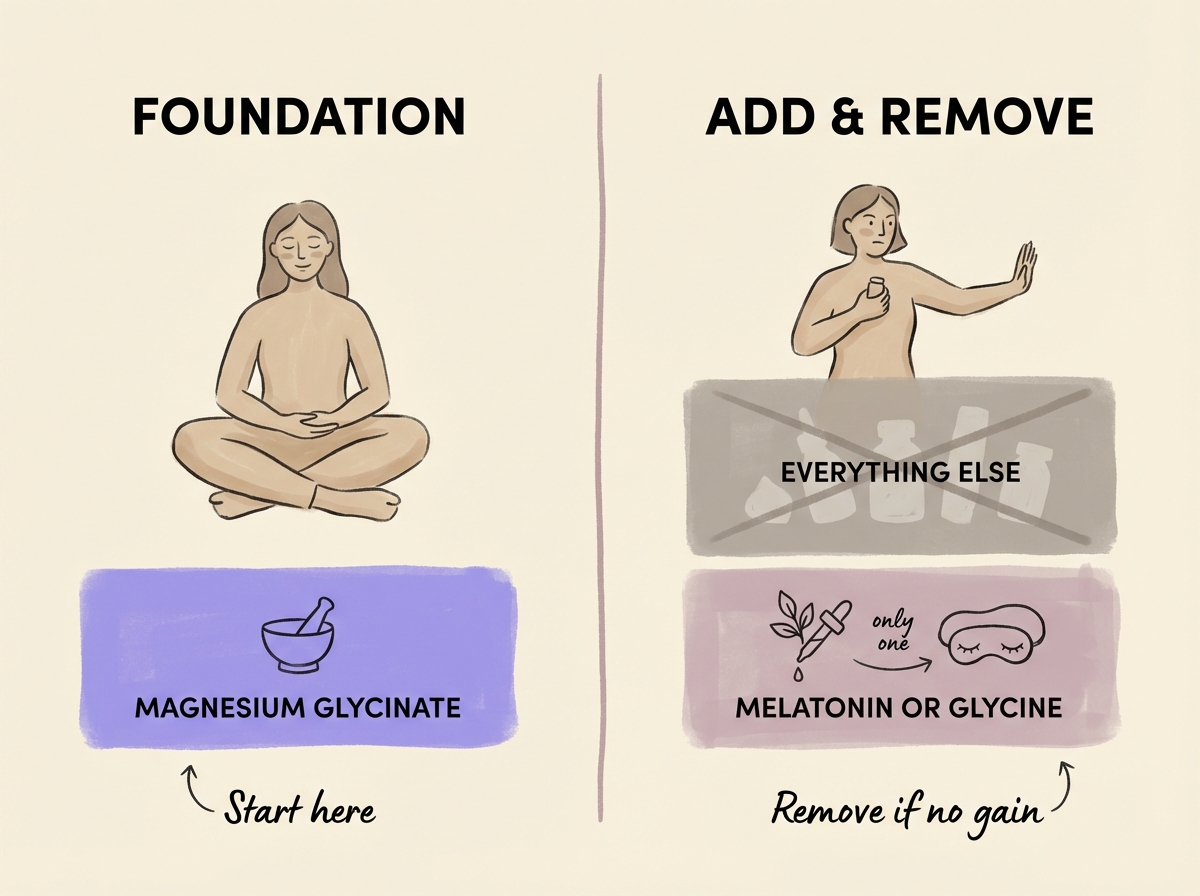
If you're already taking a sleep stack (melatonin, glycine, L-theanine, magnesium, or whatever else), the first question before adding anything is: what can you remove? Eight weeks of a combination you never tracked isn't a protocol. It's hoping.
Start clean. Magnesium glycinate alone for the first four weeks, no other sleep supplements. Your sleep log from that window becomes the real baseline. If you see improvement and want to push further, the two add-ons with some supporting evidence are low-dose melatonin (0.5 to 2 mg; most people start way too high) and glycine (3 g).64 Both sit alongside magnesium without interaction concerns.
Stop rule: if a supplement hasn't moved any of your tracked metrics after eight weeks on a stable protocol, it isn't earning its place. Remove it, wait two weeks, and check your log. Same or better? It was doing nothing. Worse? It was contributing. Either way, you have an answer.
Four weeks in and still don't know if it's actually helping? Share what you've been noticing with Your Supp' Buddy. Get a read on your own data, honestly.
Questions people ask before committing to the protocol
Still on the fence about timing, form, or whether this is even worth trying? Run one controlled 4-to-8-week trial at 200 mg elemental before bed, track your sleep, and let your own data answer. That beats reading indefinitely.
What's the best time to take magnesium glycinate for sleep?
30 to 60 minutes before bed, same time every night. Consistency beats exact timing: a steady 9:30 p.m. dose will get you further than a variable dose landing anywhere from 8 p.m. to midnight.5
Does glycinate work better than citrate for sleep?
No trial has directly compared the two on sleep outcomes. Glycinate is gentler on the gut, which matters because it's the form you're more likely to stay on. If tolerability isn't an issue, the pooled evidence doesn't give a clear winner.5
How long until I notice anything?
Most responders notice something between weeks two and four. Some take up to eight. No change at week eight on a stable dose usually means your dietary magnesium is already adequate, though stress, sleep hygiene, and light exposure shape sleep too, so those are the next places to look.5
Can I take it with my antidepressant?
Mention it to your prescriber. They're the right person to confirm for your specific regimen, especially if your dose has changed recently.
Thinking about thinning out your sleep stack? Run your whole list by Your Supp' Buddy and see which bottles are earning their spot, and which you can quietly drop.
Key takeaways
- Magnesium glycinate for sleep is worth trying as a first step (low risk, real evidence), but expect modest and gradual improvement, not an overnight fix.
- Start at 200 mg elemental magnesium, 30–60 minutes before bed. Only titrate to 400 mg after a consistent two-week trial at the starting dose.
- Glycinate vs citrate: the advantage is tolerability, not proven sleep superiority. Stick with the form you can take consistently.
- Most failures come from quitting before week four or changing too many variables at once. Pick one thing and hold it steady.
- Check drug interactions before your first dose, especially if you take antibiotics, bisphosphonates, or have kidney disease.